
AEO customs status: Requirements and application for companies
The AEO (Authorized Economic Operator) customs status is an EU-wide recognized seal of approval that grants eligible companies simplified customs procedures and priority treatment during inspections. Those seeking this status should start immediately with two concrete steps: completing the Self-Assessment Questionnaire (SAQ) and contacting the responsible main customs office at the location of their main accounting department.
The immediately noticeable benefits after issuance:
- Fewer physical checks at the border
- Priority in customs inspections and faster processing
- Easier access to simplified customs procedures under the Union Customs Code (UCC)
- Recognition in all EU member states without a new application
- For AEOS holders: Facilitations under mutual recognition agreements (MRAs) with third countries
Key insights
The AEO customs status brings EU-wide recognized customs simplifications, but requires structured preparation, auditable documentation and ongoing compliance obligations.
| Theme | Details |
|---|---|
| Immediate first step | Download SAQ, appoint a responsible person and contact the relevant main customs office. |
| Choose type of approval | AEOC for customs simplifications, AEOS for security and MRA benefits, AEOF for both. |
| Keep the timeline realistic | From SAQ to decision, it typically takes 6–12 months. |
| IT logs and documentation | Set up and secure auditable system exports from ERP and WMS early on. |
| Don't underestimate ongoing obligations. | Changes must be reported, annual self-assessment recommended, documents should be kept for ten years. |
Table of Contents
- What is AEO customs status, and what types of authorization are there?
- What specific advantages does AEO status bring under the UCC?
- What does the main customs office check during the AEO application process?
- What is the step-by-step process for AEO application in Germany?
- What applies after issuance: obligations, monitoring and revocation
- What do mutual recognition agreements (MRAs) mean for trade?
- How do companies systematically prepare evidence?
- Sources
What is AEO customs status, and what types of authorization are there?
The term "Authorized Economic Operator" is in Article 38 of the Union Customs Code (UCC) This is enshrined in law. Companies that meet the criteria receive authorization from the relevant national customs authority. This authorization is then valid throughout the EU.
There are three variants:
| Type of permit | Focus | Typical use cases | Typical benefits |
|---|---|---|---|
| AEOC (Customs Simplifications) | Customs procedures and compliance | Importers, exporters, customs agents | Access to simplified procedures, fewer document checks |
| AEOS (Security and Hazard Prevention) | Supply chain security | Freight forwarders, warehouse operators, carriers | Fewer security checks, MRA facilitation with third countries |
| AEOF (Combined Authorisation) | Both | Companies with broad customs and security needs | All benefits from AEOC and AEOS |
A company can hold both individual authorizations simultaneously or apply directly for the combined AEOF authorization. Administratively, the combined authorization is treated as a single authorization, but requires fulfillment of all criteria for both types.
Important: AEOS is relevant for security-related facilitations and MRA agreements with third countries.While AEOC primarily regulates customs simplifications and does not automatically include MRA consideration, companies that mainly export to third countries should therefore consider AEOS or AEOF.
What specific advantages does AEO status bring under the UCC?
The The EU Commission describes the benefits. Clearly, AEO holders receive fewer physical checks, preferential treatment during audits, and easier access to simplified customs procedures. In practice, this means shorter waiting times at borders, better supply chain planning, and reduced security requirements for certain procedures.
Specific benefits at a glance:
- Fewer physical and document-related checks compared to non-certified companies
- Priority treatment in selected checks, which reduces delays
- Advance notification during inspections, so that companies can prepare
- Easier access simplified registration procedures and other customs facilitations
- Lower security deposits in customs procedures with deferred payment (AEOC)
- MRA facilitations for exports to countries with mutual recognition agreements (AEOS/AEOF)
The European Court of Auditors stated in its report Special Report 13/2023 firmly: The AEO program generally facilitates trade, but the practical application of the benefits varies across member states. Monitoring and performance measurement mechanisms are lacking in several countries. Companies should therefore have realistic expectations and anticipate discrepancies between legal entitlements and actual practice.
There is another aspect that is often overlooked: AEO status applies exclusively to the authorized economic operator itself. Business partners do not automatically benefit from it. Therefore, anyone expecting suppliers or service providers to also benefit from their own authorization is mistaken.
What does the main customs office check during the AEO application process?
The accreditation criteria are set out in Article 39 of the Union Customs Code (UCC) and detailed in the EU AEO Guidelines. There are five core areas:
The AEO audit requires an auditable system of business records and supply chain control. Companies must provide technical evidence, such as WMS logs and shipping lists, not just descriptions of processes.
1. Compliance with customs and tax regulations
No serious or repeated violations in the last three years. Evidence: tax assessments, customs assessments, audit reports without significant objections.
2. Auditable accounting and logistics systems
The ERP or inventory management system must allow customs authorities a complete audit trail. Evidence required: system documentation, access rights concept, export lists from the WMS or ERP.

3. Solvency
No insolvency, no pending insolvency proceedings, stable financial situation. Evidence: Annual financial statements for the last three years, credit reports, bank confirmations.
4. Professional competence (AEOC only)
Proven customs expertise within the company, either through qualified personnel or external customs consultants. Evidence: certificates, training records, Chamber of Industry and Commerce (IHK) certificates.
5. Security standards (AEOS/AEOF only)
Physical security of the premises, personnel reliability, IT security. Evidence: security concept, access control lists, background checks for key personnel.
Common reasons for rejection include incomplete documentation of accounting systems, lack of proof of solvency, and inadequate security concepts. Conducting a gap analysis early on saves time during the audit.
Pro tip: Regional Chambers of Industry and Commerce (IHK) offer preparatory advice for the AEO application. Preliminary consultation with the IHK can help identify weaknesses before the main customs office conducts its review.
What is the step-by-step process for AEO application in Germany?
In Germany, applications are submitted to the responsible main customs office at the company's main accounting office. Access to the application and the SAQ (Standard Account Qualification) is available via the customs portal (zoll.de), or you can also request a straightforward Long-distance move from Mannheim — Munich, Frankfurt, Stuttgart Rely on reliable relocation logistics.
- Internal preparation: Designate responsible parties, download SAQ, conduct a gap analysis, and compile relevant documents.
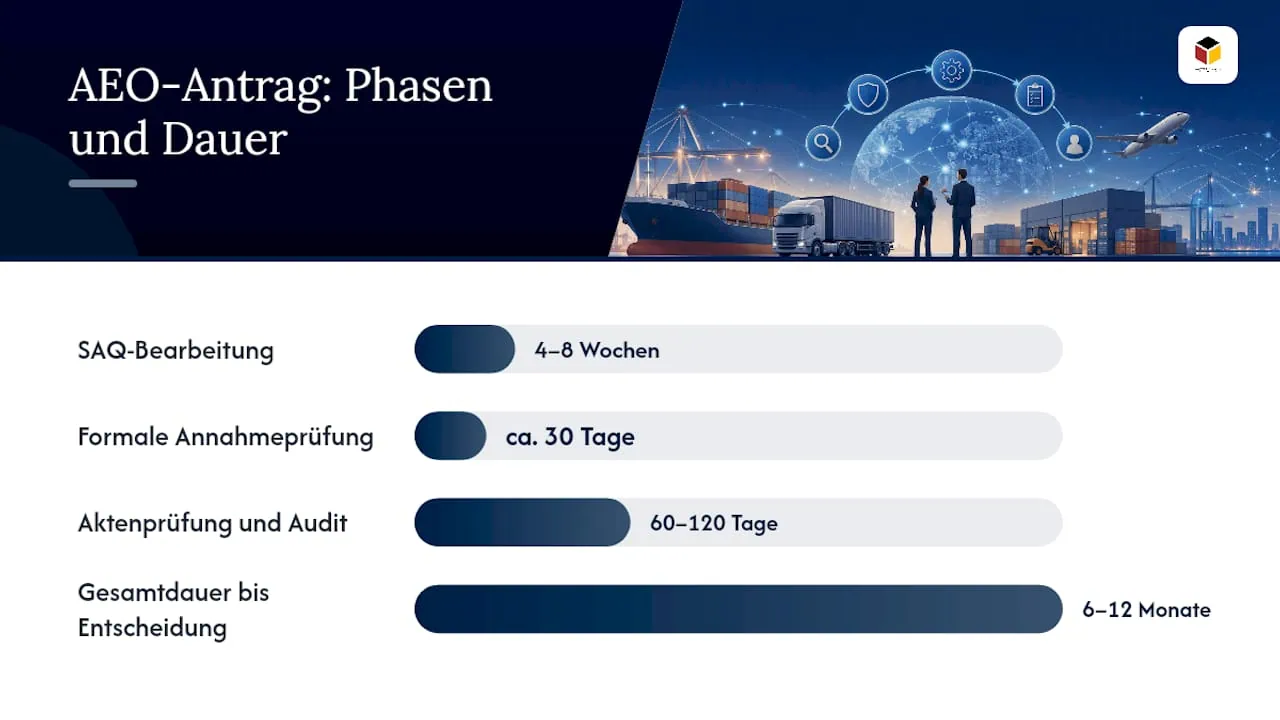
- Complete the SAQ: The self-assessment questionnaire covers all five assessment areas. Typical completion time is 4–8 weeks.
- Submit application: Electronic submission via the IAEA procedure (AEO internet application) on zoll.de, together with the completed SAQ and the accompanying documents.
- Formal acceptance testing: The main customs office checks for completeness and jurisdiction. This takes approximately 30 days.
- File review: The submitted documents are reviewed for plausibility and completeness. Inquiries and requests for additional information are common at this stage.
- On-site audit: Inspectors from the main customs office visit the company premises. Duration: 60–120 days. Typical document requests include: ERP exports, security logs, and personnel records.
- Decision: Approval or rejection with reasons given. In case of rejection, there is the possibility of appeal.
Questions during the audit should be answered in writing and completely. Incomplete answers will significantly prolong the process.
| Phase | Typical duration |
|---|---|
| SAQ processing | 4-8 weeks |
| Formal acceptance testing | about 30 days |
| File review and audit | 60-120 days |
| Total time until decision | 6-12 months |
What applies after issuance: obligations, monitoring and revocation
The authorization is valid indefinitely, but not unconditionally. AEO status is recognized by all EU member states without the need for a new application. However, benefits can only be claimed by the holder themselves, not by business partners.
Ongoing obligations after issuance:
- Reporting obligation: Changes that affect the licensing requirements (e.g., insolvency proceedings, serious violations, changes in company structure) must be reported to the main customs office without delay.
- Document storage: Customs-related documents must generally be kept for at least ten years.
- Regular monitoring: The main customs office conducts ad hoc and periodic audits.
Typical reasons for reassessment, suspension, or revocation include criminal convictions of key personnel, insolvency proceedings, systematic customs violations, and failure to comply with reporting obligations. Revocation is not automatically final: a new application can be submitted once the deficiencies have been rectified.
Pro tip: An annual internal self-assessment based on the original SAQ helps to identify deviations early. Those who proactively report changes, instead of waiting for inquiries, significantly reduce the risk of suspension.
What do mutual recognition agreements (MRAs) mean for trade?
Mutual Recognition Agreements (MRAs) allow AEO holders to be recognized as trusted traders in third countries. AEOS and AEOF holders are particularly relevant in this context, as AEOC does not automatically grant MRA eligibility.
Typical MRA benefits:
- Fewer security checks on exports to the partner country
- Avoiding duplicate checks through mutual recognition of security status
- Priority treatment in case of disruptions to trade (e.g. heightened security situation)
- Faster processing at the borders of the partner country
The EU has concluded MRAs with several countries, including the USA, Japan, China, Canada, and Switzerland. The list is dynamic and regularly updated. Companies should therefore check whether a current MRA exists and what specific relief measures it provides before exporting to a particular third country. The current MRA list is available on the European Commission's website.
How do companies systematically prepare evidence?
Structured preparation is the key to a smooth audit. The following checklist is based on the five audit areas of the Union Customs Code (UCC):
- Name the responsible person: Designate one person as AEO coordinator who oversees all audit areas and acts as the contact person for the main customs office.
- Perform process mapping: Document the flow of goods, document flow and customs processes in writing, including interfaces to ERP, warehouse management system (WMS) and shipping software.
- Secure IT logs: Set up automated exports from ERP and WMS to fully log goods movements, customs declarations, and document history. Observe retention periods.
- Document the internal control system (ICS): Document the four-eyes principle, access rights and approval processes in writing.
- Create a security concept (for AEOS/AEOF): Document access control, IT security, and staff reliability.
- Compile financial documents: Have annual financial statements, credit reports and tax assessments for the last three years ready.
- Conduct an internal pilot audit: Use the SAQ to simulate an internal trial run, identify and fix gaps before submitting the formal application.
- Coordinate with the main customs office early on: A preliminary discussion before the formal submission reduces questions during the audit and clarifies local specifics.
Automation pays off here. Platforms that integrate shipping and customs processes, such as Paket International with its automated export document managementThis significantly facilitates the generation of auditable log and invoice data. Who Shipment tracking and customs clearance Centrally managed data has a structural advantage in audits: the data is complete, consistent, and quickly accessible.
Pro tip: Early coordination with the responsible customs office reduces the number of follow-up questions during the audit. Conducting an internal pilot audit using the SAQ and addressing weaknesses in the process significantly shortens the overall duration of the audit.
Sources
- Special Report 13/2023: Authorised Economic Operators – Solid customs program with untapped potential and inconsistent implementation
- Regulation (EU) No 952/2013 (Union Customs Code)
- AEO Certification — C, S, F according to UCC Art. 38 – Transport Wiki
- EU AEO Guidelines (Excerpts) – Taxation & Customs (EU)
- AEO Legislation & Management Instruments – European Commission
This article provides general information and does not replace advice from a qualified lawyer. Consult a qualified legal professional regarding your personal situation before acting on the basis of this content.