

API for customs: What e-commerce merchants really need
A customs API performs three tasks: It calculates the landed cost from customs duties, import VAT, and fees; it automatically generates the necessary customs and shipping documents; and it sends a webhook notification when a shipment is released or held. This automation will be available from the... EU reform of the IOSS regulation This will become mandatory, as the previous exemption limit is being abolished. Paket International offers these functions as a tested, directly integrable solution.
In short:
- For small shipping volumes, a CSV upload is sufficient, while for hundreds of shipments per day, a real-time API at checkout is required.
- From July 1, 2026, the €150 exemption limit for shipments from third countries will be abolished, making automatic landed cost calculation increasingly important.
- At a minimum, the CN/HS code, country of origin, weight, value of goods, EORI number and IOSS number must be correctly stated to avoid detention by customs.
- A phased rollout of the API, starting with test runs and later real-time integration, minimizes risks in automation.
- Paket International offers a platform that instantly calculates shipping costs and customs fees, as well as enabling automated customs clearance without manual effort.
Table of Contents
- What is a customs API and when do you need it?
- Mandatory data per shipment: the minimum technical requirements
- What functions must a customs and shipping API offer?
- Integration paths: How to introduce automation step by step
- Compliance checks that prevent delays
- How do you test a customs API before going live?
- International Parcel: Automated customs and shipping processing from a single source
- Sources
- FAQ
What is a customs API and when do you need it?
A commercial customs and shipping API is not an official interface from a customs authority. It sits between your shop or ERP system and the actual customs processes, calculates costs in advance, and passes the completed data to freight forwarders or parcel services. Whether the effort of full integration is worthwhile depends on the shipment volume.
- Those who handle a few dozen international shipments per month can often get by with a CSV upload or a hybrid solution.
- Anyone who ships hundreds of international orders daily needs a real connection with real-time responses at checkout.
- Those who serve marketplaces like Amazon or eBay in parallel benefit from a central API that treats all channels equally.
From July 1, 2026, the customs duty exemption limit of €150 for shipments from third countries will be abolished. Without IOSS support, many previously inexpensive small orders will then be subject to customs duties in addition to import VAT, fundamentally changing the calculation for low-value orders. Those already using automated landed cost calculation will not need to manually recalculate for this change.
Mandatory data per shipment: the minimum technical requirements
Customs clearance rarely fails due to the software. It fails due to missing or incorrect data for each item. Every customs API requires a fixed set of fields before it can even generate a declaration.
- CN/HS code, if possible eight digits, because shorter codes are often insufficient for EU import.
- Precise product description, no collective terms like "accessories" or "parts".
- Country of origin the goods, not the country from which they are shipped.
- Net and gross weight in a clear unit, usually kilograms.
- Quantity and value of goods in the original currency of the invoice.
- EORI number, Incoterm and, for small shipments to the EU, the IOSS number.
- Invoice number and invoice date, so that the declaration remains clearly identifiable.
If one of these fields is missing or does not match the commercial invoice, German customs authorities are permitted to hold the shipment until the information is corrected. Depending on the case, this can take days or even weeks, even if the goods themselves are not defective.
Pro tip: Check your HS code length and the stored address data for customs before you make an API live. Most rejections in the first test run are due to incomplete address or EORI fields, not the interface itself.
What functions must a customs and shipping API offer?
Four key elements determine whether an integration holds up in everyday use or constantly generates rework.
- Landed Cost CalculationCustoms duties, import VAT and fees are added before checkout so that the customer sees the true final price.
- Auto-classification with manual correctionThe API suggests an HS code, but the final decision remains with the retailer because product descriptions from the shop system are often inaccurate.
- Automatic document creation: Commercial invoice, customs documents and IOSS field are generated without manual input.
- Plausibility check and ENS/ICS2 preparationThe API compares weight, value, and code against each other and prepares the security data for import.
Typical landed cost APIs provide fixed endpoints for this purpose, such as for cost calculation and product classification, as described in Dutify's API documentation. Many systems allow automatic classification but recommend pre-validated assignment for higher accuracy.
Important for booking with parcel services: Carrier integrations often require the IOSS number as a separate reference field in the booking profile so that they is correctly transferred during the shipping processAnyone who forgets this field risks double taxation for the recipient.
Integration paths: How to introduce automation step by step
A full API integration on day one is rarely advisable. The usual approach involves three stages, each with its own effort and benefits.
- Quick start with CSV or Document-AIExisting exports from the shop system are uploaded, and a document AI automatically reads invoices. No development effort is required, but there is also no real-time response.
- Booking API with separate declarationThe customs declaration is transferred via an upsert before the actual booking step, which allows for error corrections before shipping, instead of only afterwards.
- Real-time REST APILanded cost queries run directly at checkout, webhooks immediately report status changes such as release or customs inquiries back to the ERP system.
In practice, this phased approach can be effectively validated using test data in a sandbox before the first real broadcast.
Pro tip: Start with a small, realistic shopping cart consisting of five to ten typical products from your range. This will allow you to identify gaps in the master data before connecting the full catalog.
Compliance checks that prevent delays
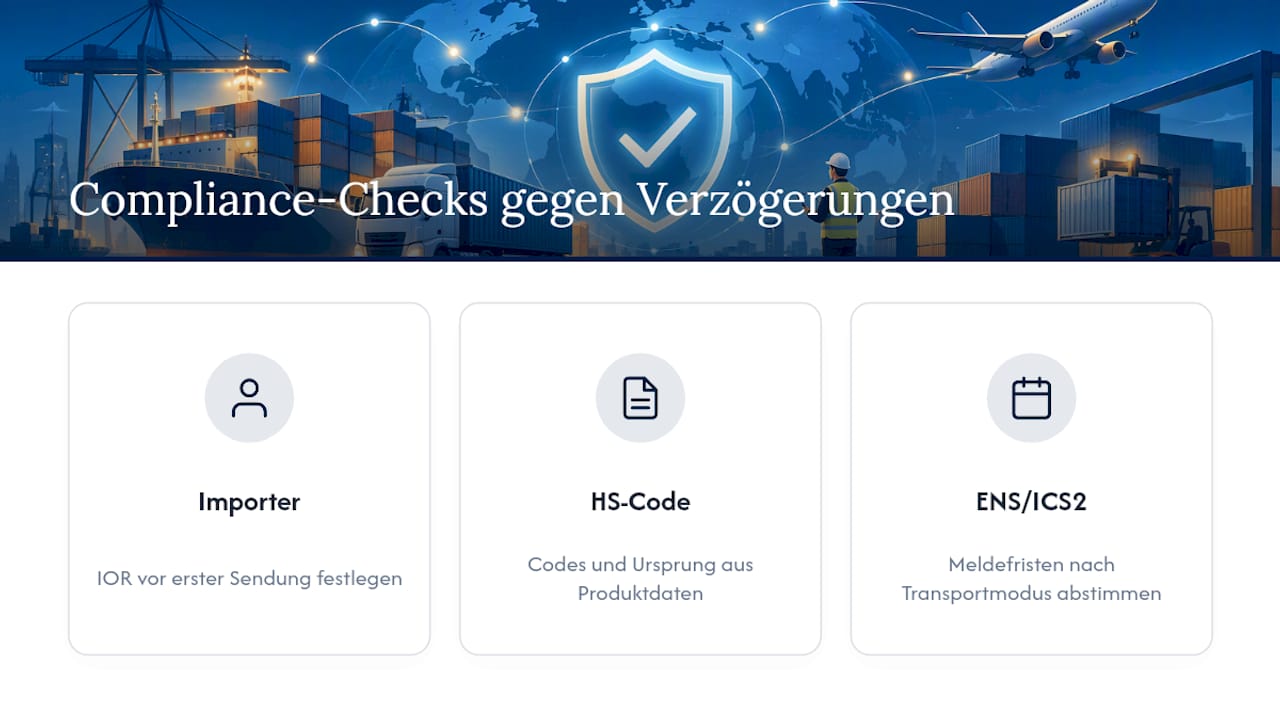
The best API is of little use if the operational foundations are lacking. In practice, three points cause the most problems when importing into Germany.
The Importer of Record (IOR) This must be determined before the first shipment is dispatched. Non-EU sellers usually need a representative or service provider to fulfill this role. According to one [source/authority], if this agreement is lacking, it is [a matter/situation] that Guide to customs clearance in Germany among the most common reasons for inspections or even seizures.
The HS classification Even with the best software, this remains the retailer's responsibility. Codes and proof of origin must come from their own product data system; an API can check plausibility, but it cannot invent missing data, as the technical documentation by Ingrid for customs declarations. Anyone who is unsure should obtain a binding customs tariff ruling instead of guessing.
The ENS/ICS2 timing It depends on the mode of transport: air freight requires earlier reporting deadlines than sea freight. Anyone who doesn't work in sync with the freight forwarder or 3PL partner risks the security data arriving too late, even if the customs data itself is correct.
How do you test a customs API before going live?
A selection decision can be based on four criteria before a contract is even signed.
- Technical testDoes the API cover all required fields? How does it react to invalid input, and how reliably do webhooks arrive?
- Functional testDoes the landed cost calculation match a manual control invoice? Is the IOSS number correctly transferred to documents and accounting entries?
- auditHow long does support take for an open request, and what does the onboarding process look like in practice?
- Cost assessmentIs a model with a fee per call or a flat rate more cost-effective for your transmission volume?
| test area | What to look for |
|---|---|
| Required field coverage | HS/CN code, country of origin, weight, IOSS field fully displayed |
| Error behavior | Clear error message instead of silent rejection |
| Document creation | Commercial invoice and customs documents without manual post-processing |
| Support response | Response time for test requests during the proof-of-concept |
A short test run with real, but non-critical, broadcasts reveals more than any product description. Those who check off these four points before going live significantly reduce the risk of costly surprises in the first live month.
International Parcel: Automated customs and shipping processing from a single source
Those looking for previous integration levels, where these functions already come together seamlessly, will find at Paket International a platform that calculates shipping costs and customs fees in seconds and carries out customs clearance without manual intervention.
The platform connects parcel services, systems, and customs services in a central dashboard and supports the document management that would otherwise be required for each shipment. For getting started, the same step-by-step approach as with any customs API is recommended: first a test phase with existing shipping data, then integration with the shop and ERP system via Paket International's technical solutions. Those who specifically want to outsource customs processing without committing their own development resources will find the appropriate product page there. For retailers who initially want to compare the entire shipping platform with various parcel services, a look at the overview page with rates for international shipments is worthwhile. The next step is straightforward: test your own shipping data in an initial run and compare the result with your previous manual calculations.
Sources
- EU IOSS / VAT One Stop Shop — Guidance
- FLEX Logistik — Customs Clearance E‑Commerce Imports Germany Guide
FAQ
What specific benefits does an API offer customs?
It calculates the landed cost including customs duties, import VAT, and fees, automatically generates commercial invoices and customs documents, and reports the shipment status via webhook. Paket International also bundles these functions with the selection of the appropriate parcel service in a single dashboard.
What data does a customs API need per shipment?
At a minimum, the CN/HS code, country of origin, net and gross weight, value of goods, EORI number, and, for small consignments, the IOSS number must be included. If any of these fields are missing, the consignment may be held by customs.
Will the EU reform of 2026 change the customs duties for small consignments?
Yes, from July 1, 2026, the current duty-free allowance of €150 will be abolished, meaning that even inexpensive orders from third countries may be subject to customs duties. This will make automated landed cost calculation mandatory for many retailers, rather than optional.
Can I start with CSV upload instead of immediately integrating an API?
Yes, starting with CSV or Document AI is a common first step before implementing a Booking or REST API. This phased approach significantly reduces the technical risk during implementation.
How much does it cost to use Paket International?
The platform charges per shipping label, with individual rates for each customer and shipping partner. You can obtain exact prices for your shipment volume directly via the Paket International platform page.