

Automated customs and shipping clearance to Australia
German retailers need an automated solution for shipping to Australia that handles HS classification, BICON verification, landed cost calculation, and N10 registration in the Integrated Cargo System without manual intervention. While customs duties and taxes can be calculated manually, the main source of error almost always lies in the lack of biosafety checks. Paket International combines precisely these steps into a single process and is considered a proven option for retailers who regularly ship to Australia.
In short:
- Without an automated solution, there is a high risk of errors in HS codes, biosafety certificates and documents when preparing shipments to Australia.
- Incorrect or missing ISPM-15 marking for wooden packaging almost always leads to rejection or destruction of the shipment.
- Important certificates and data such as HS code, value of goods and origin must be clearly checked and verified for accuracy before shipment.
- The landed cost consists of customs duties, VAT and tiered fees, which should be calculated automatically.
- A platform for shipping to Australia needs API functions for automatic classification, cost calculation, document creation and N10 export in the customs system.
Table of Contents
- Shipping to Australia Customs: Which authorities and standards apply?
- What documents and data are required for a shipment to Australia?
- How is customs duty calculated for shipments to Australia?
- What technical features does an automated customs solution need?
- How does Paket International implement automated customs clearance for Australia?
- Set up automated customs clearance for Australia now
- Sources
Shipping to Australia Customs: Which authorities and standards apply?
Two authorities determine whether a shipment to Australia passes through smoothly. The Australian Border Force (ABF) is responsible for standard customs clearance: tariff classification, valuation, and duty collection. Simultaneously, the Department of Agriculture checks biosecurity, regardless of whether the ABF has already cleared the shipment.
For tariff classification, each shipment needs an eight-digit HS code. This code determines the customs duty rate, which according to Douana's overview of the Australian customs system Customs duties for many product categories usually vary within a low range; however, they can be significantly higher for textiles and shoes. An incorrect code almost always leads to additional charges or a return of the goods.
The real hurdle, however, is rarely the customs duty itself. Biosafety deficiencies in packaging and accompanying documents cause significantly more delays than tariff issues, because the Department of Agriculture consistently holds shipments without valid documentation.
BICON, the Australian Biosecurity Import Conditions System, lists the applicable import regulations for thousands of product groups. Anyone who fails to consult this database before shipping risks confiscation or destruction of the goods. The following are particularly affected:
- Food and processed agricultural products
- Plants, seeds and wood products
- Medicines and medical devices subject to registration requirements
- Wooden packaging without valid ISPM-15 treatment
BICON and ISPM 15 as core requirements: According to the Koblenz Chamber of Commerce and Industry Australia requires ISPM-15 treatment and labeling for all wooden packaging. If this is missing, the shipment is often rejected entirely, regardless of the value of the goods.
What documents and data are required for a shipment to Australia?
An automated system must undergo a fixed series of checks before generating the shipping document. If a data field is missing, processing is delayed, sometimes by several days.
The following documents are required for every commercial shipment:
- Commercial invoice including the value of goods, buyer and seller details
- Packing list including weight, quantity and packaging type
- Waybill of the respective parcel service
- Proof of origin, if a customs preference is claimed
- ATA Carnet for temporary imports, e.g. for trade fair goods
At the data level, the HS code, the value of the goods, the agreed Incoterm, the weight, the country of origin, and any applicable tariff preference are the fields that a system must check before preparing the N10 declaration. Only then is automated comparison against BICON and the ISPM 15 requirements for wooden packaging worthwhile. If this step is skipped, the problem will only surface upon arrival in Australia, when correction is virtually impossible.
Pro tip: Don't wait until shipping to check the HS code; check it when you create the item in your shop system. Guide to determining HS codes for textiles This shows how quickly product groups can be misclassified and what consequences this has for the customs duty rate.

The most common mistake in practice: The value of the goods on the commercial invoice does not match the value stored in the shipping system. The quickest way to counteract this is to perform a mandatory field comparison between the shop, invoice, and shipping label before any label is even printed.
How is customs duty calculated for shipments to Australia?
The landed cost of a shipment to Australia consists of three components: the goods-group-specific customs duty, a value-added tax (GST), and a tiered customs clearance fee. GTAI lists the current fee levels based on the value of goods and the type of processing, which forms the basis for the automatic calculation.
In Germany, the registration types IPK and IZA apply to the electronic registration of commercial shipments above certain thresholds. tariff Postal and courier services often handle this registration directly, but an automated system must provide the necessary data in advance.
A functioning calculation logic requires at least:
- Current exchange rate conversion between Euro and Australian Dollar
- Checking for compliance with free trade agreements to ensure correct origin assessment
- Automatic assignment to the appropriate fee level
An example illustrates the process: Goods valued at €800 with an assumed customs duty rate of 5% This results in a customs duty of €40. In Australia, the GST is calculated on the value of the goods plus customs duties and freight costs. A tiered clearance fee is also added.
These three items together make up the Landed Cost, which a system ideally displays to the merchant before checkout.
What technical features does an automated customs solution need?
A platform for shipping to Australia requires specific API functions to ensure the entire process runs smoothly without manual intervention. Five endpoints are crucial:
- Tariff inquiry for automatic HS classification
- Landed cost calculation including customs duties, GST and fees
- Document generation for commercial invoice and packing list
- N10 export directly into the ABF Integrated Cargo System
- Shipment tracking with real-time status updates
The workflow begins with the order in the shop system, goes through automatic HS extraction and BICON check, leads to the landed cost display in the checkout and ends with the N10 lodging and label generation. StarShippers example of customs broker software This shows that HS extraction, duty and GST calculation, and N10 drafts can already be reliably automated from a technical standpoint, significantly reducing the time required for manual classification.
The operational benefit lies less in pure time savings than in the audit trail: Every automatically checked classification and every BICON reconciliation can be fully traced during an ABF audit. This also reduces the volume of support requests regarding shipment status. For integrations, webhooks for status changes, batch modes for high shipment volumes, and a fallback to a customs agent for special cases that cannot be resolved using rules are recommended.
How does Paket International implement automated customs clearance for Australia?
Paket International combines the calculation of shipping costs and customs fees in a single step that takes only seconds. The platform connects parcel services such as DHL, UPS, FedEx, DPD, and DB Schenker with customs clearance, eliminating the need for merchants to switch between multiple systems.
Key functions include:
- Automatic calculation of shipping costs and customs duties in real time
- Automatic customs clearance without manual paperwork
- Central dashboard for managing all shipments
- Comparison of economy, premium, express, pallet and general cargo shipping
For retailers with regular shipments to Australia and complex compliance requirements, such as those related to wooden packaging or product categories requiring registration, end-to-end automation is particularly beneficial. Those who only occasionally ship individual packages will naturally experience the effect less than retailers with daily volumes.
Pro tip: First, test the integration with a single product group, such as electronics or textiles, before connecting your entire product range. This allows you to selectively check HS codes and BICON results without jeopardizing ongoing shipping.
The process involves three steps: registration on the platform, a test shipment to check the calculation logic, and then integration into the existing shop system via API or plugin.
Set up automated customs clearance for Australia now
Anyone still manually looking up HS codes and checking BICON conditions wastes valuable time on every shipment to Australia. Paket International automatically calculates customs duties, GST, and shipping costs, and generates customs documents directly from the order data, eliminating the need for team members to manually compile the N10 declaration.
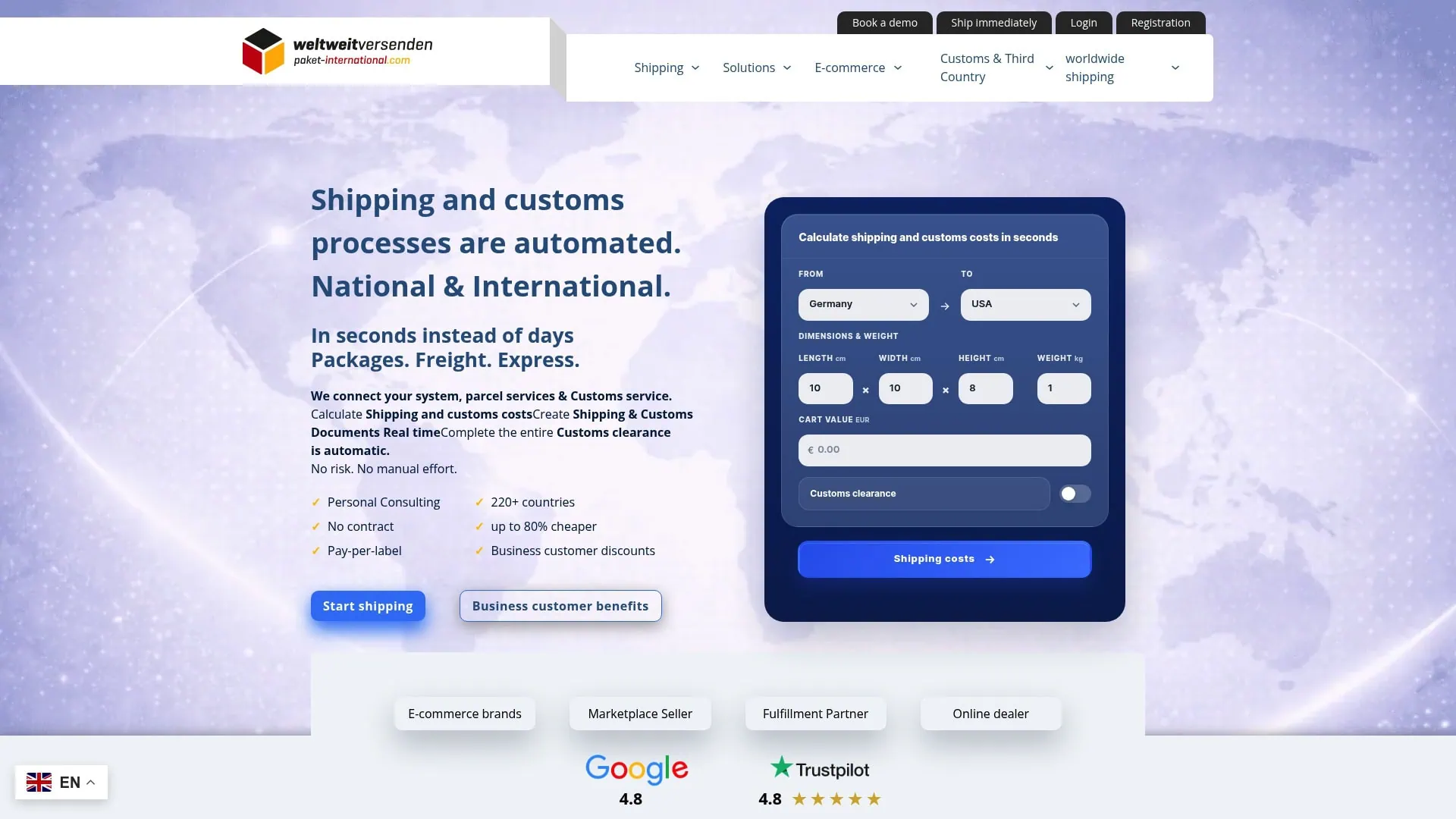
For an initial consultation or demo, it's helpful to have the following information ready: average monthly shipment volume to Australia, the relevant product categories including HS codes, the shop or ERP system used, and any special cases such as wooden packaging or products requiring registration. This information will allow us to plan the integration via the landing page. International shipping with professional customs clearance Prepare directly.
There are also suitable options for related product categories: Those who supply electronics will find them on the page for electronics mail order specific instructions, while bulky goods are listed via the overview to the Bulky goods shipping The next step is straightforward: registration, test shipment, integration, and from this point on, customs clearance to Australia runs automatically in the background.
Sources
- Koblenz Chamber of Industry and Commerce — Customs law and import restrictions Australia
- German Customs — Internet orders / postal shipments from non-EU countries
- StarShipper — Customs Broker Software (Example of technical automation)