

Carrier selection rules: How to automate shipping control
The most effective method is a parameterized if→then rule set (a rules engine) with lane logic, weight thresholds, merchandise value rules, and a clearly defined fallback. This structure connects the checkout promise to the customer with the operational reality in the warehouse and prevents bottlenecks if a carrier fails or a rate is unavailable. Before implementation, three things should be checked: a full carrier audit, the quality of the master data, and the alignment of cut-off times with the shipping promise.
In short:
- Carrier selection rules are based on weight, destination, cargo value, service level, and cost to ensure automation and operational reliability.
- Error and skip mechanisms ensure smooth operation, even in the event of API failures, through automatic rule forwarding.
- The rollout should be accompanied by carrier audits, master data verification, and sandbox test runs to minimize risks.
- Continuous monitoring of key performance indicators such as on-time rate, fallback rate and claim rate is essential to keep the rules up to date.
- Integrated platforms like Paket International combine carrier selection, customs clearance and label creation for greater efficiency in international shipping.
Table of Contents
- How does a rules engine for carrier selection work?
- What criteria should be included in every carrier rule?
- Practical If→Then rules for immediate use
- How do you safely implement new carrier rules?
- What key performance indicators show whether the rules are working?
- How does an automated platform link rules, labeling, and customs?
- When does an integrated solution like Paket International make sense?
- Sources
- FAQ
How does a rules engine for carrier selection work?
A rules engine evaluates each shipment against a list of conditions, sorted by priority. Customer-specific rules are applied first, followed by rules at the organizational or site level, and then a general catch-all rule. This principle is also described in detail. Carrier selection module in logistics software, which make warehouse and customer-level rules separately configurable.
The engine requires multiple data inputs simultaneously for each decision. If one of these is missing or incorrect, the evaluation switches to the next rule or to a fallback.
- Weight and dimensions of the shipment, including calculated volumetric weight
- Destination postcode and derived lane (national, EU, third country)
- Value of goods and resulting insurance needs
- Distribution channel (own shop, marketplace, B2B order)
- Booked service level at checkout (Standard, Express, Economy)
- Current API status of the respective carrier
The error and skip mechanism is crucial: If a carrier doesn't return a valid rate, for example due to an API timeout, the engine automatically jumps to the next suitable rule match instead of stopping the process. Technically, this happens as a rate lookup before a label is even created. This is critical because a label on the wrong route is extremely difficult to correct cost-effectively. The latency of this entire process must remain within a few seconds; otherwise, queues will form at checkout or in fulfillment. According to [source/company name], such routing modules support [functionality/solution]. Documentation for Carrier Route Modules multiple parallel routing trees and explicitly fallback paths, precisely to ensure this scalability.
What criteria should be included in every carrier rule?
Every rule needs verifiable conditions. Five factors recur in virtually every functioning set of rules, and each of them can be directly translated into an If→Then condition.
Weight and dimensions The carrier class is often determined by the weight alone. Packages weighing over 31,5 kilograms or with a girth exceeding 300 centimeters are usually automatically routed to a freight forwarder rather than a standard parcel service, because otherwise high costs would be incurred. Bulky surcharges The volumetric weight must be calculated correctly, not just the actual weight, otherwise the rule will apply too late or not at all.
Destination and lane mapping Decide which carriers can reliably serve a region. Islands, remote postal code areas, and international lanes require separate coverage checks, as not every partner covers every region equally well.
Value of goods and insurance This triggers additional conditions: Above a certain value threshold, the rule should automatically require tracking with a signature or additional insurance. Practical guide to cargo insurance shows how declared value information can be incorporated into such triggers.
Service level comparison The checkout promise is linked to the carrier's actual cut-off time. If the shop promises "there tomorrow," but the customer selects a service with pickup only in the afternoon, the promise breaks at the interface between sales and logistics.
Cost balance The base price should never be the only factor. Surcharges for bulky goods, remote areas, or cash on delivery significantly alter the actual cost per shipment, which is why rules should be based on the total cost (cost-to-serve), not on the list prices.
| Criterion | Typical threshold / trigger | Regular action |
|---|---|---|
| Weight/Girth | over 31,5 kg or girth > 300 cm | Forwarding to freight forwarder |
| destination | remote postal code or island | Specialized carrier instead of standard |
| cart value | high value, definable limit | Tracking with signature plus insurance |
| service level | Express booking at checkout | Only carriers with a suitable cut-off are permitted. |
| Cost situation | high risk of being awarded a surcharge | Comparison based on total costs instead of base price |
Pro tip: Never manually check the girth measurement in your head. Calculating it as length plus twice the circumference seems simple, but if measured at the wrong point, it can quickly lead to incorrect rule decisions and costly recalculations. A Instructions for correctly calculating girth measurement explains the measurement method in detail.
Practical If→Then rules for immediate use
The following templates can be adopted into a rules engine almost unchanged. The order is important: customer rules come before channel rules, channel rules before weight rules, weight rules before lane rules, and the catch-all rule is always at the very end.
- High-value rule: If the value of the goods exceeds the defined limit, then select the premium service with signature and insurance, regardless of the destination.
- Oversize rule: If the weight exceeds 31,5 kilograms or the girth exceeds 300 centimeters, then route it to a freight forwarder instead of the standard parcel service.
- Remote zip code rule: If the destination postcode is on the list of remote areas, then choose the carrier with proven coverage for that region, even if it is more expensive.
- Express Promise Rule: If express shipping was booked at checkout, first check carriers whose cut-off time still allows for the promised delivery.
- Catch-all rule: If none of the previous conditions apply, then choose the cheapest available standard service with a valid rate.
Each of these rules requires a clear condition and a definite action; otherwise, gray areas arise where two rules apply simultaneously. According to one [source/expert], these four layers—lane logic, weight and dimension check, delivery promise matching, and exception ownership—form the basis of [a specific framework/system]. Guide to Carrier Routing Rules The basic framework of functioning routing systems in European online retail. For bulky goods, it's also worth taking a look at the specifics. Costs and options for shipping bulky goods, as surcharges vary particularly greatly here.
How do you safely implement new carrier rules?
The introduction of a set of rules takes place in clearly separable phases, and each phase has its own condition before the next one can begin.
- Carrier audit: Coverage areas, cut-off times and surcharge structures of all current contracting partners are documented, not just the base prices.
- Master data validation: Weights, address formats, and country codes must be correct before the rules are evaluated. Incorrect ISO country codes or incorrectly formatted postal codes will otherwise lead to routing rejections, often without any discernible error message.
- Create sandbox rules: The If→Then logic is created in a test environment, priorities are set, and a catch-all rule is configured before any real shipment is affected.
- Limited-volume test phase: Between 10 and 25 percent of the shipping volume will be subject to the new rules, while the rest will continue as before. This percentage allows, according to Practical guide to the multi-carrier strategy Reliable key performance indicator (KPI) measurement without bearing the entire operational risk.
- Versioning and rollback: Every rule change is documented with the date and responsible party, so that a rollback to the previous version is possible within minutes.
Pro tip: Never start the testing phase during peak season. A new rule, which will run at full capacity for the first time in November, reveals its weaknesses precisely when mistakes are most costly.
There's no single best way to validate addresses, but it absolutely must be done before the first rule evaluation, not after. Skipping this step will make it nearly impossible to trace the cause of subsequent delivery failures back to the correct rule.
What key performance indicators show whether the rules are working?
A regulatory framework without monitoring deteriorates unnoticed over time because carrier conditions, surcharges, and coverage areas are constantly changing. Five key performance indicators provide a reliable picture.
- On-time rate: Percentage of shipments arriving within the promised time window, evaluated separately per carrier and per lane.
- Failed Delivery Rate: The percentage of failed delivery attempts is often an early indication of outdated address data or incorrect coverage assumptions.
- Claim rate: The proportion of shipments with complaints or damage reports is important for evaluating insurance rules.
- Cost-per-shipment: Actual total costs including surcharges, not the list price alone.
- Fallback rate: Percentage of broadcasts that were handled via the catch-all rule instead of a specific rule. A consistently high value indicates that the actual rules are too restrictive or outdated.
A sudden spike in the claim rate in a single lane or an API outage at a primary carrier should automatically trigger an alert that temporarily disables the affected rule and prioritizes the fallback carrier. Typical multi-carrier setups consist of a primary carrier, a specialist for exceptions, and a backup, as recommended by best practices in shipping strategy.
Responsibility should be clearly defined: a rule owner maintains the logic, an operations lead monitors daily key performance indicators, and a carrier account manager negotiates directly with the contractual partner in case of recurring problems. This separation of roles is also cited as a key success factor in analyses of documented exception ownership, because each exception category requires a designated role for rapid escalation. A monthly review cycle is sufficient during normal operations, but should be shortened to weekly before peak periods.
How does an automated platform link rules, labeling, and customs?
A rules engine alone only resolves the carrier decision. The real time savings only occur when this decision is directly transferred to tariff calculation, label creation, and customs clearance, without anyone having to re-enter the data.
One such platform exemplifies this interplay: The rules engine selects the carrier based on weight, destination, and value of goods; the system calculates shipping costs and customs duties within seconds; and customs clearance then proceeds automatically without any manual intervention. In practice, this means the following for shipping teams:
- Fewer manual interventions between order placement and label printing
- Faster label creation because rate lookup and customs calculation run in parallel.
- A central dashboard that allows you to track all shipments regardless of the chosen carrier.
Anyone testing such a platform in a demo meeting should ask specific questions: How are fallback carriers handled in the event of an API failure? How quickly does the system react to changes in customs duties in individual destination countries? And can existing rules from the company's own ERP system be adopted, or do they need to be rebuilt?
When does an integrated solution like Paket International make sense?
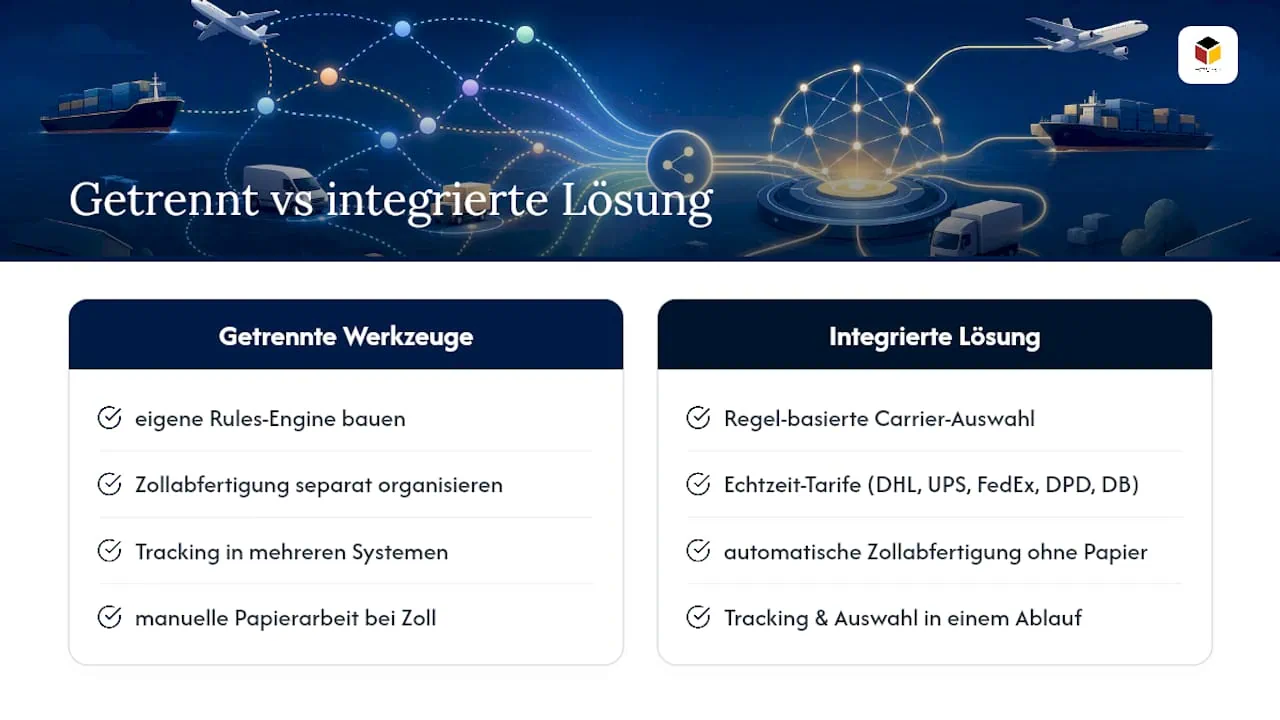
Anyone who works internationally with multiple carriers knows the problem: building their own rules engine, organizing customs clearance separately, and then consolidating tracking data from multiple systems. An integrated solution combines these three steps into a single process instead of three separate tools.
Such a platform combines rule-based carrier selection with real-time rates from DHL, UPS, FedEx, DPD, and DB Schenker, as well as automated customs clearance that eliminates manual paperwork. For shipping teams with international volumes, recurring customs issues, or frequent exceptions like oversized or high-value shipments, this eliminates precisely the steps that would otherwise waste time between carrier selection and label printing.
Anyone who wants to check how their own carrier logic can be transferred into an automated process will find information on the page about International shipping with professional customs clearance the appropriate starting point for an initial assessment of one's own shipment volume.
Sources
For those wanting to delve deeper into the technical implementation, CartonCloud offers concrete configuration principles for priority and catch-all rules. FLEX describes the four decision layers of rule-based routing in detail for European online retail. Current weight and girth thresholds are provided by Deutsche Post/DHL, and the freight portal glossary offers an introduction to the optimization logic behind carrier selection.
- DHL Parcel Prices – Deutsche Post / DHL
- Carrier Routing Rules For European E‑commerce – FLEX.
- Carrier Selection Rules – CartonCloud Help
FAQ
What exactly are carrier selection rules?
These are If→Then conditions that automatically determine the appropriate shipping provider for each shipment based on weight, destination, value of goods and service level.
How many carriers should a set of rules cover at a minimum?
Practical guidelines recommend at least one primary carrier, one specialist for exceptional cases such as bulky goods, and one backup carrier for failures.
From what weight should a shipment be routed to a freight forwarding company?
For packages weighing approximately 31,5 kilograms or with a girth exceeding 300 centimeters, it is generally more worthwhile to forward them to a freight forwarding company rather than a standard parcel service.
Can a platform like Paket International Carrier rules directly link customs clearance?
Yes, Paket International combines carrier selection with automatic tariff calculation and customs clearance in a single process, without manual intermediate steps.