

De minimis threshold: What retailers need to know now
Since July 1, 2021, there has been no exemption limit for import VAT in Germany. Every shipment of goods from a non-EU country triggers import VAT, regardless of the value of the goods. Until June 30, 2026, the €150 customs duty exemption limit still applies: shipments below this amount are duty-free, but not exempt from import VAT. From July 1, 2026, according to... Federal Ministry of Finance This limit also applies. Instead, a flat customs duty of €3 per goods category applies to shipments under €150.
For retailers, this means specifically:
- No more EU tax exemption Since mid-2021, EUSt (European Union VAT) is generally levied on all shipments to third countries.
- Duty-free allowance below 150 euros This applies until the end of June 2026; after that, a flat customs duty will be levied per goods category.
- The decisive factor is the import date., not the order date. An order placed on June 25, 2026, but only implemented on July 3, 2026, is subject to the new rules.
- iOS (Import One-Stop Shop) makes it possible to pay EUSt at the time of sale and avoid subsequent claims from the recipient.
- DDP (Delivered Duty Paid) as an Incoterm ensures that customs duties and EU import VAT are paid by the sender before the goods reach the recipient.
Pro tip: Anyone selling goods up to €150 to private individuals in the EU should consider IOSS registration. Those offering DDP (Delivered Duty Paid) must include customs duties and EU import VAT in the checkout process; otherwise, additional charges will be incurred, leading to returns.
Key insights
From July 1, 2026, the €150 duty-free allowance will be completely abolished: Traders must include a flat customs duty of €3 per goods category for each shipment from a third country under €150, in addition to the EUSt, which has been in effect without a duty-free allowance since 2021.
| Theme | Details |
|---|---|
| EU VAT exemption limit no longer applies | Since July 2021, EUSt (19% or 7%) has been levied on every shipment to a third country, without a minimum value. |
| Duty-free allowance from July 2026 | The €150 limit is eliminated; instead, there is a €3 flat rate per product category per shipment. |
| Mixed programs | For five categories of goods in one package, a flat customs duty of 5 × €3 = €15 will be charged. |
| IOSS and DDP at checkout | IOSS or DDP pricing prevents additional charges and reduces returns. |
| International Package | Automated landed cost calculation, customs documents and IOSS handling via a central platform. |
Table of Contents
- What exactly does the de minimis limit mean in customs law?
- What threshold values currently apply in Germany?
- How do you calculate customs value, tax base and import VAT?
- What options do traders have regarding IOSS, Incoterms and documentation?
- How does Paket International support retailers with de minimis issues?
- Quick checklist: 10 things you need to check before shipping from a third country
- Paket International makes landed costs and customs clearance transparent.
- Sources
What exactly does the de minimis limit mean in customs law?
The term "de minimis" comes from Latin and roughly translates to "of minor importance". In customs law, the de minimis threshold refers to the value of goods in a shipment from a third country below which import duties are not levied, either wholly or partially.
Important: This customs value limit has nothing to do with de minimis aid under EU state aid law, i.e., maximum state funding limits for companies. This article deals exclusively with the customs law version.
What factors are included in the assessment?
- Country of origin of the goods: Only shipments from third countries (outside the EU) are affected. Intra-Community deliveries are subject to different rules.
- Value of goods (invoice value): The value of the goods shown on the commercial invoice. (At the) Customs value Shipping costs and insurance will be added.
- Shipping: These are added to the value of the goods to determine the customs value.
- Number and type of product categories: For mixed shipments, the flat fee will be charged per product category from July 2026 onwards, not per shipment.
The difference between customs value and invoice value is relevant in practice: The invoice value is the purchase price, while the customs value includes shipping costs and insurance. The customs value is the basis for calculating import VAT.
What threshold values currently apply in Germany?
The legal situation has changed twice in recent years, and is about to change again.
| Period | EU VAT exemption limit | duty-free allowance | flat rate |
|---|---|---|---|
| Until June 30, 2021 | 21,05 € | 150 € | no |
| From 1 July 2021 | no | 150 € | no |
| From 1 July 2026 | no | no | €3 per product category |
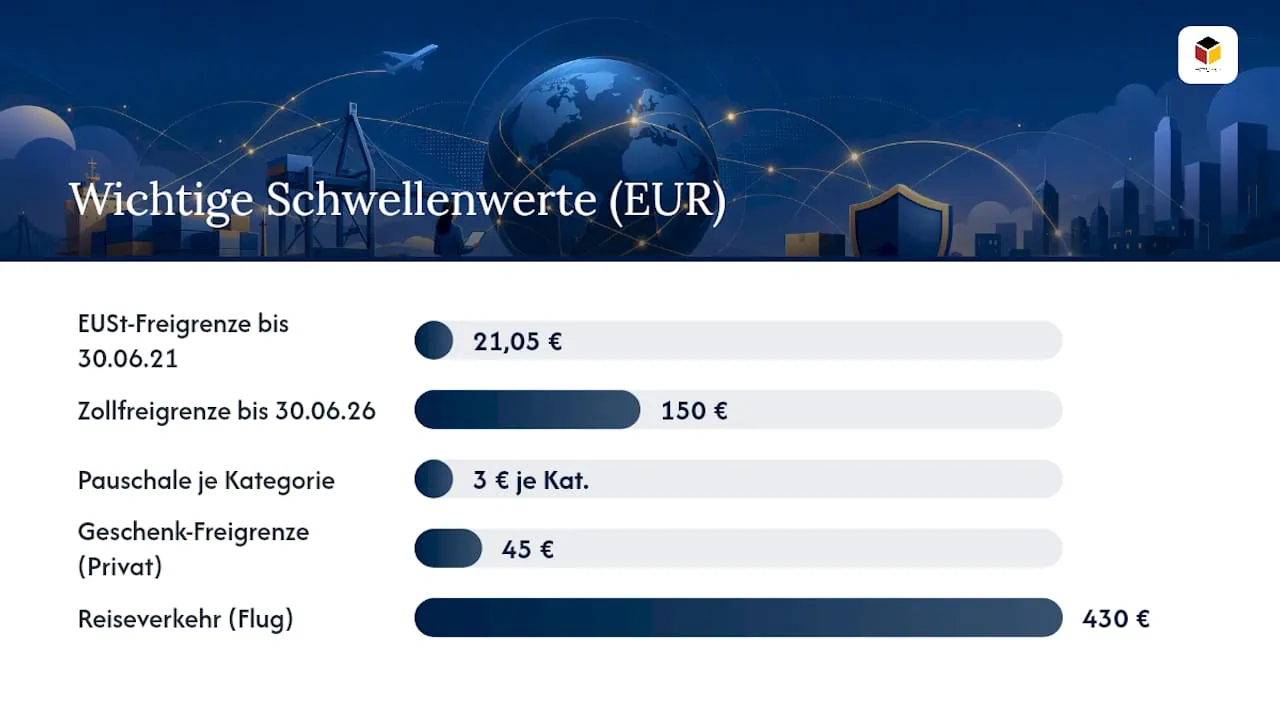
Since July 1, 2021, import VAT is levied on every shipment from a third country, regardless of the value of the goods. Additional excise duties may also apply, for example to alcohol, tobacco, or energy products.
Exceptions and special cases:
- Gift shipments Transactions between private individuals may be exempt from customs duties and EU VAT under certain conditions if the value does not exceed €45.
- Travel: Travelers from third countries can import goods up to a value of €430 duty-free (for air travel), provided they are for personal use.
- Special exemptions EU customs law applies, for example, to goods with preferential origin from countries with which the EU has concluded free trade agreements.
How do you calculate customs value, tax base and import VAT?
The calculation follows a fixed three-step process. Lexware describes The formulas are as follows:
- Customs value = Value of goods + shipping costs (+ insurance)
- Assessment basis EUSt = Customs value + Customs duties + Excise taxes
- EUSt = Tax base × Tax rate (19% or 7%)
Calculation example: A retailer imports electronic accessories from China with an invoice value of €80. Shipping costs are €12. From July 2026, a flat customs duty of €3 will be levied (one product category).
- Customs value: €80 + €12 = 92 €
- Assessment basis for EUSt: €92 + €3 = 95 €
- EUSt (19%): 95 € × 0,19 = 18,05 €
- Total fees: €3 + €18,05 = 21,05 €
Additional service fees from the courier may apply. Consumer advice centre points out that courier services may charge their own fees for customs clearance, which can significantly increase the total amount for the recipient.
Pro tip: For mixed shipments containing multiple product categories, a flat fee of €3 per category applies. Five different categories in one package mean 5 × €3 = €15 in customs duties. Therefore, careful itemization and clear categorization in the customs documentation are worthwhile even during order planning.

What options do traders have regarding IOSS, Incoterms and documentation?
IOSS: Pay import VAT on sales
The Import One-Stop Shop (IOSS) is an EU procedure for distance sales to private individuals for goods valued up to €150. Merchants who register for IOSS pay the import VAT directly upon sale. The IOSS number must be included on all shipping documents so that customs recognizes the tax already paid and no additional charges are levied on the recipient. Marketplaces like Amazon or eBay often handle the IOSS obligation for their sellers, but this should be verified on a case-by-case basis.
DDP vs. DAP: Who pays the taxes?
- DDP (Delivered Duty Paid): The sender covers all customs duties and import VAT. The recipient pays the stated price; no additional charges will apply. Greater transparency, lower return rate.
- DAP (Delivered At Place): Customs duties and import VAT are the responsibility of the recipient. Additional charges may be claimed by the courier. This is a frequent reason for refused deliveries.
For the checkout process, this means: Anyone offering DDP must Import duties at checkout Calculate and itemize costs correctly. Those who choose DAP (Direct On-the-Post) should clearly inform customers that additional costs may apply.
Operational requirements for documentation
- Correct commercial invoice including goods value, quantity, country of origin and HS code (customs tariff number)
- Customs tariff number for each item
- Bill of materials for mixed shipments, specifying the product categories
- IOSS number on the shipping label if the procedure is used
- Shipping costs must be shown separately, as they are included in the customs value.
Pro tip: The customs duty calculator on zoll.de and the eZOLL app from the customs authority help calculate duties before shipping. Those using systems such as ERP or online shops should check whether an automatic interface for customs calculation is available.
How does Paket International support retailers with de minimis issues?
Paket International offers a fully automated platform that directly supports retailers in calculating and processing import duties:
- Automatic landed cost calculation: Customs value, EUSt and customs flat rates are calculated in seconds, including shipping costs and product category flat rates from July 2026.
- Integration into the ERP system and the online shop: Taxes are displayed directly at checkout, so customers can see the total price before purchasing.
- Automatic customs documents: Commercial invoices, pro forma invoices and shipping labels with correct HS codes are generated automatically.
- IOSS handling: The platform supports the correct entry of the IOSS number on shipping documents.
- Carrier selection and price comparison: DHL, UPS, FedEx, DPD and DB Schenker are compared so that retailers can choose the cheapest and fastest shipping method.
- Proactive customs communication: If customs authorities have any questions, Paket International handles the communication without requiring manual intervention from retailers.
Quick checklist: 10 things you need to check before shipping from a third country
- Confirm country of origin — Does the goods come from a third country? If so, import VAT and possibly customs duties will apply. (Duty)
- State invoice value correctly — The value of goods on the commercial invoice must correspond to the actual transaction value. (Customs document required)
- Shipping costs will be shown separately. Shipping costs are included in the customs value and increase the EU VAT assessment basis. (Checkout change required)
- Determine the HS code (customs tariff number) for each item of goods. — Incorrect tariff numbers will lead to delays or additional charges. (Customs document required)
- Product categories include — From July 2026, a flat fee of €3 per category will apply. Mixed shipments must be itemized. (Checkout change required)
- Check IOSS status — Does IOSS apply to this shipment? If so, include the IOSS number on the shipping label. (Customs document required)
- Establish Incoterm — DDP or DAP? Communicate the decision at checkout so that customers do not incur unexpected costs. (Checkout change required)
- Include the courier's service fees in your calculations. — Courier services often charge their own customs clearance fees, which increase the total amount. (Check shipping charges)
- Use the tax calculator — Check the total duties before shipping using the duty calculator on zoll.de or the eZOLL app.
- Pay attention to the import deadline. — The decisive factor is the import date, not the order date. Shipments with an order date before July 1, 2026, that are imported after that date are subject to the new rules.
Pro tip: Anyone shipping packages containing multiple product categories should check whether splitting them into separate shipments reduces the overall flat rate. For five categories in one package, the flat rate is €15; for one category per shipment, it's only €3. This can be worthwhile depending on the shipping volume and the value of the goods.
Paket International makes landed costs and customs clearance transparent.
Any retailer who wants to remain competitive in shipping from July 2026 onwards needs more than just a table of threshold values. The duty calculation must be integrated into the checkout process, the customs documents must be correct, and the IOSS number must be automatically included on the shipping label.
Paket International automates these steps: Landed costs are calculated in seconds, customs documents are generated, and all common parcel services such as DHL, UPS, FedEx, DPD, and DB Schenker are compared in a single dashboard. The platform can be integrated directly into existing ERP systems and online shops via API or plugin, ensuring that duties are correctly displayed at checkout. This prevents additional charges, reduces return rates, and saves manual time.
For retailers who regularly ship from third countries, it's worth taking a look at the Customs clearance for international parcelsIntegration can be quickly checked and requested directly.
This article provides general information and does not replace advice from a qualified lawyer. Consult a qualified legal professional regarding your personal situation before acting on the basis of this content.
Sources
The following sources are reliable and directly usable for daily work in shipping:
- Federal Ministry of Finance – Customs exemption for goods shipments under 150 euros is abolished
- Consumer advice centre
- Import VAT: All the important information at a glance
Merchants who want to offer their customers transparency can link to relevant websites such as consumer protection agencies or customs.de directly in their shop's FAQ. This reduces support requests and builds trust.