
Customs clearance in dropshipping: What really applies from 2026 onwards
The €150 customs exemption limit will be abolished from July 1, 2026. This means that dropshipping shipments from third countries will generally be subject to customs duties, regardless of the value of the goods. A [new regulation] will apply until July 1, 2028. Transitional rule with a flat rate of €3 per product group for certain types of shipments. Afterwards, customs clearance on a product-specific basis via a new EU customs data platform is planned.
For retailers, this means: act now, don't wait. Three factors determine whether shipments run smoothly or are blocked:
- Check IOSS status and register if necessary
- Apply for an EORI number and clarify the applicant role contractually.
- Suppliers must be obligated to use correct CN codes and provide complete product descriptions.
In short: Anyone who has not clarified these three points by the deadline risks customs delays, additional demands and dissatisfied customers.
Key insights
Customs clearance in dropshipping is only successful if IOSS, EORI and the applicant role are clarified before the first shipment, not afterwards.
| Theme | Details |
|---|---|
| Deadline: July 1, 2026 | From this date, the 150-euro exemption limit will be abolished; until 2028, the 3-euro flat rate per product group will apply. |
| Clarify applicant role | Contractually stipulate who is liable for customs duties in order to avoid liability and subsequent claims. |
| Documentation as a source of error | Precise product descriptions and correct CN codes prevent the most common delays. |
| Model selection based on margin | EU pre-storage reduces duties per unit; direct shipping is suitable for product testing. |
| Automation as a lever | Paket International handles customs calculation and data transfer directly during label creation. |
Table of Contents
- Dropshipping Customs Handling: Obligations, Roles and Typical Mistakes
- How do you practically implement IOSS, EORI and Incoterms?
- Direct shipping, EU warehouse or hybrid: Which model suits your product range?
- How does Paket International automate customs clearance?
- How to get started with International Package
- Sources
Dropshipping Customs Handling: Obligations, Roles and Typical Mistakes
Anyone importing goods into Germany needs an EORI number. Without it, no customs declaration can be submitted, not even automatically. The application process is handled by the German customs administration and usually takes a few working days. Suppliers outside the EU often require an indirect representative who submits the declaration in their own name but on behalf of the customer.
The key question is: Who is the declarant and therefore liable for customs duties? This role determines who is responsible in case of a dispute and who pays any subsequent customs demands. If this isn't contractually agreed upon, the dealer can quickly become the importer himself, even if he never intended to, as one example illustrates. Analysis of Chinese imports in e-commerce shows.
Four documents determine a smooth processing procedure:
- A complete commercial invoice including the value of goods, recipient and sender.
- The customs declaration with a precise description of goods
- The correct CN number (Combined Nomenclature) for each product group
- Proof of origin is required if preferential tariffs are to apply.
The most frequent errors do not arise from malicious intent, but from negligence on the supplier's side: inaccurate product descriptions such as "gift item" instead of the actual product name, incorrectly assigned CN codes, or missing IOSS numbers on the invoice. According to a Analysis of Dropshipping Customs Law more often the cause of delays than the customs duty itself.
Pro tip: Oblige your suppliers contractually to use uniform product names and have the CN codes used confirmed in writing before the first shipment.
How do you practically implement IOSS, EORI and Incoterms?
The technical implementation follows a fixed sequence. Anyone who skips a step will pay twice later, either in time or in additional customs fees.
- Check IOSS status. If you haven't already done so, register via the BZSt portal. This procedure allows for the centralized reporting of import VAT for shipments up to €150 and eliminates the need for registrations in multiple member states. With the transitional rule, IOSS remains relevant, but the flat rate of €3 per product group also applies to certain shipments.
- Apply for EORI. In parallel, clarify who will act as the representative in the contract if the supplier is located outside the EU.
- Define Incoterms. With DDP (Delivered Duty Paid), the seller assumes all import duties and becomes the importer. With DAP (Delivered on Delivery), the buyer pays the duties themselves, which often leads to surprises at the doorstep. A comparison between DDP and DAP shows which option suits which business model.
- Standardize commercial invoices and CN codes. Create a fixed template that always includes the value of goods, country of origin and CN number.
- Label and checkout integration. IOSS number, EORI and KN code should be mandatory fields when creating labels, not optional addenda.
- Test shipment and monitoring. Send out several test shipments per product group and check where sorting errors occur.
These points will help with the check:
- Does the CN number match the actual description of the goods?
- Is the IOSS number visible on the commercial invoice?
- Was the applicant's role contractually stipulated?
Pro tip: Implement a validation routine that automatically checks the CN code, IOSS number, and merchandise value against a reference list every time a label is created. This prevents errors that could later lead to additional claims.
Direct shipping, EU warehouse or hybrid: Which model suits your product range?
The choice of shipping model directly determines your margin, because the new flat rate applies per product group and shipment, not per order value.
direct shipping Shipping from a third country requires no warehousing or upfront investment. However, each individual shipment carries the full customs clearance risk, and with multiple items per order, the flat fee quickly adds up. Customers also frequently experience delays due to customs holding, which detracts from the overall experience.
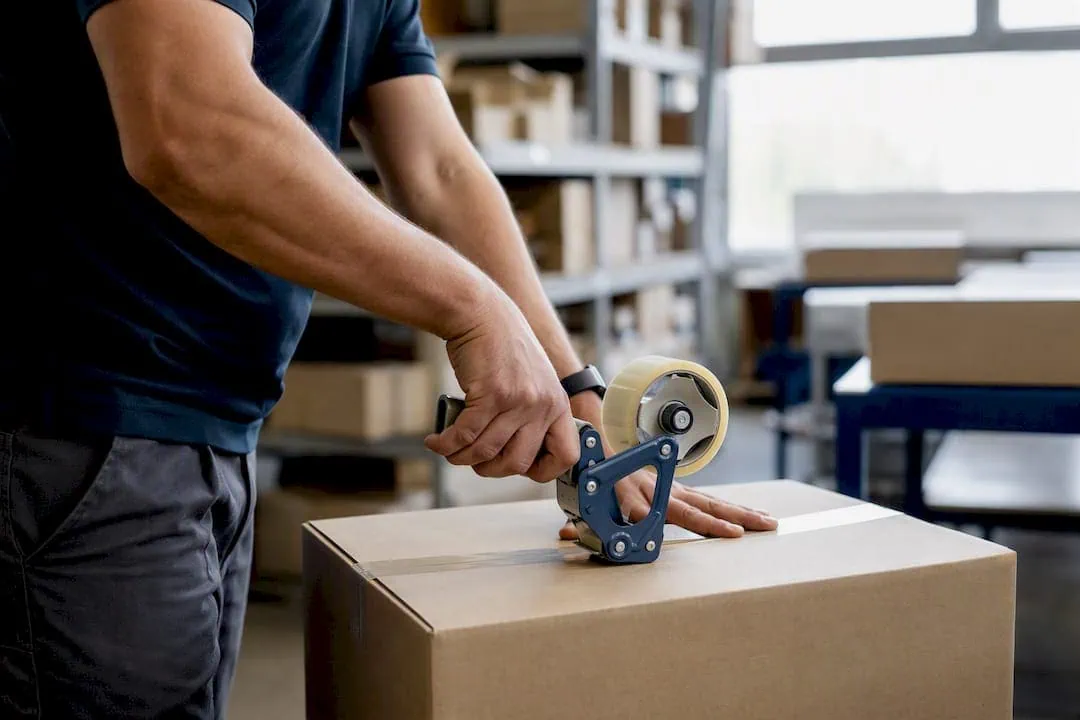
EU pre-storage It bundles imports in larger quantities. One Cost comparison for shipping from China This shows that consolidated imports significantly reduce duties per unit because the flat rate is only charged once per shipment instead of for each individual end-customer package. Delivery time to the customer also decreases because the package is already within the European legal area. This is offset by storage costs and a certain amount of tied-up capital.
Hybrid models Start with direct shipping to test new items and switch to EU warehousing once demand is validated. This is particularly suitable for products with a high repurchase rate, where the upfront costs are worthwhile.
Four factors are taken into account in the calculation:
- The €3 flat rate per product group and shipment
- The import VAT on the customs value
- Parcel service processing fees for customs declaration
- Storage costs when pre-stored in an EU warehouse
Anyone who regularly moves bulky goods or larger quantities of merchandise should also check whether Shipping of individual items or pallets This is worthwhile for consolidated imports. Even more complex transport cases, such as oversized shipments, follow similar basic customs regulations as a Contribution to international heavy transport made clear.
How does Paket International automate customs clearance?
Manual customs data is the biggest time-waster in everyday dropshipping. Paket International automatically calculates shipping costs and import duties when creating the shipping label, without requiring merchants to check each shipment individually.
The platform combines inventory management, parcel services, and customs services in a single system. IOSS number, EORI, and CN code are directly integrated into the shipping label and transmitted to customs authorities, instead of being entered on separate forms. This significantly reduces the sources of error that would otherwise lead to customs delays.
- Automatic calculation of shipping costs and import duties per shipment
- Direct transfer of customs data from the shop system to the label
- Central dashboard for shipment tracking
- Up to 80% less manual paperwork, according to the supplier.
Pro tip: Start with a test integration via API or plugin and check some real shipments before switching over the entire flow of goods.
A frequently asked question: Is the automatic calculation sufficient even when CN codes change due to new suppliers? Yes, provided the product data is correctly stored in the system, the calculation updates automatically with every change.
How to get started with International Package
Manual customs clearance is time-consuming, time that would be better spent on product range and marketing in a dropshipping business. Paket International handles customs automation, multi-carrier routing via DHL, UPS, FedEx, DPD and DB Schenker, and the calculation of import duties directly at checkout.
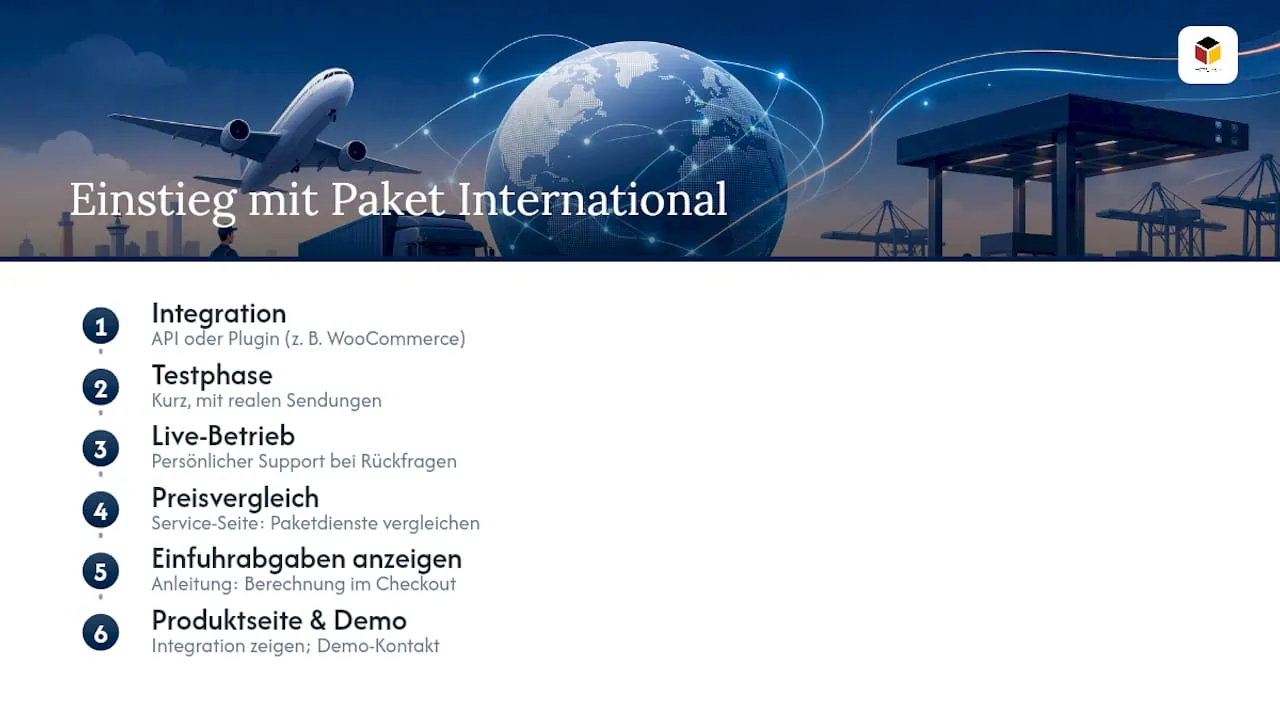
The entry point is via an API or plugin integration, for example for WooCommerce shopsAfter a short test phase with real shipments, live operation continues with personal support should any questions arise regarding the CN code or IOSS assignment for specific product groups. For retailers who want to start their own pricing immediately, a look at the... Service page for customs clearance with a direct price comparison of parcel services. Those who also want to transparently display shipping costs in their own online shop will find what they need in the... Instructions for calculating import duties at checkout the appropriate next step. A look at the Product page for online retailers shows how the integration into existing shop systems is structured in concrete terms, including contact options for a demo.
Sources
For the specific IOSS or EORI application and for checking legal details, it is worth taking a direct look at the primary sources:
- Abolition of the €150 customs exemption limit from 01.07.2026 – New customs obligations for small consignments
- Dropshipping & Customs Law — Butz
- Shipping From China To Germany For Dropshipping — DailyFulfill