
Guaranteed Landed Costs: What really protects German retailers
Guaranteed Landed Costs mean a binding total price that includes customs duties, import VAT, and all known clearance fees, and is displayed to the buyer at checkout. No additional charges at the door, no returns due to unexpected customs costs. The seller contractually covers any difference if the actual charges exceed the calculated amount.
This brings three immediate advantages for German online retailers:
- No surprise costs for the end customer, because customs duties and import VAT are already paid at the time of purchase.
- Higher conversion in international checkout, because buyers know the final price and don't have to expect unknown additional charges.
- Protected margins, because discrepancies between calculated and actual charges are not the responsibility of the dealer, provided the warranty conditions are met.
Responsibility is distributed according to the delivery terms model: With DDP (Delivered Duty Paid), the shipper bears all import duties and ensures that the goods arrive at the recipient's address cleared through customs. With DAP (Delivered at Place), customs duties and taxes remain the responsibility of the recipient. A true landed cost guarantee requires DDP. In this case, the supplier acts as an underwriter: They calculate the duties in advance, collect them from the retailer or buyer, and bear the risk of any miscalculation.
Key insights
Guaranteed Landed Costs are only effective if HS codes are correct, documents are complete, and the supplier contractually assumes the duty risk.
| Theme | Details |
|---|---|
| scope of warranty | Customs duties, import VAT and broker fees are included; misclassifications and excise duties are typically not. |
| Requirements | Correct HS codes, complete trading documents, a valid EORI number and a clarified IOR role are mandatory. |
| IOSS relevance | Shipments under €150 to the EU with IOSS registration significantly simplify warranty processing. |
| Test criteria | Dealers should have liability frameworks, reconciliation deadlines and audit rights confirmed in writing before concluding a contract. |
| International Package | Offers platinum tariffs with guaranteed fees, automatic HS code validation and dashboard reconciliation for German traders. |
Table of Contents
- What are guaranteed landed costs and what items do they cover?
- What services are included and what is typically excluded?
- How does the warranty work technically and contractually?
- What do German retailers need to know about IOSS, EORI and IOR?
- How do retailers technically integrate the calculation into their shop?
- What pricing models are available for a landed cost guarantee?
- How can retailers recognize a reputable and effective warranty?
- How does Paket International technically implement guaranteed total costs?
- International Package: Guaranteed Landed Costs without System Breakdowns
- Sources
What are guaranteed landed costs and what items do they cover?
Landed Costs This includes all costs incurred until goods reach the recipient: the value of the goods, transport costs, insurance, customs duties, import VAT, and other official fees. The calculation depends on the HS code, the country of origin, and the freight charge. A guarantee turns this estimate into a binding amount.
Items typically included in a landed cost guarantee:
- Value of goods (transaction value according to commercial invoice)
- International freight costs (part included in the customs value)
- Insurance costs (insofar as they are relevant to customs value)
- Import duties according to the applicable customs rate for the respective HS code
- Import VAT (in Germany 19%, reduced rate 7% for certain product groups)
- Customs agency and broker fees
- Delivery charges of the carrier in the destination country
The following example calculation shows how the items are composed:
This amount is what the retailer or buyer pays. If customs deviates from this, the guarantor covers the difference. DHL recommends calculating all components systematically but points out that standard online calculators provide estimates and do not replace legally binding assessments. This is precisely the difference between this and a genuine guarantee.
What services are included and what is typically excluded?
Landed cost coverage is not unlimited. Retailers should carefully check which cases are covered and which are not before concluding a contract.
Included:
- Customs duties based on the declared HS code and origin
- Import VAT according to the applicable tax rate in the destination country
- Standard carrier delivery charges in the destination country
- Customs brokerage fees for standard clearance
- Corrections in the event of official reassessments of the customs value, provided all documents were correct.
Typical exceptions:
- Incorrectly declared or missing HS codes (misclassifications are the responsibility of the retailer)
- Missing proof of origin or incomplete trade documents
- Excise duties (alcohol, tobacco, mineral oil) and anti-dumping duties
- Local handling surcharges for island deliveries or special zones
- Express surcharges and bulky goods surcharges are shown separately.
- Sanctions or embargo goods
- Subsequent customs audits based on false information provided by the dealer
Liability limits are contractually agreed upon. Common limits are set per shipment or per month. Claims for reimbursement generally require the retailer to report the discrepancy within a defined timeframe and submit the original documents.
Pro tip: Even with a landed cost guarantee, separate transport insurance can still be advisable if the goods are of high value or if deliveries are being made to countries with an increased risk of confiscation. The guarantee covers customs duty discrepancies, not loss or damage to goods.
Special transports, such as heavy or oversized goods, often have their own surcharge rules that are not automatically included in standard guarantees. Special transport companies describe... own contractual framework for such cases.
How does the warranty work technically and contractually?
The process from order placement to customs clearance follows a clearly defined procedure. Merchants should be familiar with each step to identify any integration gaps early on.
- Data input: The retailer transmits product data (description, value of goods, weight, dimensions, country of origin) to the platform.
- HS code validation: The platform checks or suggests the correct HS code. Incorrect codes are marked or automatically corrected.
- Tariff inquiry: Based on HS code, country of origin and destination country, the Pricing Engine retrieves current customs duties and tax rates.
- Calculation: Customs value, customs duties, import VAT and fees are calculated and combined into a guaranteed total amount.
- Display at checkout: The buyer sees the final DDP price including all taxes and duties. No hidden charges.
- Payment and underwriting: The tax amount will be collected at the time of purchase. The seller assumes the risk of any discrepancies.
- Customs clearance: Shipping documents are generated automatically. Duties are paid to customs in advance.
- Reconciliation: After customs clearance, the actual duty burden is compared with the calculated amount. Discrepancies are documented in the dashboard.
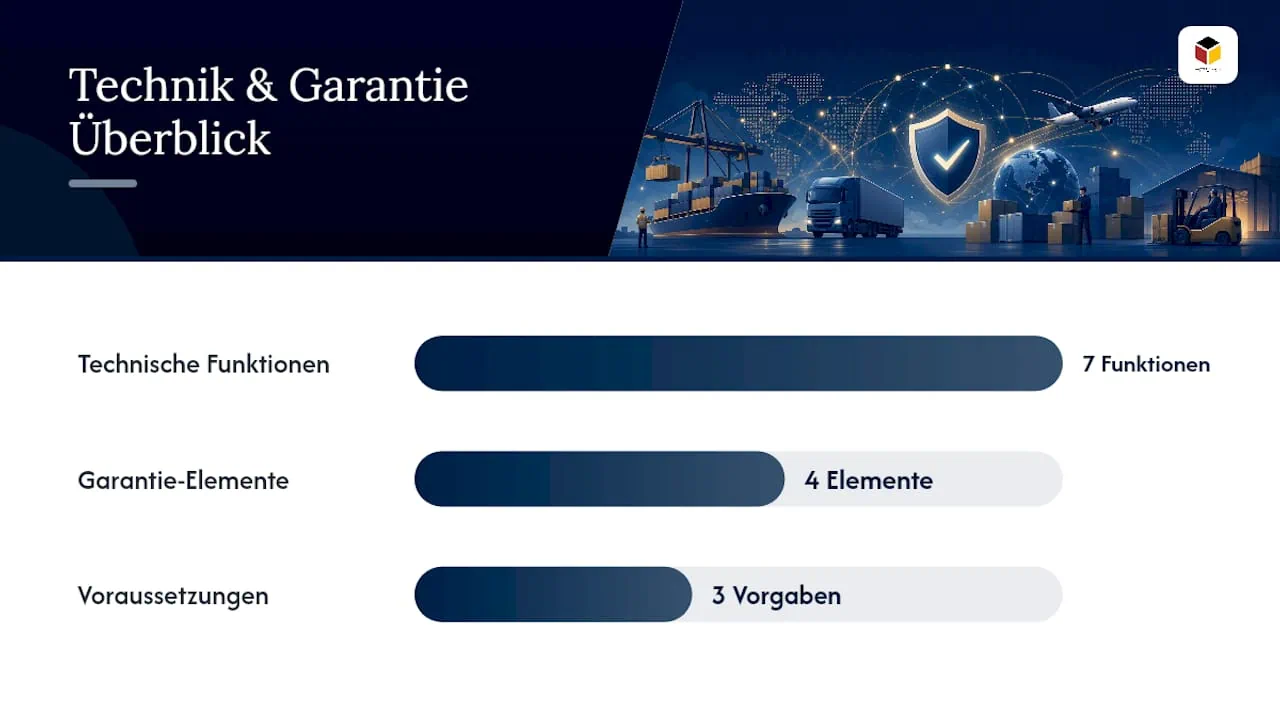
Certain prerequisites are mandatory for this process to take place:
- Correct HS codes for all products
- Complete commercial invoice including transaction value, country of origin and product description
- EORI number of the dealer (for export from Germany)
- Clarification of the IOR role (importer of the goods) in the destination country
- Complete customs declaration with no missing mandatory fields
Odoo describes Landed costs are additional costs that are added to the inventory valuation. For reconciliation, this means that dealers need not only a price guarantee, but also an interface that provides monthly statements with supporting documents.
Checklist for retailers before go-live:
- All products are marked with a validated HS code.
- EORI number applied for and filed
- IOR regulation for target markets clarified
- SLA deadlines for claims in the contract were checked (typically: 30 days after delivery)
- Test run conducted with sample shipments
- Reconciliation access set up in the dashboard
What do German retailers need to know about IOSS, EORI and IOR?
As an EU member state, Germany is subject to specific regulations that directly influence how a landed cost guarantee works.
IOSS (Import One-Stop-Shop):
- Applies to B2C shipments with a merchandise value of up to €150 to the EU.
- Merchants with IOSS registration collect the VAT of the destination country at the time of purchase and report it centrally.
- Shipments with a valid IOSS number are processed at the border without further VAT collection, which speeds up customs clearance.
- IOSS does not apply to shipments over €150. Regular import VAT and customs duties apply and are included in the landed cost calculation.
- A landed cost guarantee for EU shipments under €150 is easier to implement through IOSS because the tax burden is known in advance and has already been paid.
EORI number:
- Mandatory for all companies that export goods from Germany or import goods into the EU.
- Customs declaration is not possible without an EORI number. The warranty is void if clearance fails for this reason.
- Application via the customs portal of the Federal Customs Office, usually within a few working days.
IOR (Importer of the goods):
- For DDP shipments to third countries, a local IOR must be designated who is legally liable for the import.
- In many markets (e.g., USA, UK, Brazil), the foreign trader cannot act as the IOR himself.
- Warranty providers often take on the IOR function as part of the DDP service or provide local partners.
Import VAT in Germany:
- The import VAT rate for goods imported into Germany is 19%, except for certain goods (e.g., books, food) which are 7%.
- It is levied on the customs value plus customs duties.
- Companies entitled to deduct input tax can claim import VAT as input tax, which reduces the effective burden.
Excise taxes (Alcohol, tobacco, energy products) are generally not covered by a standard landed cost guarantee and must be dealt with separately.
How do retailers technically integrate the calculation into their shop?
Technical integration is the point where many projects fail or are delayed. Three integration paths are common in practice:
API integration:
- Direct connection of the pricing engine to the shop system or ERP.
- Real-time calculation during every checkout process.
- Suitable for retailers with their own development team and individual system requirements.
- International Package represents a Multi-carrier shipping software With API access, customs duties and shipping costs are calculated in seconds.
Plugins for WooCommerce and Shopify:
- Pre-configured integrations that can be installed without in-depth development knowledge.
- The WooCommerce plugin by Paket International The calculation is handled automatically at checkout.
- Shopify merchants use similar integrations via the platform interface.
Hosted Checkout / ERP Integration:
- For merchants who do not want to operate their own checkout infrastructure.
- The calculation takes place on the provider's platform; the retailer then forwards the buyer.
- Direct ERP integration (e.g., SAP, Microsoft Dynamics) for B2B retailers with complex order structures.
The checkout process should clearly differentiate between the product price, shipping costs, and import duties. Buyers unfamiliar with the difference between DDP and DAP need a brief explanation: "All customs duties and taxes are already included in the price. No additional charges upon delivery." This reduces abandoned orders and returns.
After the order is placed, the operational process runs automatically: shipping labels are created, customs documents are generated, and duties are paid in advance. Merchants can see the status of each shipment in the dashboard and report any discrepancies directly. Calculate import duties at checkout This is therefore no longer a manual step, but part of the automated shipping process.

What pricing models are available for a landed cost guarantee?
Warranty providers operate with different fee structures. Retailers should choose the model that suits their shipping volume and profit margin.
Common model forms:
- Pay-per-label surcharge: A fixed amount per shipment in addition to the shipping fee. Easy to calculate, good for medium volumes.
- Percentage on taxes: The supplier adds a surcharge to the calculated customs duties and taxes. This surcharge scales with the value of the goods.
- Subscription / Volume Price: Monthly flat fee for a defined shipping volume. Advantageous for high, consistent shipping volumes.
- Underwriting fee: A separate fee for assuming the tax risk, often combined with one of the models mentioned above.
Online calculator They provide technical estimates and show model assumptions such as currency conversion and the €150 threshold. They are useful as planning tools, but do not replace a binding guarantee. Sample calculations show how customs value, customs duty rate and import VAT significantly change the overall costs in various cases, especially when the €150 exemption limit is exceeded.
An example calculation including service fee:
Internally, retailers should also factor in costs for tracking, claims handling, and reconciliation. These are rarely included in the base price but affect the effective margin. Bulky goods Additional charges apply for special shipping, which must be shown separately.
How can retailers recognize a reputable and effective warranty?
Not every "landed cost guarantee" delivers on its promises. These checklists will help you quickly assess contracts:
Contract clauses and SLA:
- Is the scope of liability clearly defined per shipment and per month?
- Are all exceptions (misclassifications, missing documents) listed?
- Is there a defined reconciliation period (e.g., monthly, quarterly)?
- Does the retailer have audit rights to billing data?
- What are the deadlines for claims?
Documents that retailers should request:
- Sample invoices from ongoing operations (anonymized)
- Refund protocols from past reconciliation cycles
- Test reconciliation with a sample shipment before signing the contract
- Documentation of the HS code validation logic
Standard questions for the provider:
- Who bears the additional costs of an official reassessment of the customs value if all documents were correct?
- How is a misclassification defined and who decides on it?
- How long does it take to receive a payment of a recognized difference?
- Which systems are used for reconciliation and how is data exported?
- Are there SLA guarantees for the response time to claims?
A provider that cannot clearly answer these questions or resorts to general marketing statements is not a reliable guarantor. Effective guarantees combine automatic HS code validation, document-based audit trails, and clearly defined underwriting for premium users.
How does Paket International technically implement guaranteed total costs?
Paket International offers German retailers a fully automated platform that calculates shipping costs and customs fees in real time and contractually enshrines the warranty conditions.
Technical features:
- Automated HS code validation for all product categories
- Real-time calculation of customs duties, import VAT and fees directly at checkout
- API integration and plugins for WooCommerce and Shopify
- Automatic creation of shipping labels and customs documents without manual intervention
- Real-time shipment tracking via a central dashboard
- Reconciliation function in the dashboard with supporting documentation
- Selection and comparison of all relevant parcel services (DHL, UPS, FedEx, DPD, DB Schenker)
Warranty conditions at a glance:
- Platinum tariffs with guaranteed calculated fees: The merchant pays the calculated amount, Paket International covers any deviations.
- The liability framework is contractually defined and applies per shipment.
- Claims are submitted via the dashboard; deadlines and documentation requirements are specified in the contract.
- Requirements: correct HS codes, complete trading documents, valid EORI number.
Example scenario: A retailer ships electronics worth €120 to the UK. The platform calculates customs duties and import VAT in advance, and the buyer pays the DDP (Delivered Duty Paid) price at checkout. UK customs assesses the customs value slightly higher and charges an additional €3,20. Paket International covers this difference, and the shipment is delivered without further charge. The retailer sees the discrepancy in their dashboard and receives the documentation for their accounting.
The Customs clearance and comparison of shipping prices They are integrated into a single process, without separate systems or manual intervention.
International Package: Guaranteed Landed Costs without System Breakdowns
For German retailers who want to handle international shipping without surprise costs, Paket International offers a direct solution: guaranteed total costs, automatic customs clearance and a reconciliation interface that makes billing transparent.
The platform covers the entire process: from HS code validation and real-time calculation at checkout to automatic label creation and shipment tracking. Platinum plans contractually guarantee compliance with fees. Merchants who Electronics Those who ship other customs-relevant goods internationally particularly benefit from automated compliance checks.
The next step: Warranty terms and integration options directly on the International Package Platform Check it out or request a demo to configure the process for your own shop.
Sources
Primary sources for tariff rules, calculators and warranty conditions:
- What are acquisition costs? Meaning, formula & calculation
- Calculator for the total cost of imported goods
- Calculate import costs online (free and without registration)
- Landed costs — Odoo 19.0 documentation
Package International pages for warranty conditions and integrations:
This article provides general information and does not replace advice from a qualified financial advisor. Consult a qualified financial professional regarding your personal circumstances before acting on this content.