

Avoid HS code errors: The practical way to find the correct customs tariff number
Immediately check any HS code error against official sources such as TARIC or the nomenclature of WCOBefore processing the shipment further, document the derivation according to the General Rules of Interpretation, as this is precisely what customs requires as proof of due diligence. Shipping software can automate this comparison and identify errors early on.
In short:
- When classifying goods, precise product descriptions, material specifications and intended uses are crucial to avoid HS code errors.
- Regular updates to the nomenclature and comparison with official sources such as TARIC or WCO are essential to prevent outdated codes.
- An incorrect HS code leads to delays, additional costs and possible sanctions, which can severely hinder import or export processing.
- To ensure correct classification, the General Rules of Interpretation should be consistently applied, documentation maintained, and a binding customs tariff ruling obtained.
- Automated software solutions and structured master data verification minimize the risk of errors and significantly accelerate the customs process.
Table of Contents
- Common causes of HS code errors
- What are the consequences of using an incorrect HS code?
- How to check an HS code: Official data sources and tools
- Step by step: Deriving the HS code according to the general rules of interpretation
- Documentation and reasonable care: What customs accepts as proof
- Process and data measures against recurring errors
- Practical examples: How to reduce HS code errors in practice
- Paket International assists with customs clearance
- Official databases and tools for instant lookup
- Sources
- FAQ
Common causes of HS code errors
Most HS code errors arise not from ignorance, but from inaccuracies at the source. A sloppy product description in the inventory management system is often enough to cause a shipment to be held up in customs.
Five sources of error repeatedly appear in practice:
- Inaccurate product description: "Plastic part" instead of specifying the material, function, and intended use. Customs needs the exact composition, not the marketing language from an online shop.
- Material mixtures: A textile product made of 60% cotton and 40% polyester is often classified according to the wrong main component because nobody checks the proportions of the blend.
- Sets and kits: A gift set consisting of several individual items requires its own classification logic according to GRI 3, but is often simply booked under the main item.
- Outdated nomenclature: Codes from an older HS edition are adopted unchanged, even though the WCO regularly updates its nomenclature.
- Master data error: A code that is incorrectly entered into the ERP system is duplicated with every new order for the same item.
The direct check for each item is: Is the material specification complete and does it match the last checked nomenclature edition? Asking this question with every new item entry avoids the majority of incorrect HS codes from the outset.
What are the consequences of using an incorrect HS code?
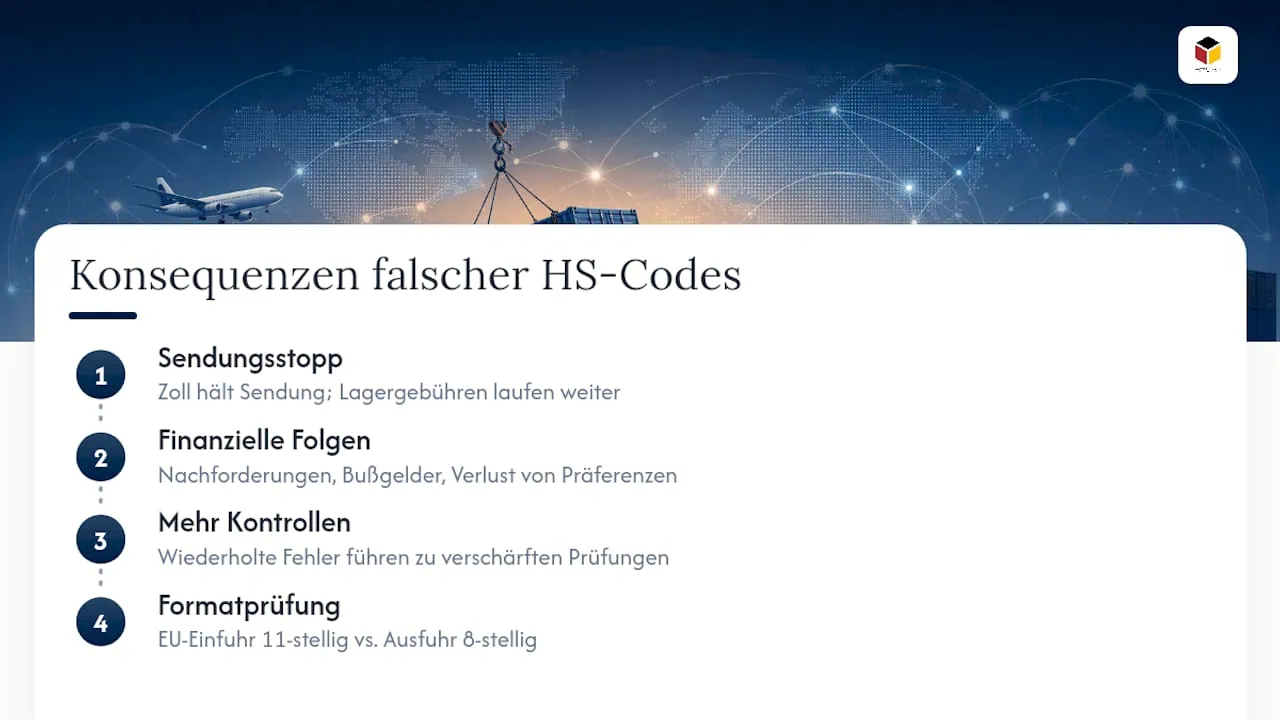
An incorrect HS code initially costs time. Customs holds the shipment, requests further documentation, and the goods are impounded while the clock continues ticking for storage fees at the freight forwarder.
The financial consequences then become concrete: back payments of import duties, in some cases fines, and, in the case of repeated violations, the loss of preferential treatment, for example under free trade agreements. A company that regularly imports under the same incorrect code also risks stricter controls for all future shipments, not just for the item in question.
An example from the practical application of format checking: For imports into the EU, a eleven-digit code number For exports, the eight-digit commodity code from the Combined Nomenclature is usually sufficient. The first six digits are based on the international HS code. Using an eight-digit export code unchanged for an import declaration will result in a formatting error that will immediately block the shipment. This check takes only a few minutes but can prevent delays of several days.
How to check an HS code: Official data sources and tools
An HS code cannot be confirmed by gut feeling. The order of the checks determines whether the result will later hold up before customs.
Five steps have proven effective in practice:
- Clarify the product description. Document the material, function, degree of processing and intended use in writing.
- Consult TARIC. The EU tariff consultation Provides the current status of EU imports, including national enlargements and measures.
- Compare with the WCO nomenclature. In international broadcasts, the current HS Edition of the WCO, whether the classification has changed due to a new edition.
- Use the trading assistant to narrow down your search. The EU Trade Assistant It helps with text-based pre-selection, but does not replace checking the section and chapter notes.
- Document the result. Archive the screenshot, source, and date of the query.
AI-powered search tools and classification tools are well-suited for narrowing down thousands of entries to a handful of candidates. However, they do not replace the final review based on annotations and rules of interpretation, as no algorithm can later be held liable to customs.
Pro tip: Create a short review note for each new product category before the first shipment goes out. This takes ten minutes and saves hours of reconstruction in the event of a customs inspection.
Step by step: Deriving the HS code according to the general rules of interpretation
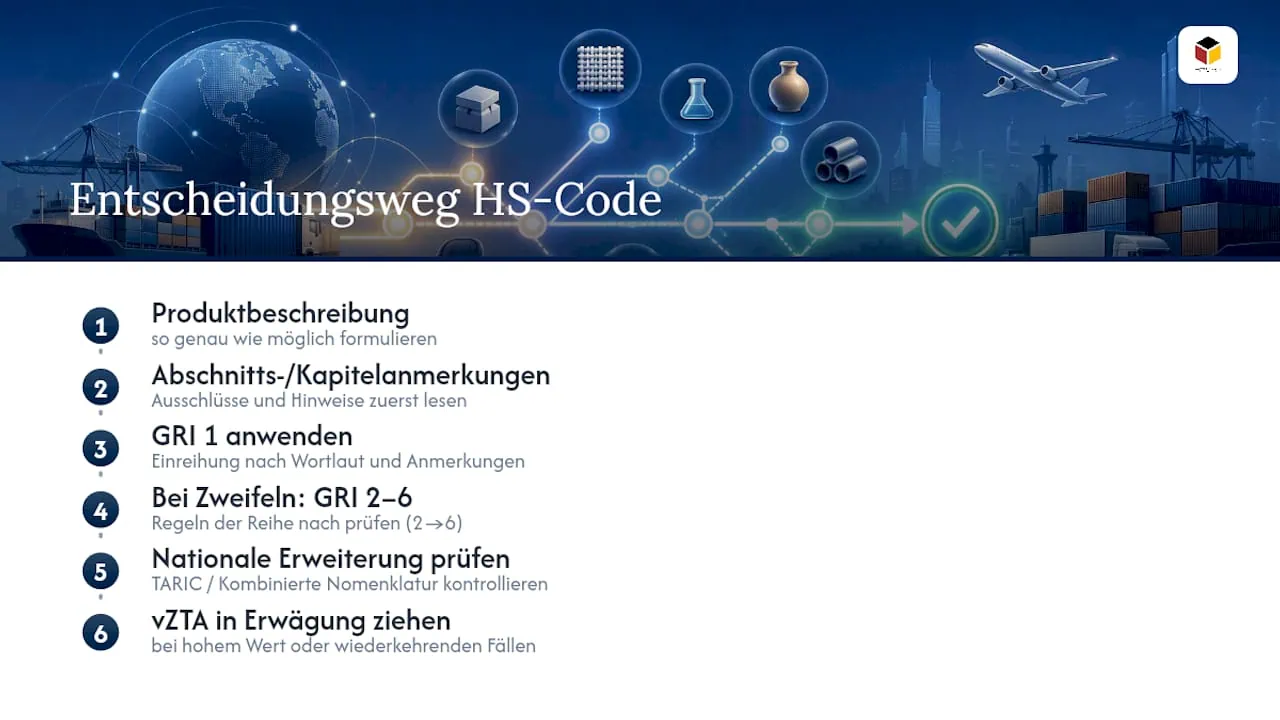
The General Rules of Interpretation (GRI), abbreviated as GRI, form the framework for any correct classification. They apply in sequence: First, it is checked whether GRI 1 applies; only if that is insufficient is the next rule applied.
GRI 1 requires the classification according to the wording of the position and the notes on sections and chapters. GRI 2 regulates incomplete or disassembled goods as well as mixtures of several substances. GRI 3 This applies to goods that appear to fit into multiple positions, such as sets. GRI 4 This is the catch-all rule for goods that cannot be clearly assigned to any position. GRI 5 Treats containers and packaging. GRI 6 transfers the logic to the sub-position level.
The practical procedure is as follows: First, formulate the product description as precisely as possible. Then, read the notes to the suspected section and chapter, as these often contain exclusions that immediately reject an obvious classification. Next, apply GRI 1 and only proceed to the following rules if there is doubt. Finally, apply the national extension via TARIC or the Combined Nomenclature Check, because the first six digits of the HS code are not sufficient for a complete EU registration.
A simple example: A shipment of goods in a plastic casing with integrated electronics is often incorrectly booked under the "plastics" category, even though the function of the electronics is the determining factor according to the notes to the section. Those who read the notes first, instead of choosing the category with the most obvious material description, are more likely to be correct.
For high-value goods, recurring borderline cases, or new product lines, a binding tariff information (BTI) ruling is worthwhile. It binds the customs authority to the classification for a specified period and creates legal certainty that an internal assessment cannot provide.
Documentation and reasonable care: What customs accepts as proof
Customs requires not only the correct code, but also proof of how it was obtained. This duty of care, known in technical jargon as "reasonable care," clearly shifts the burden of proof to the importer.
The following documents belong in every audit file:
- Technical specifications and product data sheets from the supplier.
- Photos of the goods, especially for sets or material mixtures.
- Correspondence with the supplier regarding the material composition.
- Previous customs assessments or binding tariff information decisions for comparable articles.
- Screenshot and date of the TARIC or WCO query.
This evidence should be stored in an audit log with version history, not scattered across email inboxes. If a misdeclaration is detected, it must be corrected promptly, the authorities informed, and the new explanation documented. Delaying too long can turn a simple error into suspicion of deliberate misconduct.
Pro tip: Structure the documentation so that the GRI justification for each item can be reconstructed in just a few minutes. That's exactly what a customs audit will ask for first.
Process and data measures against recurring errors
Individual corrections only solve the problem in the short term. The error rate will only become permanently reduced when master data and supplier processes are properly set up.
- Define the HS code as a mandatory field in the master data record, with clear responsibility for its release.
- Require new suppliers to provide information on material composition and customs tariff number during the onboarding process, instead of accepting their information without verification.
- Conduct quarterly reviews of the most frequently used codes against the current nomenclature edition.
- Use automated plausibility checks that immediately flag formatting errors such as an incorrect number of decimal places.
Supplier or freight forwarder details do not legally protect the importer. Liability remains with the so-called Importer of Record, regardless of who originally suggested the code. An automated Comparison of the master data It reduces precisely this source of error because it detects deviations before the shipment leaves the warehouse.
Practical examples: How to reduce HS code errors in practice
A look at industry guidelines shows how detailed the auditing process becomes in practice. Guide to HS code lengths It explains the required number of positions in each target market, a detail that is regularly overlooked in international shipments. For textiles, the Guide to the classification of textiles concrete clues, because material mixtures are particularly prone to causing errors there.
Automation is particularly effective where people work under time pressure: when creating new product listings, during mass imports from marketplaces, or when transferring supplier data into their own system. A dashboard that compares master data against current tariff data makes discrepancies visible before a shipment even leaves the warehouse. Those who also... dangerous goods-specific requirements Companies that work, for example with UN3373 shipments, benefit from the same discipline in documentation and pre-screening.
Paket International assists with customs clearance
An automated comparison with stored tariff data significantly reduces the risk of incorrect HS codes compared to a manual sample at the end of the month.
Modern shipping platforms take over the customs clearance as part of the shipping process, they automatically generate the necessary customs documents without requiring employees to manually transfer codes into multiple systems. Many systems utilize a central dashboard where audit trails and shipping statuses can be tracked, offering advantages over searching through scattered emails and Excel spreadsheets. For companies using multiple parcel services simultaneously, the system consolidates the data. Shipping platform The selection between DHL, UPS, FedEx, DPD, and DB Schenker is available in a single process. Those who currently handle their customs clearance manually can test modern solutions for their next international shipment and experience automated reconciliation in practice.
Official databases and tools for instant lookup
For quick verification of an HS code: TARIC consultation of the EU Commission, WCO nomenclature with current editions, Destatis guidelines to the Combined Nomenclature and the EU resources on customs classification.
Sources
- TARIC consultation — European Commission
- Taxation and Customs Union — Tariff Classification & Combined Nomenclature
- Destatis — Commodity Classification of Foreign Trade 2026
- WCO — HS Nomenclature (Editions and Tools)
- EU — Aid for the Trade Assistant
FAQ
How can I verify an HS code?
First, use the EU Commission's TARIC consultation to see the current status for EU imports. Then, compare the result with the current HS edition of the WCO and document the source and date of the query.
What is meant by an HS code?
The HS code is the six-digit base number from the Harmonised System of the World Customs Organization, used to classify goods uniformly worldwide. Countries such as the EU member states extend these six digits with additional national codes for statistical and customs purposes.
Is the HS code the same as the customs tariff number?
Not quite. The HS code comprises the first six digits, while the customs tariff number is the complete, nationally extended number, in the EU usually the eight-digit Combined Nomenclature or the eleven-digit TARIC number for imports.
Where can you get the HS code for a product?
The authoritative source is the TARIC database for EU imports, supplemented by the WCO nomenclature for international shipments. In case of uncertainty, a binding tariff information ruling from the relevant customs authority can be obtained, and a platform like Paket International can automate the daily checks during the shipping process.