
HS codes for textiles: Chapters 50–63 at a glance
Textiles fall under chapters 50 to 63 of the Harmonised System. The most common clothing headings are: 6109 (T-shirts, knitted) 6205 (shirts, woven) and 6309 (Household linen, used textiles). However, anyone importing or exporting goods to or from Germany needs more than the 6-digit HS number: The EU requires the 8-digit Combined Nomenclature (CN) and, for customs measures, the 10-digit TARIC code.
Quick orientation for beginners:
- Chapters 50–55: Textile raw materials and fibers (silk, wool, cotton, synthetic fibers)
- Chapters 56–60: Non-woven fabrics, carpets, lace, knitted fabrics
- Chapter 61: Clothing, knitted or crocheted
- Chapter 62: Clothing, woven or not knitted
- Chapter 63: Other made-up textiles, household linen, secondhand goods
Next step: Access the TARIC database, check the appropriate CN code and, if uncertain, request a binding tariff information (BTI).
Pro tip: When documenting your product, note the material composition, manufacturing method (knitted or woven), and intended use. This significantly speeds up both the TARIC search and any subsequent binding tariff information (BTI) application.
Key insights
Correctly classifying textiles requires the full TARIC number, not just the 6-digit HS code, because customs duties, measures and preferences only become visible at the TARIC level.
| Theme | Details |
|---|---|
| Relevant HS chapters | Textiles are covered in chapters 50–63; knitted clothing in chapter 61, woven clothing in chapter 62. |
| Number hierarchy | HS (6 digits) is extended in the EU to KN/CN (8 digits), TARIC (10 digits) and German commodity code (11 digits). |
| TARIC obligation | Customs duties and measures are only fully visible at the TARIC level; a TARIC query should be performed before each import. |
| vZTA in cases of uncertainty | For complex products or high-value goods, the vZTA/EBTI provides a legally binding classification. |
| Automation saves time | Platforms like Paket International calculate duties and automatically generate customs documents from the CN code. |
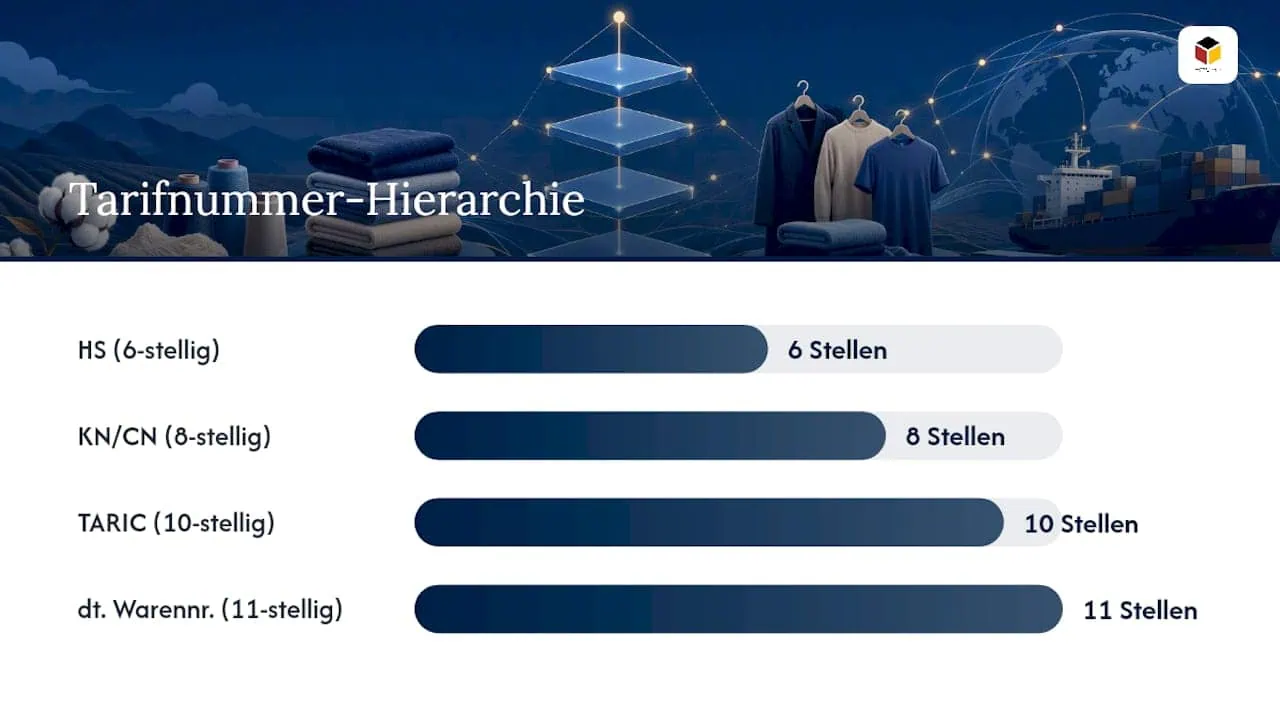
Table of Contents
- How the Harmonised System is structured and which chapters include textiles
- Which HS codes are particularly common for textiles and clothing?
- Why the 6-digit HS code is often insufficient for Germany
- Step by step: How to find the right code for your textile product
- What duties and documents are required when importing textiles to Germany?
- How automated shipping platforms simplify classification and customs clearance
- Common mistakes when sorting textiles and how to avoid them.
- Binding tariff information: When it makes sense and how the application works
- Sources
How the Harmonised System is structured and which chapters include textiles
The Harmonised System (HS) is an international standard of the World Customs Organization (WCO) with a 6-digit base number. More than 200 countries worldwide use this scheme for customs declarations, foreign trade statistics, and trade agreements.
The structure follows three levels:
- Chapter (2 places): Product group, e.g., chapter 61 for knitted clothing
- Position/Heading (4 positions): Specific type of goods, e.g. 6109 for T-shirts
- Sub-position (6 positions): Further differentiation according to material or design
Chapters 50–63 of the HS cover the entire textile field: From raw fibers (silk, wool, cotton, synthetic fibers) to yarns and fabrics, all the way to finished clothing and household linens. These 14 chapters form the basis for every customs tariff number in the textile sector.
For the EU and German context, the 6-digit HS code alone is insufficient. The EU extends the system to 8 digits (Combined Nomenclature, CN) and to 10 digits in TARIC. In certain cases, Germany adds another digit for national administration, so customs declarations here use a commodity code of up to 11 digits.
Which HS codes are particularly common for textiles and clothing?
The distinction between knitted/crocheted (Chapter 61) and woven/non-knitted (Chapter 62) is the most important classification criterion for clothing. A knitted T-shirt belongs in Chapter 61, a woven shirt in Chapter 62. In addition, material, function, and condition (new or used) determine the precise classification.
Overview of common headings:
- 6109 – T-shirts, undershirts and similar knitted goods (HS code T-shirts)
- 6110 – Sweaters, sweatshirts, vests, knitted
- 6203 – Suits, jackets, trousers for men, woven
- 6204 – Costumes, jackets, skirts for women, woven
- 6205 – Men's woven shirts
- 6206 – Blouses for women, woven
- 6309 – Used clothing and other used textiles
The chapter overview shows where HS coding for fabrics and finished goods applies:
The specific characteristics that determine the classification are: fiber type and proportion, manufacturing process (knitted or woven), function of the item, and whether it is new or used. For blended fabrics, the predominant fiber content is generally the classification criterion.
Why the 6-digit HS code is often insufficient for Germany
The 6-digit HS code is the international starting point, but more is needed for customs declarations in the EU and Germany. Number hierarchy is:
- HS (6-digit): International standard, basis for all further levels
- KN/CN (8 digits): Combined Nomenclature of the EU, binding for all EU imports and exports
- TARIC (10 digits): EU customs database with trade policy measures, tariffs and preferences
- German commodity code (up to 11 digits): National supplement for customs declarations in Germany
Customs duties, anti-dumping measures, import quotas, and preferential trade agreements are only visible at the TARIC level. Those working solely with the 6-digit HS code will not see these measures.
The EU Commission's TARIC database This is the central source for current customs duties and trade policy measures for individual CN/TARIC codes. For example, for code 6109 10 00 10, the TARIC query directly shows which duties and measures apply to imports into Germany.
For customs declarations in Germany, the full TARIC or commodity code must always be used, not the abbreviated HS code.
Step by step: How to find the right code for your textile product
- Capture product features: Material composition (e.g. 100% cotton or blended fabric), manufacturing method (knitted or woven), function (outerwear, underwear, household linen), condition (new or used).
- Narrow down HS chapters: Are we talking about raw fibers or yarns? Then see chapters 50–55. Finished clothing? See chapter 61 or 62, depending on the manufacturing method.
- Check knitted or woven materials: Chapter 61 applies to knitted and crocheted clothing, Chapter 62 to woven and non-knitted articles.This distinction is the first filter criterion for clothing.
- Perform a CN/TARIC search: Access the EU Commission's TARIC database and use search terms such as "knitted", "cotton", or "household linen". The search will provide relevant CN codes with their corresponding customs duties and measures.
- Document the result: Record the CN code, customs duty rate, relevant measures and search protocol for the customs declaration.
Documents that secure classification include: fabric samples or product photos, manufacturer's material certificates, technical descriptions, and production records. The more complete these documents are, the faster the customs clearance process.
Pro tip: In TARIC searches, specific terms yield better results than general ones. "Knitted cotton outerwear" leads to the correct heading faster than just "T-shirt".
When an expert or an automated platform makes more sense than manual searching: for blended fabrics with multiple fiber components, for technical textiles with special functions, or when large quantities of goods with many different items need to be declared regularly.
What duties and documents are required when importing textiles to Germany?
Customs duties for textiles vary considerably depending on the TARIC code. Therefore, precise classification is not a mere formality, but directly impacts import costs. Declaring with an incorrect or overly general code risks subsequent demands or delays.
Typical types of taxes:
- Customs duty rate: It is based on the TARIC code; for textiles from third countries without preferential trade agreements, rates can range from single-digit to double-digit percentages.
- Import VAT (EUSt): In Germany, the current rate is 19% on the customs value plus customs duties and transport costs; a reduced rate of 7% applies to certain goods.
- Anti-dumping or countervailing duties: Possible for certain textile imports from individual countries; visible in the TARIC database.
Required documents for textile imports:
- Commercial invoice including product description, quantity, value and country of origin
- Bill of lading or waybill
- Proof of origin (e.g. EUR.1 or declaration of origin) for preferential customs duties
- Packing List
- If applicable, conformity assessments or product certificates
Specific trade policy measures such as anti-dumping duties or import quotas must be checked exclusively via the TARIC database. Anyone who overlooks these measures may face unexpected additional costs despite having the correct CN number. Export documents They can be generated directly from the ranking results using an automated platform.
How automated shipping platforms simplify classification and customs clearance
For retailers who regularly import or export textiles, manually searching for TARIC data for each shipment is time-consuming. Automated shipping platforms like Paket International handle several of these steps directly within the shipping process.
What the platform specifically covers:
- Automatic suggestions for CN/TARIC codes based on product descriptions
- Calculation of import duties and landed costs in real time
- Creation of shipping labels and customs documents from a single interface
- Automated customs clearance without manual intervention for each shipment
- Integration with ERP systems and online shops via API or plugin
Misclassifications of textiles often arise from incomplete product data. A platform that systematically records material specifications, manufacturing method and intended use and transfers them directly to the customs declaration significantly reduces this risk and saves time on every shipment.
The practical advantage for retailers: Instead of manually researching TARIC codes and creating documents for each shipment, the entire process is automated. This is particularly relevant for online shops with a wide range of textiles, where material compositions and product categories change frequently.
Common mistakes when sorting textiles and how to avoid them.
The classification of textile goods is more prone to errors than that of many other product groups because several characteristics are decisive at the same time.
Typical mistakes:
- To confuse knitted and woven fabrics: The most common mistake of all. A knitted sweatshirt belongs in Chapter 61, not Chapter 62.
- Material information incomplete: For blended fabrics, the exact fiber content must be known. "Polyester-cotton blend" is not sufficient; the percentage determines the sub-category.
- Ignore refinements: Impregnations, coatings or functional finishes can trigger a different heading, for example in the case of water-repellent jackets.
- Misclassifying sets and complete items: A shirt and trousers set is ranked according to the main component, not the cheapest code.
- Underestimate technical textiles: Articles with a technical function (e.g. medical compression garments) often do not fall under chapter 61/62, but under other chapters.
Red Flag: If a textile product has a special function, consists of more than two fibers, or has undergone special finishing, classification should not be carried out without expert review or binding tariff information.
To prevent problems, a standardized product data sheet with fields for material composition, manufacturing method, function, and finishing is recommended. Recording this data during product setup avoids later inquiries from customs authorities and reduces processing time for customs declarations.
Binding tariff information: When it makes sense and how the application works
A binding tariff information ruling (BTI) or, at EU level, an EBTI provides legally binding clarity regarding the classification of goods. The EU EBTI database displays previously issued rulings and can serve as a guide.
When a vZTA is useful:
- In cases of high-value goods or large import volumes, where an incorrect code causes significant additional costs.
- For technical textiles or mixed products with unclear classification
- If customs authorities have asked questions about previous shipments
- For new product categories for which no prior experience exists
Steps to apply:
- Submit an application to the responsible main customs office in Germany (for national binding tariff information) or via the EU-EBTI portal for EU-wide valid information.
- Submit a detailed product description: material composition, manufacturing process, photos, technical data sheets, samples if possible.
- Please allow for processing time: Usually several weeks to a few months.
- Use the issued binding tariff information (BTI) for all customs declarations for the goods in question; it is binding on the customs authorities.
The binding tariff information (vZTA) is valid EU-wide for three years. Once applied for, it can be used for all shipments of the same goods, thus providing legal protection.
Sources
Several official and practical resources are available for researching the correct customs tariff number for textiles:
For retailers who want to automate classification and customs clearance, Paket International offers a Complete customs clearance with automatic tax calculation and document creation.