
IOSS explanation: How the tax rule for shipments to third countries works
IOSS allows you to collect import VAT on shipments from a non-EU country directly at the point of sale, instead of charging it to the customer upon delivery. You need this procedure if you sell goods with a value up to a specified maximum to private customers in the EU and the shipment originates outside the EU. Check beforehand whether your goods are stored in an EU warehouse and what reporting requirements your marketplace has, as both of these factors affect who is actually responsible for paying the tax.
In short:
- The IOSS procedure is relevant if you regularly sell goods with a value of up to €150 from a third country to private customers in the EU and the shipment starts outside the EU.
- Only warehouses in the EU or shipments with a value exceeding €150 are exempt from IOSS, which must be taken into account when planning your customs and tax strategy.
- In Germany, registration is handled by the Federal Central Tax Office; the monthly report includes the summarized sales values per EU country and the corresponding tax.
- Incorrect tax rates at checkout or duplicate reports by marketplaces pose risks of subsequent claims and delays in customs clearance.
- Automated platforms like Paket International can significantly simplify the process of tax calculation, document creation and data transfer.
Table of Contents
- Definition and legal basis of the IOSS
- For whom is the IOSS procedure relevant?
- Advantages and benefits for retailers and customers
- How does registration and monthly reporting work?
- Obligations, accounting and invoicing information at IOSS
- Limitations, exclusions and common practical pitfalls
- Practical checklist: To-dos for shop, fulfillment and accounting
- Practical solution: How to automate IOSS processes in the International Package
- Brief overview: When Paket International is the right solution for you
- Sources
- FAQ
Definition and legal basis of the IOSS
IOSS stands for Import One-Stop-Shop. This procedure allows you to declare import VAT for distance sales from a third country with a value up to a specified maximum value centrally via a single declaration, instead of registering individually in each EU member state. In Germany, the legal basis is Section 18k of the German VAT Act (UStG) in conjunction with the underlying EU regulation. The competent authority for registration is the [relevant authority/body]. Federal Central Tax Office, which handles the registration and monthly reporting via its online portal.
IOSS differs significantly from OSS, even though both names sound similar:
- iOSThis applies to imports from third countries to private customers with a tangible value up to a specified maximum value; reporting is required monthly.
- Health CareThis applies to intra-community sales between EU countries with a threshold of several thousand euros; reporting is required quarterly.
According to one VATupdate comparison Clearly distinguish: IOSS concerns the journey of goods to Europe, OSS concerns trade within Europe.
For whom is the IOSS procedure relevant?
IOSS is worthwhile for you if you regularly sell shipments from a non-EU country to private customers in the EU. Both EU-based and non-EU companies can register, but there is an important difference regarding the intermediary obligation.
For the broadcast to actually fall under IOSS, three conditions must be met:
- The transport begins outside the EU.
- The recipient is a private individual, not a company.
- The material value of the shipment is at most the specified maximum value.
Non-EU companies generally need an intermediary based in the EU for registration. This intermediary assumes liability risks and, according to [relevant regulations/guidelines], conducts checks. Stripe often in advance which customers and products he will accept, which can significantly differ costs and conditions depending on the shipment volume.
Advantages and benefits for retailers and customers
The biggest advantage of IOSS lies in the checkout process: you collect VAT at the point of sale, so your customers won't receive an unexpected additional charge from customs upon delivery. This significantly improves the shopping experience.
Pro tip: Prepaid taxes reduce delivery complaints and returns, which Stripe says can have a positive impact on the conversion rate.
Further advantages at a glance:
- No additional customs charges for the recipient, resulting in fewer support requests.
- One reporting channel for all of Europe instead of individual registrations in each member state
- Faster customs clearance thanks to the verified IOSS number at the border
The EU Commission estimates that IOSS significantly reduces the administrative burden for traders because registrations in individual EU member states This effect has been eliminated. Since the abolition of the previous import duty-free allowance of €22, this effect has been reduced for traders with high volumes from third countries, according to... Munich Chamber of Commerce and Industry This has become even more relevant, as almost every shipment now has to be recorded for tax purposes.
How does registration and monthly reporting work?
The registration process follows clear steps:
- Select portalEU-based companies register via the BZSt portal, non-EU companies via an intermediary in any EU member state.
- Check effectiveness: Registration is generally valid from the first day of the month following application, in some cases even earlier if the notification is made in good time before the start of sales.
- IOSS number obtained: After successful registration, you will receive an individual IOSS identification number, which you should enter in checkout, invoices and customs documents.
- Report monthlySubmit your IOSS declaration by the end of the following month, broken down by destination country and the applicable tax rate.
The report itself doesn't require complicated information, but it does require accuracy: total sales value per EU country, tax rate applied, and tax paid. An error in this breakdown will quickly lead to inquiries from the tax authorities.
Obligations, accounting and invoicing information at IOSS
Anyone using IOSS also assumes a record-keeping obligation that goes beyond mere reporting. They must document every transaction in such a way that an audit remains traceable at any time, and retain these documents for ten years.
Specifically, this includes:
- Order number, value of goods and destination country of each shipment
- The applicable tax rate of the destination country and the tax amount shown on the invoice.
- The IOSS number, complete and correct on shipping documents and customs declarations.
Customs checks the IOSS number against an EU-wide database upon import. According to the Federal Central Tax Office (BZSt), if a valid number is found, customs clearance is automated and no additional tax is levied at the border.
Limitations, exclusions and common practical pitfalls
IOSS only applies to shipments with a value of up to €150. If the value exceeds this, the standard import procedure applies, including regular import VAT and, where applicable, customs duties, regardless of whether you otherwise use IOSS.
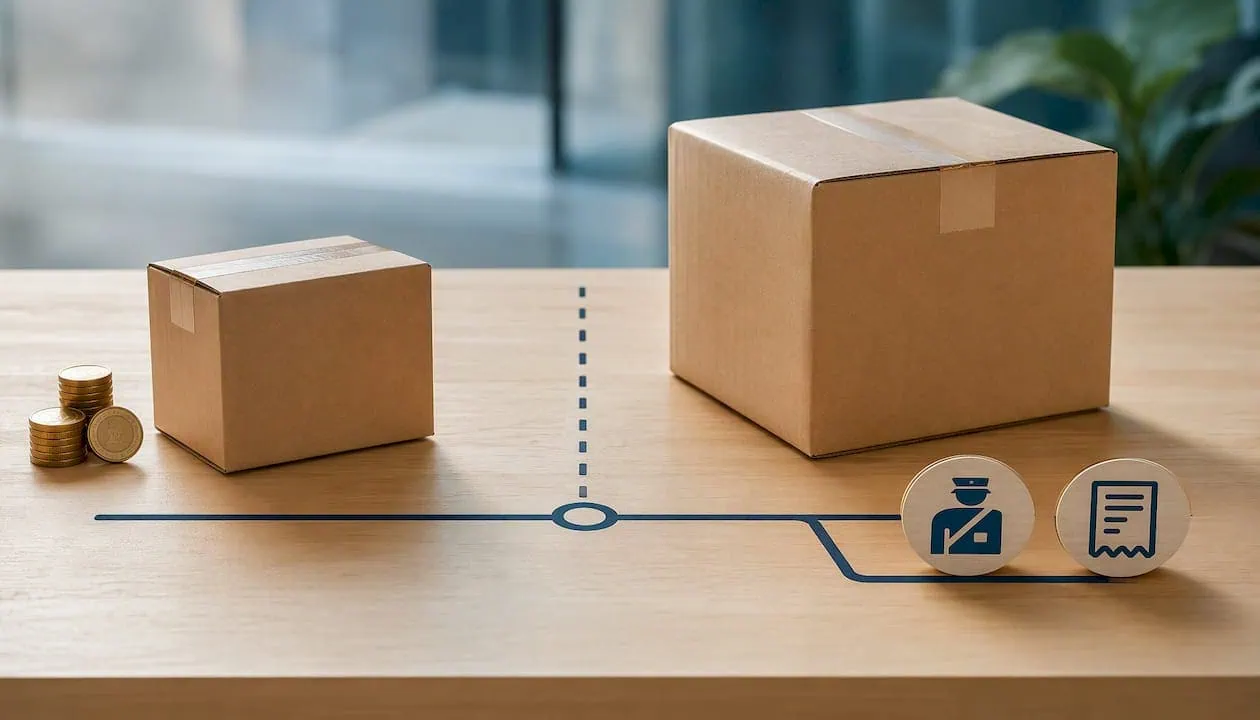
A second common mistake concerns the storage location: If your goods are already in an EU warehouse, it is no longer considered an import from a third country, but an intra-Community sale. In this case, OSS is the appropriate regulation, not IOSS.
Other pitfalls in practice:
- Marketplaces such as large online platforms assume the reporting obligation themselves in certain situations; in such cases, the merchant is not allowed to report twice.
- Incorrectly applied IOSS leads to additional tax demands and significantly delays customs clearance.
- Understating the value of an asset in the declaration is considered tax evasion, not a minor offense.
Pro tip: For each new sales channel, clarify individually who is responsible for the IOSS reporting. Marketplace regulations vary, and duplicate or missing reports are usually only noticed during an audit.
Practical checklist: To-dos for shop, fulfillment and accounting
The implementation is divided into three areas that must work closely together:
- Checkout: During the ordering process, enter the correct tax rates for each destination country and calculate the tax before payment, not afterwards.
- Fulfillment and shipping documents: Automatically transfer the IOSS number to every customs declaration and shipping label to prevent any manual entry being forgotten.
- AccountingExport the transaction data monthly by destination country and compare it with the submitted IOSS declaration before the deadline expires.
Pro tip: An IOSS data layer in the checkout, which bundles the IOSS number, destination country tax rate and product classification in one place, makes the monthly export almost completely automated and significantly reduces the reconciliation effort.
An incorrectly maintained tax rate in the checkout process leads to under-collection. This not only reduces the profit margin but also increases the likelihood of subsequent tax assessments by the tax office, as described in VATupdate analyses. More information on the tax details surrounding this topic can be found here. Import sales tax and to de minimis limit You can find this information in the respective guides.
Practical solution: How to automate IOSS processes in the International Package
Manually managing tax rates, IOSS numbers, and customs documents is time-consuming and precious in a growing e-commerce business. Paket International combines checkout, shipping providers, and customs clearance into a single platform that automates these steps.
Specifically, the platform takes over:
- Calculate shipping costs, customs duties and guaranteed landed costs in seconds.
- Automatic creation and transmission of customs documents including the IOSS number, without manual input.
- A central dashboard for shipment tracking and data exports, which serve as supporting documentation for your monthly report.
For retailers with regular shipments to third countries, this reduces the effort that would otherwise be lost between the shop system, shipping service provider and accounting.
Brief overview: When Paket International is the right solution for you
If your shop ships a high percentage of packages to third countries, operates multiple sales channels simultaneously, or uses dropshipping, manual IOSS maintenance quickly becomes a bottleneck. Paket International takes care of precisely this part of the shipping process, so you don't have to worry about tax rates and customs data for each country individually.
The platform connects systems, shipping providers, and customs services into a seamless process. Customs clearance is automated, the IOSS number is directly transferred to the customs declaration, and a central dashboard displays every shipment in real time. Those who connect to their shop system via API or plugin also avoid the need for duplicate data entry between checkout and shipping.
Check the page for International shipping with professional customs clearanceFind out which shipping option suits your shipment volume and start with a non-binding calculation of your current Landed Costs.
Sources
- Import One-Stop-Shop (BZSt)
- Import One-Stop-Shop: IOSS explained | Stripe
- IOSS/OSS (Munich Chamber of Commerce and Industry)
- EU Commission – One-Stop-Shop Resources
- OSS vs IOSS – VAT update
FAQ
What is the difference between OSS and IOSS?
IOSS applies to imports from a third country to private customers with a value of up to €150 and is reported monthly. OSS, on the other hand, applies to intra-Community sales between EU countries with a threshold of €10.000 and quarterly reporting.
When do I pay import VAT?
Without IOSS, import VAT is collected during customs clearance, often resulting in a subsequent demand for payment from the recipient. With IOSS, you collect the tax at the time of sale, so no additional payment is required upon delivery.
What is the IOSS tax and how does it work?
IOSS is not a separate tax, but a reporting procedure for the existing import VAT on distance sales from third countries up to a value of €150. You collect the tax amount at checkout and report it centrally on a monthly basis via the Federal Central Tax Office (BZSt) or an intermediary.
Where can I find my IOSS number?
You will receive your IOSS identification number after successful registration via the BZSt portal or via your intermediary if you are a non-EU company. You then enter this number in the checkout process, on invoices, and in every customs declaration, for example, when using [method of payment/declaration]. International Package Automate your customs processes.