

For individuals and SMEs: Use CETA and avoid additional charges when shipping to Canada
Yes, packages can easily be sent from Germany to Canada. However, every shipment is subject to customs duties and requires the correct documentation: a customs declaration (CN22 or CN23) and, for higher-value items, a commercial invoice. Additionally, import duties such as customs and GST/HST are often levied in Canada. Platforms like Paket International calculate these costs and automatically generate the necessary documents before the package even leaves the post office.
In short:
- For shipments to Canada, in addition to a customs declaration (CN22 or CN23), the correct documents and proper valuation are always essential to avoid additional costs.
- For private shipments, the tax-free allowance is a maximum of 20 Canadian dollars, while for commercial shipments a precise classification according to customs tariff numbers is necessary.
- In Canada, customs duties, GST and provincial taxes typically range from 5 to 15 percent of the value of the goods, although preferential certificates of origin can reduce the tariff.
- For fast and smooth processes, we recommend choosing express shipping, which usually takes 2 to 5 working days and electronically registers customs clearance in advance.
- Automated platforms like Paket International simplify customs clearance for regular shipments through automatic document creation and transparent landed costs.
Table of Contents
- Brief overview: Important rules, responsibilities and boundaries
- Customs formalities from Germany: CN22, CN23 and export declaration
- How does Canadian customs calculate import duties?
- Which shipping method is suitable: Express, Parcel Post or Standard?
- Private shipping: Gifts, allowances and prohibited goods
- What do SMEs need to consider when shipping to Canada?
- Automated customs clearance for shipments to Canada
- Sources
Brief overview: Important rules, responsibilities and boundaries
From a customs perspective, Canada is considered a third country. This means that customs documents are required for every shipment, regardless of whether it's a small gift or an entire delivery of goods. EU single market rules do not apply here.
It's also important to distinguish between private and commercial shipments. Private individuals sending a gift usually only need a simple CN22 declaration. Businesses, on the other hand, often have to provide a full commercial invoice including the customs tariff number, as Canadian authorities scrutinize commercial shipments more closely.
And who ends up paying the bill? That depends on the chosen shipping method:
- DDP (Delivered Duty Paid): The sender covers customs duties and taxes upon shipment.
- DDU (Delivered Duty Unpaid): The recipient in Canada pays the duties locally upon delivery.
- In practice, the DDU model still often dominates for private shipments, which can lead to unpleasant surprises for the recipient.
Customs formalities from Germany: CN22, CN23 and export declaration
For exports from Germany, there is a clear rule of thumb: For goods valued up to €300, the simple customs declaration CN22 is usually sufficient. Above this amount, or for commercial shipments, the more detailed CN23 is required, supplemented by a Commercial invoice including product description, value, country of origin and sender details.
For certain quantities of goods, commercial exports, or specific products, a simple declaration is no longer sufficient. In these cases, a formal export declaration via the ATLAS system is required, resulting in an export accompanying document (EAD). The process typically follows this procedure:
- Check the value of the goods and the type of shipment to determine whether the registration requirement applies.
- Register in the ATLAS system of the customs administration or commission a service provider to do so.
- Enclose the generated export accompanying document with the shipment or hand it over to the courier service.
- Only after approval will the package be shipped to Canada.
However, for most private parcels and smaller business shipments, this step is unnecessary as long as the shipment complies with the Universal Postal Convention.
Pro tip: Please complete the goods description on the CN22 or CN23 form in English or French if possible. Canadian customs officials process shipments with clear, bilingual descriptions significantly faster than those with vague German terms like "gift" or "sample."
How does Canadian customs calculate import duties?
The basis for calculating import duties is generally the transaction value of the goods, i.e., the price actually paid or payable. Depending on the type of goods, the Canada Border Services Agency The shipping costs and sometimes also the insurance are included before the customs duty is applied.
Several taxes and fees are then added to this value:
- The actual customs duty rate depends on the customs tariff number of the goods.
- The nationwide Goods and Services Tax (GST) of 5%.
- Depending on the province, an additional Harmonised Sales Tax (HST) or a provincial sales tax may apply.
Customs duties, GST and provincial taxes add up in Canada depending on the province and type of goods. approximately 5 to 15% of the value of the goods – a range that can hardly be reliably predicted without knowledge of the exact customs tariff number.
Those who ship goods of German or European origin can benefit from CETA: The free trade agreement allows duty-free or reduced imports for many product groups, provided the preferential origin This must be correctly proven. Without this proof, the recipient pays the full standard rate, even if the goods would actually be eligible for preferential treatment.
Which shipping method is suitable: Express, Parcel Post or Standard?
The choice of shipping method not only determines the delivery time but also how smoothly customs clearance proceeds. Express courier services often handle customs formalities themselves and electronically notify Canadian customs authorities of shipments in advance. This significantly speeds up the clearance process.
- Express courier: Delivery time is usually 2 to 5 working days, higher price, but significantly smoother. customs clearance through electronic advance notification.
- International Merchandise Mail: A cheaper option for light private packages, however with durations of approximately 1 to 2 weeks.
- Standard shipping: Attractively priced, but more prone to delays due to strikes, holidays, or high shipping volumes.
For valuable or time-critical shipments, the express service is almost always worthwhile, as a functioning Shipment Tracking It provides additional security. For small, low-value shipments, International Merchandise Post is usually sufficient, as long as you can allow for the longer delivery time.
Private shipping: Gifts, allowances and prohibited goods
Private gift shipments to Canada remain duty-free and tax-free up to a value of CAD 20. This limit is significantly lower than many expect, and it applies only to actual gifts between individuals, not to merchandise orders.
Simply labeling an item as a gift is not enough if the customs officer doubts its value or the type of goods seems suspicious. Certain goods are prohibited or severely restricted anyway.
- Alcohol and tobacco products, even in small quantities.
- Certain foods, especially fresh meat and dairy products.
- Plants, seeds and animal products without the appropriate certificates.
- Cash exceeding certain thresholds and unexplained jewelry.
Pro tip: If a shipment is refused at the border, you risk return costs and additional storage fees. It's better to check the CBSA's list of prohibited goods too often than to have to retrieve a package later.
What do SMEs need to consider when shipping to Canada?
Small and medium-sized enterprises (SMEs) should take a closer look at CETA. The entitlement to duty-free or reduced rates requires that the goods were actually processed or manufactured in the EU and that valid proof of origin is available, for example, via a declaration on the commercial invoice.
Equally crucial is the correct customs tariff number. An incorrectly chosen number not only leads to incorrect duties but also to delays at the border and, in the worst case, to additional charges being levied on the customer. Anyone who regularly ships to Canada should therefore rely on automated calculation rather than estimates.
- Document CETA proofs of origin systematically, instead of only looking for them when making a complaint.
- Determine customs tariff numbers correctly once and store them for recurring products.
- Use automated platforms like Paket International to calculate Landed Costs transparently in advance and integrate them directly into ATLAS export processes.
Automated customs clearance for shipments to Canada
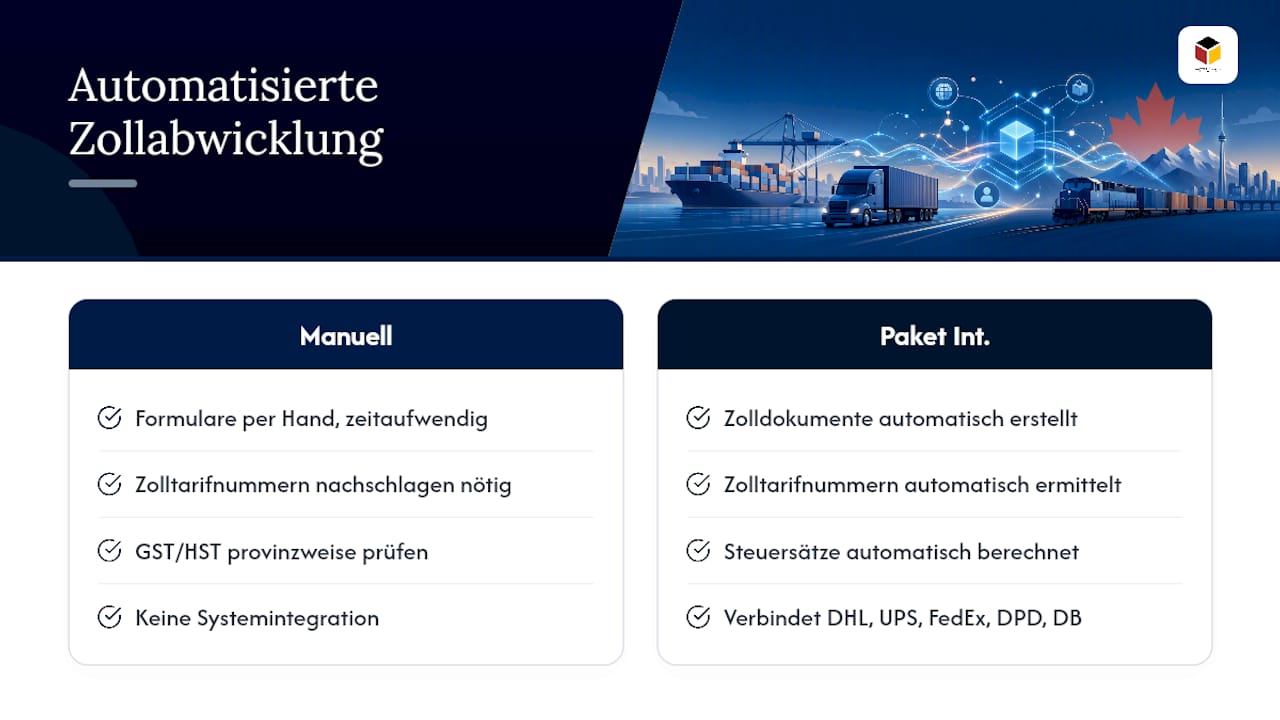
Manually filling out customs forms, looking up customs tariff numbers, checking GST and HST rates by province: Paket International takes care of all this work for companies that regularly ship to Canada. The platform calculates shipping costs and import duties in seconds and automatically generates the necessary customs documents, eliminating the need for anyone to manually check each shipment.
The difference compared to traditional shipping methods via postal service or freight forwarder lies in the details: Instead of creating CN23 forms and commercial invoices individually, Paket International connects the systems of DHL, UPS, FedEx, DPD, and DB Schenker with a central dashboard. Customs clearance is automated, shipment tracking remains accessible at all times, and the calculation of landed costs prevents customers in Canada from being surprised by unexpected additional charges. This is particularly beneficial for CETA shipments, as the platform integrates certificates of origin and customs tariff numbers directly into the shipping process.
Who his International shipping with professional customs clearance Anyone who wants to put it on a reliable basis can test the platform directly for the next Canada shipment and view the cost calculation in real time.
Sources
For more in-depth checks, it is worth consulting official sources directly: Zoll.de for German export regulations, the Canada Border Services Agency for Canadian import regulations, and GTAI for practical import instructions for commercial shipments.
- tariff
- Canada Border Services Agency (CBSA)
- Logistics Journal — Parcel to Canada: Providers, Costs & Customs
- Germany
- DHL — Parcel to Canada (Private Customers)