
Importers: Calculating Landed Cost, formula and practical example (1.000 units)
Calculating the landed cost means combining the product price, freight, insurance, customs duties, taxes, and other fees into a single sum. The formula provides the actual unit price of an imported good as soon as it arrives at the customer's location. This allows importers to recognize their true margin instead of relying solely on the purchase price. Knowing this value enables realistic sales price calculations and avoids costly miscalculations regarding import VAT.
In short:
- An accurate Landed Cost calculation includes all costs such as freight, insurance, customs duties and taxes to determine the actual unit price upon arrival.
- Errors in HS codes and insufficient consideration of incidental costs can lead to significant deviations in the calculation.
- Automated systems with real-time data significantly reduce errors and accelerate the process when there is a high transmission frequency.
- The allocation of costs to individual products should be based on value, weight, or fixed fees to ensure realistic unit costs.
- A structured approach to document procurement and calculation avoids forgotten costs and optimizes price planning.
Table of Contents
- Which cost components should be included in the landed cost calculation?
- What is the exact formula and what does a calculation example look like?
- How do you correctly allocate ancillary costs to individual products?
- Which errors most frequently distort the landed cost?
- When does automated software for calculation become worthwhile?
- In what order do you practically approach the calculation?
- Automated customs clearance for importers with high shipment frequency
- Sources
Which cost components should be included in the landed cost calculation?
A correct landed cost calculation begins with the product price, usually based on FOB (Free on Board) or EXW (Ex Works). Both Incoterms determine at what point the buyer pays for transport and risk, which directly impacts the final amount. Depending on where responsibility changes, different cost components are added.
You should systematically record the following items before you begin. Calculation of acquisition costs begin:
- freight chargesSea, air or land freight, each with its own cost drivers such as volume, weight and transit time.
- Insurance: protects against transport damage and is usually calculated as a percentage of the goods' value
- Packaging and handlingCosts for loading, handling and storage at the terminal
- Port and inland feesTerminal fees, customs yard, onward transport to the warehouse
- Customs duties: depending on the HS code of the goods and the country of origin
- Import sales tax: is levied on the value of the goods plus customs duties and freight.
- Broker and bank feesCustoms agency, letters of credit, bank transfer fees
- Exchange rate markupsFluctuations between order and payment
Each of these positions can Arrival costs The price should be significantly higher than the pure purchase price. Anyone who forgets a single item underestimates their actual unit costs and calculates selling prices too tightly.
What is the exact formula and what does a calculation example look like?
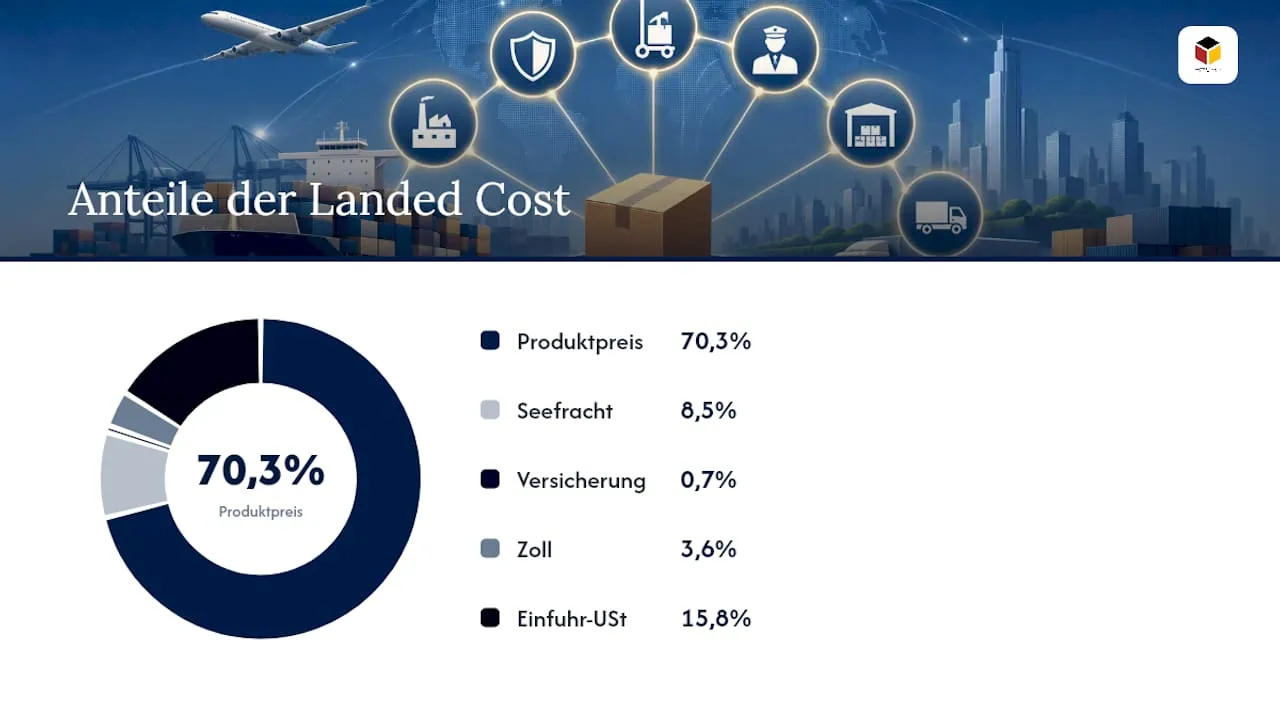
The basic formula remains the same in almost every textbook and specialist source: Landed Cost = Product Price + Freight + Insurance + Customs Duties + Taxes + Other Charges. Customs duties are not calculated on the final price, but on the customs value, which is usually the value of the goods plus freight and insurance up to the EU border. The relevant HS code determines the applicable customs duty rate, so careful classification before the initial calculation is worthwhile.
An example makes this more tangible. An importer orders 1.000 units of an electronic item at US$8 each FOB, totaling US$8.000. The exchange rate is US$1,08 per euro, so the US$8.000 is approximately €7.407.
- Product price: €7.407
- Sea Freight€900 for the entire container share
- Insurance: 1% of the value of the goods, i.e. approximately €74
- Customs value: €7.407 + €900 + €74 = €8.381
- Customs duty (assumed 4,5% according to HS code): €377
- Basis of assessment for import VAT: €8.381 + €377 = €8.758
- Import VAT (19%): €1.664
- Broker and bank fees: €120
The landed cost of this shipment is therefore €7.407 + €900 + €74 + €377 + €1.664 + €120 = €10.542. Divided by the number of units, this results in a unit price clearly higher than the original FOB price. This figure determines whether the planned selling price even allows for a viable margin. Anyone who only roughly estimates the total landed cost risks miscalculating the margin by several percentage points at this point.
How do you correctly allocate ancillary costs to individual products?
As soon as a shipment contains multiple items, the question of allocation arises. Not every type of cost can be distributed equally, and the wrong method significantly distorts the unit costs of individual products.
- Value-based allocation: suitable for customs duties and insurance, as both are based on the value of the goods anyway.
- Weight- or volume-based allocation: useful for sea freight and air freight, because freight rates are usually calculated per cubic meter or kilogram.
- Unit-based distribution: suitable for fixed fees such as document fees or port fees per shipment
A mixed container with three products clearly illustrates the difference. Product A is light but valuable, product B is heavy and inexpensive, and product C falls somewhere in between. If freight is allocated by value instead of weight, product A carries a disproportionately high freight share, while product B is calculated too cheaply. Systems like Odoo therefore support mixed allocation methods for each cost type, which significantly increases the accuracy of individual product costing.
Which errors most frequently distort the landed cost?
The biggest source of error remains incorrect HS code classification. A single incorrect code can change the customs duty rate by several percentage points, thus invalidating the entire calculation. Importers also frequently underestimate ancillary costs such as port handling or customs clearance, which together can add a significant surcharge to the FOB price.
Unrealistic exchange rate assumptions are another classic pitfall, especially with longer payment terms between order and delivery. Waiting charges, post-inspections, or short-term carrier surcharges often only appear in the final invoice and are missing from the original calculation. With consolidated shipments, improper allocation can lead to some products appearing profitable while others incur losses unnoticed.
Pro tip: Run each landed cost calculation once with a realistic exchange rate and once with a slightly less favorable one. If the margin deviates by more than two to three percentage points, you should consider hedging against the exchange rate.
When does automated software for calculation become worthwhile?
Manual Excel spreadsheets work for individual shipments, but quickly reach their limits as tariffs, HS codes, and exchange rates change constantly. Automated calculators require at least the HS code, the value of the goods, the agreed Incoterm, the shipping method, and the shipment's dimensions, weight, and insured value as input data. If any of this information is missing, any estimate will be inaccurate.
Real-time data on customs duties and exchange rates This significantly reduces errors compared to manual calculations because tariff changes take effect immediately, rather than only with the next table update. A simple online calculator often only covers standard cases and reaches its limits with consolidated containers, multiple HS codes, or fluctuating freight rates.
- Tariffs and HS references must be regularly updated, otherwise miscalculations regarding customs duties will occur.
- Integrated platforms combine customs data, freight rates, and exchange rates in a single dashboard.
- Automation significantly reduces the time from order placement to approved cost calculation.
Paket International combines these data sources in an automated process and calculates shipping costs and customs duties in seconds, instead of compiling them manually. This closes the gap between a simple online calculator and a fully integrated calculation system.
In what order do you practically approach the calculation?
A structured approach prevents individual cost categories from being overlooked. Gather all relevant documents first before you begin the actual calculation.
- Commercial invoice and packing list procure, including precise product description
- HS code Define for each item of goods or have it confirmed by a customs expert
- Incoterm Check to determine which costs are already included in the product price.
- Freight, insurance and handling costs obtain per shipment
- Customs value and customs duty rate calculate using the HS code
- Import sales tax Determine based on customs value plus customs duties
- Document the result and release for accounting and pricing decisions
Before final approval, a plausibility check is recommended: If the calculated Landed Cost is significantly higher or lower than comparable previous shipments, you should review the input values. The exact distribution of costs and responsibilities between buyer and seller depends on the agreed terms. Incoterms, which also determine which fees should be included in your own calculations.
Automated customs clearance for importers with high shipment frequency
Those who import regularly benefit from a platform that combines customs calculation and shipping costs in one step, instead of maintaining spreadsheets and customs forms individually. Such a platform connects systems, parcel services, and customs services in an automated process and calculates landed costs and customs duties in seconds.
The platform compares offers from DHL, UPS, FedEx, DPD, and DB Schenker, handles customs clearance automatically, and displays all shipments in a central dashboard. This is particularly beneficial for high-frequency shipments, where any miscalculation is repeated across many orders.
Anyone who no longer wants to manually maintain their own landed cost calculation will find information on the page. International shipping with professional customs clearance Get an overview of the automated calculation and can directly request a quote or a demo.
Sources
- Calculating acquisition costs: Import duties, freight and actual product costs | ECOSIRE
- Landed Cost – UNIS Freight & Logistics Glossary