
Customs and shipping to Mexico: What German shippers need to know
Shipping between Germany and Mexico is possible, but requires meticulous customs formalities on both sides. Anyone sending goods should clarify three things before even packing the first box: the correct HS code, the rules of origin for potential customs benefits, and a complete set of documents. For sellers, the choice of Incoterm and, depending on the circumstances, a local import representative through the Padrón de Importadores (Importer's Representative) also determine whether a shipment arrives smoothly or gets stuck in customs for days.
In short:
- For swift customs clearance in Mexico, correct classification according to HS code and proof of origin are essential to avoid delays.
- The EU-Mexico free trade agreement reduces tariffs only if origin rules are met and proof of preferential origin is provided, without VAT reduction.
- For imports to Germany, the customs duty depends on the HS code; in addition, German import VAT is levied on the customs value.
- For Mexican customs clearance, digital documents such as commercial invoice, packing list and proof of origin are required, and errors can lead to significant delays.
- Parcel shipping to Mexico automates customs clearance and reduces potential errors, which can lower overall costs by up to 80%.
Table of Contents
- EU-Mexico Free Trade Agreement: Which tariffs actually apply?
- Customs law in Mexico: HS codes, VAT, IEPS and clearance fees
- Importing to Germany from Mexico: Customs duties and import VAT
- These documents and portals determine the processing.
- How long does customs clearance really take?
- Padrón de Importadores, DDP limits and non-tariff hurdles
- Checklist: How German shippers prepare their shipments
- Returns from Mexico: What to consider during customs clearance
- Special tariffs and anti-dumping measures on Mexican imports
- Who do you contact with customs questions in Mexico?
- Paket International handles customs clearance for you
- Sources
- FAQ
EU-Mexico Free Trade Agreement: Which tariffs actually apply?
The EU-Mexico Association Agreement reduces tariffs on a large portion of trade, but not automatically. The preferential treatment only applies if a product meets the agreement's rules of origin and a valid proof of preferential origin is provided. full agreement text including rules of origin It is available for viewing at EUR-Lex, and anyone who regularly ships to Mexico should read this text in its entirety at least once.
The origin of goods is not determined by where they are shipped from, but by where they were actually manufactured or substantially processed. A product assembled in Germany with predominantly Chinese components often does not meet the origin rules, even if it is shipped from Hamburg. This is precisely where many preferential treatment applications fail in practice.
Preferential treatment usually requires:
- A certificate of origin that proves the origin of the goods according to the criteria of the agreement.
- Correct classification according to HS code is necessary because the rules of origin differ depending on the product group.
- Complete documentation of intermediate products is required if the goods are composed of products from several countries.
- An invoice declaration or a corresponding certificate, depending on the value of the goods and the trade route.
Not every product category benefits to the same extent. GTAI points out that Mexico temporarily Tariff increases for certain product groups These measures are imposed, for example, to protect domestic industries. Such measures are usually temporary, but can also affect goods that are generally covered by the free trade agreement. Exporters should check before each large shipment whether their product category is currently subject to such a special measure. Checking current customs declarations should therefore be routine, not the exception.
It is also important to note that the agreement does not protect against Mexican import VAT. It merely reduces or eliminates the customs duty, while IVA and, where applicable, IEPS are still levied.
Customs law in Mexico: HS codes, VAT, IEPS and clearance fees
Mexico calculates import duties according to a fixed scheme consisting of four components: the customs duty rate according to the HS code, the value-added tax (IVA), any applicable excise duty (IEPS), and the customs clearance fee. Knowing these four items allows you to realistically calculate landed costs instead of being surprised by the customs bill at the end.
Like almost every country, Mexico uses the international Harmonized System, but extends the six-digit HS codes in its own customs tariff by adding extra digits. Chapter 98 contains this information. special regulations For special cases such as samples or returns. An incorrect classification not only leads to an incorrect customs duty rate, but can also trigger a completely different inspection obligation, such as NOM certification, which would not have been necessary for the actual goods.
The basis for calculating all duties is the CIF value: value of goods plus transport costs plus insurance up to the Mexican border crossing. Anyone who only declares the pure value of the goods and lists freight or insurance separately risks a subsequent demand for payment, because customs will recalculate the CIF value themselves.
The four cost categories at a glance:
- Customs duty rate: depending on the HS code, with or without preference from the free trade agreement
- VAT: Standard tax rate of 16% of the customs value plus import duty
- IEPS: Excise tax on certain product groups such as tobacco, alcohol or sugary drinks
- Customs clearance fee: usually 0,8% of the CIF value, but in fixed preference agreements sometimes calculated as a fixed amount, according to GTAI. for example, 425,44 Mexican pesos
Pro tip: Don't just factor in IEPS for obvious luxury goods. Certain confectionery, energy drinks, and pesticides are also subject to excise tax in Mexico, something many German exporters initially overlook.
The IVA of 16% This applies almost universally to commercial imports, regardless of the country of origin. The free trade agreement with the EU therefore only affects the customs duty, not this tax. Anyone who calculates solely based on the customs duty and forgets VAT regularly underestimates the actual tax burden by several percentage points of the goods' value.
Importing to Germany from Mexico: Customs duties and import VAT
The reverse process, i.e., the import of Mexican goods to Germany, follows EU customs law and functions fundamentally differently than Mexican imports. Here, too, the customs value is the basis: the value of the goods, transport costs, and insurance up to the EU's external border.
In Germany, in addition to customs duties, import VAT is levied. This VAT is based on the applicable VAT rate and is calculated on the customs value plus customs duties. As in Mexico, the actual customs duty rate depends on the HS code. Textiles, electronics, and foodstuffs often fall within different ranges, and preferential rates from the EU-Mexico agreement also apply here, provided the proof of origin is valid.
One practical difference concerns the method of processing:
- Small parcel shipments are usually handled by the parcel service provider, who takes care of the customs declaration on behalf of the recipient.
- Larger freight shipments by air or sea usually require a formal customs declaration by a freight forwarder or customs agent.
- For parcel shipments, the administrative effort for private individuals is lower, but the traceability of the exact calculation of duties is often worse.
- Freight shipments offer more control over documentation, but incur higher fixed costs per shipment.
The choice of Incoterm significantly alters the risk. With DAP (Delivered at Place), the buyer in Germany bears the import duties and must handle the customs declaration themselves, which often leads to delays for private customers because they are unfamiliar with the process. With DDP (Delivered Duty Paid), the seller in Mexico assumes all duties and customs clearance, which is more convenient for the buyer but requires the seller to be registered with customs authorities in Germany or to appoint a representative. For German companies purchasing from Mexico, it is almost always worthwhile to clearly stipulate in the contract who bears which duties before the goods are even shipped.
These documents and portals determine the processing.
Without the correct paperwork, every shipment to Mexico will be held up in customs, regardless of the value of the goods. The Mexican customs authority, SAT, now handles import declarations entirely digitally via the [system name missing in original text]. VUCEM Portal This is where the importer or their customs agent submits the electronic declaration, called a pedimento. Anyone who thinks they can still salvage anything at the airport with paper documents is mistaken: Without documents submitted digitally in advance, a shipment won't even be released for inspection.
The following documents should be available for every commercial shipment:
- Commercial invoice including the exact value of the goods, a complete item description, HS code, and the Incoterm used.
- Packing List including weight, dimensions and quantity per package
- Freight document of the respective carrier, such as the air waybill or the bill of lading
- Proof of origin or preferential document, if the customs benefit from the EU-Mexico agreement is claimed.
- NOM conformity certificates, if the product group is subject to a Mexican standard, such as electrical appliances, toys or certain foodstuffs
The NOM standards (Normas Oficiales Mexicanas) are non-tariff requirements that apply independently of customs duties and taxes. An electrical appliance without a valid NOM certificate will be held up at the border, even if customs duties and VAT have been calculated correctly. Therefore, it is worthwhile to check whether your product category is affected as early as the quotation stage, and not just when shipping.
The most common errors on commercial invoices are surprisingly simple: an understated value of goods, a missing or incorrect Incoterm, and an inaccurate description of goods without an HS code. All three errors lead to inquiries from Mexican customs, and each inquiry takes days.
Pro tip: Describe the goods on the commercial invoice as specifically as possible, including the material and intended use. "Textile goods" is not sufficient for customs officials, but "cotton shirt, men's, leisure wear" is.
How long does customs clearance really take?
With complete documentation and correct classification, customs clearance in Mexico often takes only one to three working days, confirms the German-Mexican Chamber of Commerce (AHK Mexico) in its [document/report/etc.]. Assessment of the complexity of Mexican customs lawIf even one document is missing, this period can easily double or triple because inquiries are handled through the customs agent and not clarified directly with the sender.
Three factors most frequently delay processing:
- Incomplete or contradictory information between the commercial invoice, packing list, and shipping document
- NOM conformity testing for product groups that require certification but arrive without the corresponding proof.
- A missing or outdated import registration of the recipient in the Padrón de Importadores
The Mexican tax authority made adjustments to courier and shipping tariffs in 2025, which, according to media reports, affect thresholds and rates for courier deliveries. Such changes increase the depth of audits in the short term because customs officials only apply new rules in practice. Anyone currently shipping should therefore also comply with the current regulations. Customs declarations Keep an eye on things instead of relying on experience from the previous year.
The most effective way to prevent delays is to pre-classify the most important HS codes before the first shipment is even booked. Correctly pricing and documenting your core products once eliminates the need for a complete check on every subsequent shipment. Digital document transmission to the courier or freight forwarder further speeds up the process, while last-minute corrections to the commercial invoice almost always lead to further inquiries instead of saving time.
Padrón de Importadores, DDP limits and non-tariff hurdles
The Padrón de Importadores is Mexico's central importer registry, and in many cases, no commercial import can be declared without registration. The German-Mexican Chamber of Commerce (AHK Mexico) describes this registration as a frequent prerequisite for importing, not as an optional administrative step. For German sellers, this means in practice that a DDP (Delivered Duty Paid) offer, where the seller handles all duties and customs clearance, only works if they are registered in the Padrón themselves or have appointed a registered representative in Mexico.
Without this registration, DAP (Delivered on Delivery) is often the only viable option, where the Mexican buyer declares the import in their own name. This significantly alters the calculations for German exporters, as the final price for the buyer becomes less transparent, and customs clearance is outside their control.
Key points for practical application:
- A Padrón registration is tied to a Mexican tax identification number (RFC), which poses a real obstacle for foreign companies without a local presence.
- Customs agents (Agentes Aduanales) can act as authorized representatives and handle the registration on behalf of a registered importer.
- Non-tariff requirements such as NOM certificates apply regardless of Padrón status and must be met in addition.
- Certain product groups, such as chemicals, medical devices or foodstuffs, require not only NOM approval but also authorization from a specialized authority.
Pro tip: Always clarify the import registration issue with the Mexican buyer before concluding the contract, not after the goods have already been shipped. A DDP (Delivered Duty Paid) promise without a verified Padrón (customer service) situation almost always leads to delays or additional costs for the recipient.
Regarding tariff-related issues, a look beyond the Mexican context also shows how seriously customs authorities worldwide take correct classification: A Article on tariff numbers in US-Israel trade This makes it clear that incorrect customs tariff numbers can lead to additional claims in virtually any trade agreement, not just in Mexican law.
Checklist: How German shippers prepare their shipments
Structured preparation saves more time than any subsequent correction. The following sequence is based on the actual process of a shipment, from planning to arrival in Mexico.
- Clarify HS code. Determine the exact customs tariff number for each product group before creating a quote. Guidance for determining the customs tariff number can make this step easier.
- Analyze the origin. Check whether the goods comply with the rules of origin of the EU-Mexico agreement, especially if intermediate products from third countries were processed.
- Check for NOM impact. Clarify early on whether your product group must comply with a Mexican standard and request the necessary certificates in good time.
- Define Incoterms. Decide together with the buyer whether DAP or DDP is realistic, depending on your own import registration in Mexico.
- Prepare the document package. Provide the commercial invoice, packing list and proof of origin digitally before the shipment is booked.
- Brief the courier or freight forwarder. Submit all documents completely and in the form required by the service provider, not only after collecting the goods.
- Monitor tracking. Actively track the shipment status so you can respond immediately to any inquiries from Mexican customs.
- Ensure customs communication. Have a direct contact method for the customs agent or courier available in case additional documents are requested.
- Appoint customs agents if necessary. For larger or more complex shipments, it is worthwhile to have a dedicated agent, Aduanal, who handles the registration and reacts directly to any problems.
This sequence works for single shipments as well as for recurring deliveries, whereby in the case of regular shipping, steps one and three only need to be repeated once per product line.
Returns from Mexico: What to consider during customs clearance
Returns from Mexico to Germany are not automatically duty-free under customs law, even if the goods originally came from Germany. Without proper documentation, German customs treats a return as a normal import and demands customs duties and import VAT again.
To avoid this, clear proof is needed that the goods were originally exported from the EU, for example via the original export declaration or a return receipt. The commercial invoice for the return shipment should explicitly state "Goods returned, not sold," along with a reference to the original shipment.
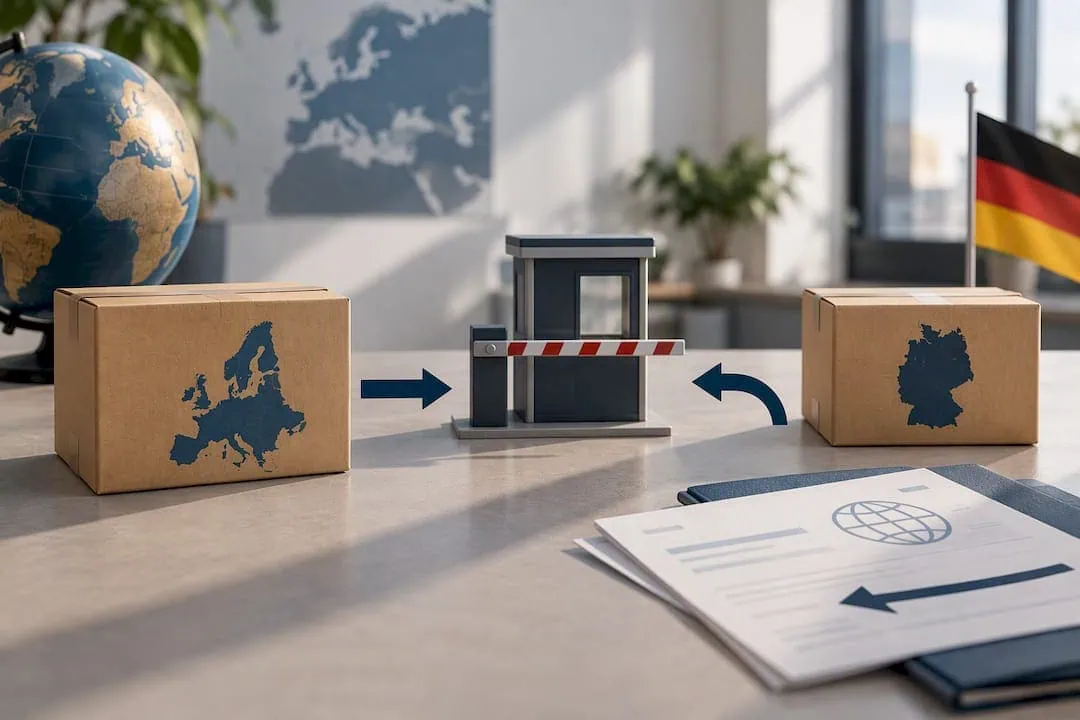
Special rules also apply in Mexico for returns to German senders. Chapter 98 of the Mexican customs tariff contains special provisions for returns and samples, which in certain cases allow for simplified or duty-free processing, provided the goods are demonstrably returned unaltered. If this proof is lacking or the goods have already been processed in Mexico, normal import clearance with full customs duties and VAT applies.
For companies that regularly expect returns from Mexico, such as those in e-commerce, it's worthwhile to have a formal agreement with their customs broker on how returns are documented and declared. Without this preparation, each individual return becomes a separate, minor customs case.
Special tariffs and anti-dumping measures on Mexican imports
In addition to regular tariffs, Mexico imposes additional protective tariffs in certain sectors, particularly against dumping prices from third countries. Such measures typically affect steel, textiles, chemicals, and certain electronic components, although the exact list of goods changes over time.
For German shippers, the crucial distinction is between the regular customs duty and any potential countervailing duty. A countervailing duty is not levied according to the EU country of origin, but rather according to the actual origin of the intermediate products or the HS code of the goods as a whole. This means that even a product manufactured in Germany could theoretically be subject to an anti-dumping measure if the entire product group falls under such a regulation, regardless of the individual place of manufacture.
GTAI documents such countervailing duties as a separate category alongside regular tariffs and advises exporters to check their product group for current special measures before each major shipment. This check is particularly worthwhile for product groups that are more frequently subject to dumping allegations internationally, such as steel products or certain chemicals. Anyone unsure whether their goods are affected should obtain a binding tariff ruling before concluding a contract, rather than relying on the last known classification.
Who do you contact with customs questions in Mexico?
For specific questions regarding imports into Mexico, several organizations are the first point of contact, depending on the specific nature of the question. For general legal questions concerning Mexican customs law, the German-Mexican Chamber of Commerce (AHK Mexico) offers a dedicated consultation service on customs, law, and taxes, specifically aimed at German companies, providing practical assessments on topics such as Padrón registration and rules of origin.
The Mexican tax authority SAT is responsible for the technical processing of a specific import declaration via the VUCEM portal, where official forms and procedural guidelines are also available. In practice, however, direct communication with customs usually takes place through an appointed customs agent (Agente Aduanal), who acts as an authorized representative and answers inquiries from the authorities directly.
German private individuals with questions about duty-free allowances or small shipments can find initial information on the websites of Mexican consulates, for example at Consulmex Frankfurt, where duty-free allowances and formal requirements for travel baggage are explained. However, for more complex commercial cases, the combination of advice from the German-speaking Chamber of Commerce (AHK) and a local customs agent remains the most reliable point of contact, because both are familiar with the practical application of the regulations, not just the legal text.
Paket International handles customs clearance for you
Anyone who has read the preceding sections carefully will quickly realize: HS code, IVA, IEPS, Padrón registration, and document verification involve an administrative burden that can hardly be handled on the side. Paket International automates precisely these steps for shipping to Mexico and other countries.
The platform calculates shipping costs and import duties in seconds, connecting systems, parcel services such as DHL, UPS, FedEx, DPD, and DB Schenker, as well as customs services, in a central dashboard. Automated customs clearance runs without manual intervention; shipping labels and customs documents are generated directly from the same data, thus reducing potential errors such as incorrect commercial invoices or incomplete proof of origin from the outset. According to the company, this automated process reduces the time spent on paperwork and the associated costs by up to 80%.
For companies that regularly ship packages, pallets, or general cargo internationally, it's worth taking a look at the Customs clearance for international parcelswhere shipping costs and customs duties can be directly compared. Those who also need to clarify their customs tariff numbers will find assistance in determining them. The next step is straightforward: calculate shipping costs and customs duties for your next shipment to Mexico directly online.
Sources
Those wishing to delve deeper into the subject can find the primary sources on which this article is based at the following locations:
- Excise duties and other import taxes | GTAI
- Customs duties and countervailing duties | GTAI
- Customs, Law, Taxes | German-Mexican Chamber of Commerce and Industry (AHK Mexico)
- Ventanilla Única (VUCEM)
- Import regulations (Consulmex Frankfurt)
FAQ
What are the customs fees in Mexico?
Customs duties in Mexico consist of the HS code-dependent customs duty rate, 16% VAT on the customs value plus import duty, a possible IEPS excise duty for special goods, and a customs clearance fee. For preferential imports from the EU, this fee may be a fixed amount instead of a percentage, for example, 425,44 Mexican pesos.
Does Germany have a free trade agreement with Mexico?
Germany benefits through the EU from the Association Agreement between the EU and Mexico, which reduces or eliminates tariffs on many product categories. This preferential treatment applies only if proof of origin is provided and does not affect VAT or IEPS.
How much does it cost to send a package from Mexico to Germany?
Shipping costs depend on weight, size, and the chosen parcel service; German customs duties and import VAT are added depending on the HS code. For shipments from various countries, we offer... International parcel prices start from €15 for international shipping. with automatic calculation of import duties.
What is the import duty to Germany?
The customs duty for imports from Mexico to Germany depends on the HS code of the goods and varies depending on the product category. It is often reduced by the EU-Mexico agreement if the country of origin is proven. In addition, German import VAT is levied on the customs value plus customs duties, regardless of the country of origin.
What happens if customs documents for Mexico are incorrect?
Missing or contradictory information on commercial invoices, packing lists, or certificates of origin leads to inquiries from Mexican customs and often extends the processing time from a few days to significantly more. Common errors include understating the value of the goods, omitting an Incoterm, or providing an inaccurate description of the goods without an HS code.