Export to Great Britain: Why the 135 GBP threshold is crucial for online retailers and logistics companies
In German-British trade, confusion frequently arises regarding Incoterms, customs, and VAT. Strict British special rules apply, particularly to shipments with a value below 135 GBP. Misinterpreting Incoterms such as DAP in these cases risks unnecessary costs and frustration in accounting.
Since Brexit, exporting from Germany to Great Britain (England, Scotland, Wales) has become a bureaucratic tightrope walk for many traders. Time and again, perceived value limits – such as the often mistakenly assumed 100 GBP threshold – and the conflation of transport terms (Incoterms) with tax obligations cause confusion.
A look at the official guidelines of the British tax authority HMRC shows what really matters for shipments up to and over 135 GBP.
The be-all and end-all: The British 135 GBP limit
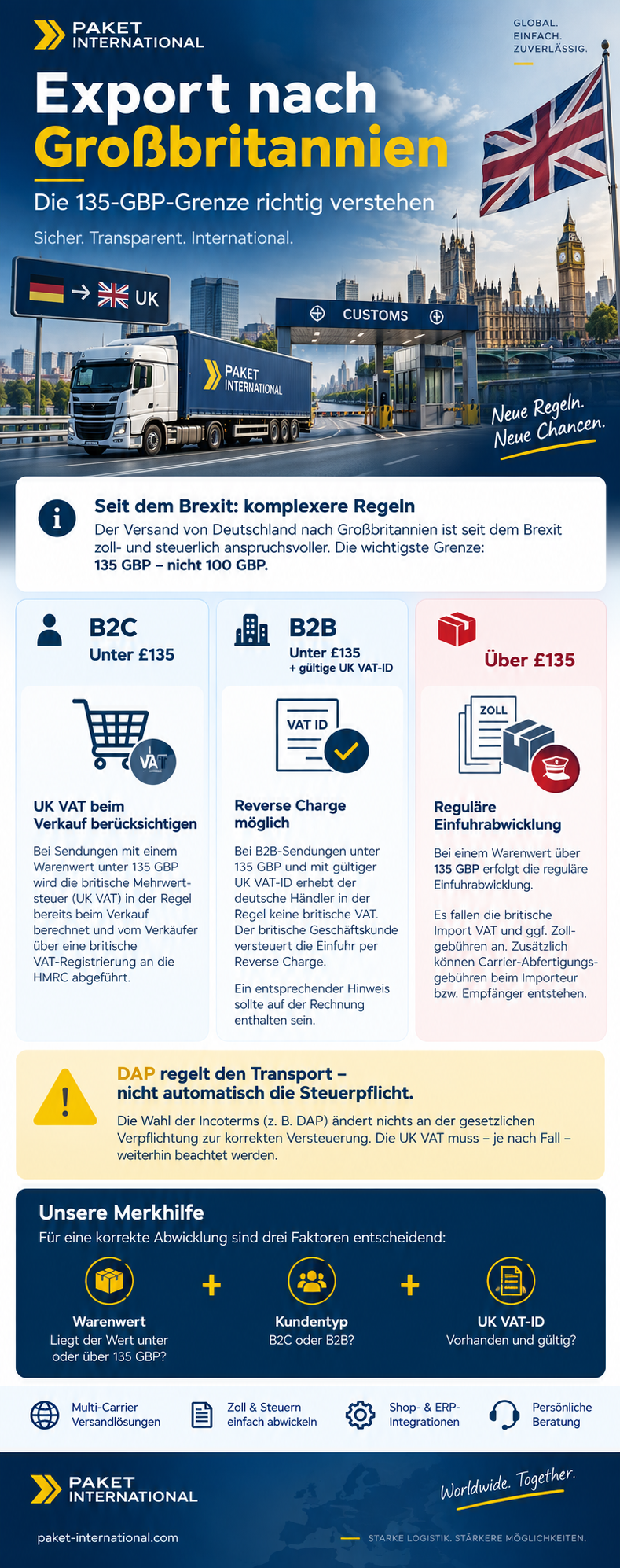
The decisive factor for British import VAT is not the often-cited threshold of 100 GBP, but precisely the 135 GBP limit (Intrinsic value of the entire shipment, excluding separately itemized transport and insurance costs). Furthermore, most standard commercial goods under £135 are exempt from customs duties (Customs Duty) on.
Practice illustrates how the processing differs depending on customer status and the value of the goods:
1. B2C sales under £135 (e.g. 90 GBP)
-
The rule: HMRC requires that British VAT be charged on direct sales to British consumers (UK VAT, usually 20%) is already charged at the point of sale (at the time of purchase) and paid to HMRC via a British VAT registration.
-
The trap with DAP: From a transport law perspective, the package can be considered DAP (Delivered at Place) run to London. But: DAP here means notYou can simply pass the British VAT on to the recipient at the parcel service. Incoterms do not change the seller's legal obligation to pay British VAT. The classic "recipient pays everything upon import" approach does not work for these low-value shipments from a tax perspective.
2. B2B sales under £135 with a valid UK VAT ID
-
The rule: If the British B2B customer provides you with their valid British VAT identification number in advance, it will be significantly easier for the sender.
-
The process: The German retailer does not charge British VAT. The British recipient pays VAT on the transaction. Reverse charge procedureThis must be noted accordingly on the invoice (e.g. “Reverse charge: customer to account for VAT to HMRC”Here too, DAP in combination with reverse charge is a clean solution.
3. Shipments over £135
-
Returning to the standard: For goods valued at over 135 GBP, the classic DAP model applies in its purest form. The importer or recipient pays the regular import VAT, any customs duties, and the often cumbersome handling and delivery procedures of the carrier.
conclusion for practice
For retailers and logistics providers who ship to the island (such as with weight- or flat-rate-based offers), the 135 GBP limit the decisive dividing line.
The value of the goods, the customer type (B2B vs. B2C), and whether a UK VAT ID is valid must be strictly separated from the shipping cost alone. Those who keep these items clearly separated and comply with British regulations will avoid unpleasant surprises during customs clearance and keep their accounting department happy.