
Shipping to Norway Customs: What you need to know in 2026
Yes, every shipment to Norway is subject to customs clearance. Norway is not part of the EU, so customs inspects every package. For B2C shipping, the VOEC procedure is the most practical solution: it works on the DDP principle, meaning the recipient doesn't pay anything extra upon delivery.
The alternative is DDU (Delivered Duty Unpaid). Here, the recipient pays customs duties and VAT themselves, which increases the return rate and causes dissatisfaction.
- DDP over VOEC: Buyer pays taxes at checkout; delivery without additional charges.
- DDU without VOEC: Recipient pays upon delivery; higher risk of cancellation.
The Norwegian VAT rate is... 25% on most shipments of goods; customs duties and excise taxes may also apply.
Key insights
Norway clears customs for every incoming shipment, and VOEC is currently the most reliable method for German B2C shippers to guarantee delivery to recipients without additional charges.
| Theme | Details |
|---|---|
| Norway is not an EU member state. | Every shipment is considered an import and must be cleared through customs, regardless of the value of the goods. |
| Using VOEC for B2C | The procedure applies up to 3.000 NOK per item and allows DDP without additional charges. |
| Complete all documents | HS code, product description and net value must match on CN22/CN23 and invoice. |
| Calculate total costs in advance | Please allow for 25% VAT plus any applicable customs duties and a service fee of around 6 euros. |
| use automation | Paket International automatically calculates customs duties and VAT and fills in customs documents directly. |
Table of Contents
- Why Norway is treated differently under customs law than EU countries
- VOEC, DDP or DDU: Which customs clearance method is right for your shipment?
- What customs documents do you need for shipping to Norway?
- How are customs duties, VAT and service charges calculated?
- You may not ship these goods to Norway without inspection.
- Checklist: How to prepare a shipment to Norway
- How automation avoids typical customs errors when shipping to Norway
- When an automated shipping solution is worthwhile for you
- Practical links to authorities and partners for further reading
- Sources
Why Norway is treated differently under customs law than EU countries
Norway is a member of the European Economic Area, but not of the EU Customs Union. This may sound like a formality, but it changes everything: Every shipment from Germany to Norway is considered an import into a third country for customs purposes, just like a shipment to Switzerland or the UK.
For shippers, this means specifically:
- A customs declaration is required for every shipment, regardless of the value of the goods.
- Norwegian VAT of 25% is levied on most goods.
- Additional customs duties or excise taxes may apply depending on the product category.
- The Norwegian customs authority toll.no and the tax authority skatteetaten set the exact rules.
The Foreign Office also points out that Norway consistently enforces its own customs regulationsEven minor errors in the declaration can quickly lead to delays or returns. Anyone who regularly sends packages to Norway should consider this basic rule a fixed part of their shipping planning, not an exception.
VOEC, DDP or DDU: Which customs clearance method is right for your shipment?
VOEC stands for “VAT On E-Commerce” and allows online retailers to collect Norwegian VAT directly at checkout. This procedure applies to shipments of goods up to NOK 3.000 per item and requires VOEC registration with the Norwegian Revenue Agency.
Here's how to choose between the options:
- Check the value of the goods. If the item value is less than 3.000 NOK, VOEC is usually the right choice for B2C shipments.
- Register for VOEC, if you regularly sell to Norwegian private customers.
- Use DDP as a pre-selection in checkout, so that buyers don't experience any surprises upon delivery.
- Use DDU only if VOEC does not apply., for example in the case of higher-value individual shipments or B2B transactions without Norwegian tax registration.
DDU remains common for larger B2B shipments where the Norwegian recipient acts as the importer and covers the import duties.
Pro tip: Never offer DDU (Delivered Duty Unpaid) only at checkout if you are selling to private customers. Additional charges upon delivery are one of the most common reasons for rejected packages and returns from Norway.
What customs documents do you need for shipping to Norway?
For shipments up to 1.000 grams, the simplified customs declaration CN22 is often sufficient. Heavier or higher-value packages require the more detailed CN23 with a comprehensive description of the goods.
Both forms and the commercial invoice depend on specific details that Norwegian customs officials routinely check:
- Full sender and recipient address including telephone number
- Precise product description, no generic terms like "gift" or "goods"
- Correct HS code or customs tariff number for each item
- Net value of the goods in the respective invoice currency
- Country of origin of the goods
Commercial shippers also need an EORI number if they regularly export outside the EU. For VOEC shipments, the VOEC registration number must appear in the electronic customs declaration or on the invoice; otherwise, the system will refuse simplified clearance. Further details on the required documents are available [here/on the website]. Shipping documents help with preparation.
How are customs duties, VAT and service charges calculated?
The calculation follows a fixed sequence: First, it is checked whether a customs duty applies to the product group. Then, the value of the goods plus shipping costs plus any customs duties forms the basis for calculating Norwegian VAT. 25%For certain products, such as alcohol or tobacco, additional excise taxes are levied.

Parcel services usually charge a separate flat fee for customs clearance. often around 6 euros, regardless of the actual taxes and duties.
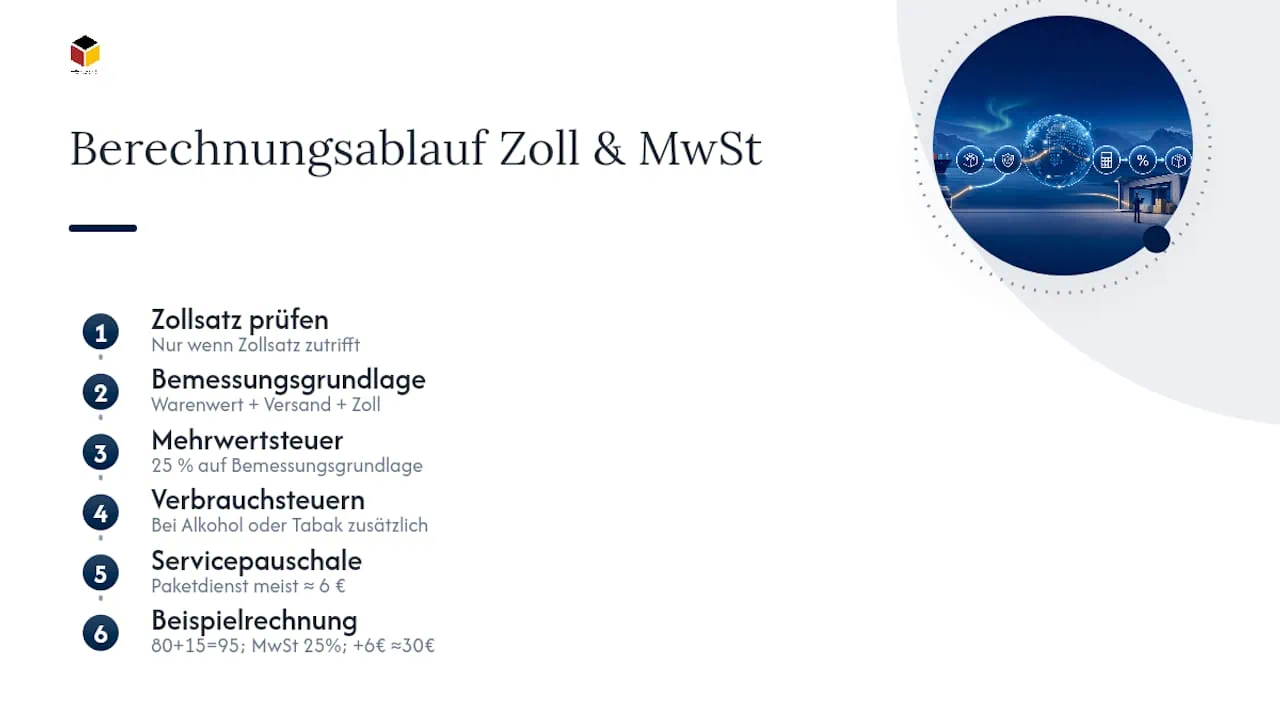
A calculation example illustrates this: A package with a merchandise value of €80 and shipping costs of €15 results in a taxable base of €95. If a service fee of €6 is added, the recipient pays almost €30 extra in total, unless VOEC applies and the goods were shipped DDU. This exact scenario can be avoided with VOEC at checkout, as the VAT is already included in the purchase price.
You may not ship these goods to Norway without inspection.
Some product categories are completely prohibited, others require prior authorization. Anyone who ignores this risks confiscation, fines, or a permanent delay in shipment.
- Weapons, ammunition, and certain dual-use goods require a permit or are prohibited.
- Protected animal and plant species, as well as some chemicals, are subject to strict import restrictions.
- Alcohol and tobacco have their own quantity limits and tax rates, which are significantly stricter than in EU trade.
- Incorrectly declared shipments are often rejected, resulting in additional costs and weeks of delay.
If you have any doubts about a particular product category, it is worth taking a look at the Norwegian customs regulations beforehand, rather than risking a return afterwards.
Checklist: How to prepare a shipment to Norway
A quick but thorough check is worthwhile before shipping. Those who work through these points will avoid most customs inquiries.
- Check VOEC registration and include the number on the invoice if it is a B2C shipment.
- Set the HS code for each item, not just at pickup.
- Prepare a commercial invoice with all mandatory information, ideally bilingual (German/English).
- Make the decision between DDP and DDU before checkout, don't leave it to the parcel service.
- Provide the address in Norwegian format, including the recipient's postal code and telephone number.
When Norwegian customs has questions, speed is of the essence: Keep your commercial invoice, HS codes and, if applicable, the VOEC number readily available so that a response can be provided within the set deadline.
Pro tip: Always attach the customs declaration clearly to the outside of the package, in addition to the invoice inside the box. Norwegian customs offices process shipments with externally visible documents significantly faster.
How automation avoids typical customs errors when shipping to Norway
Manual customs clearance is prone to errors, especially with recurring shipments containing different product categories. Automated calculation of landed costs directly at checkout shows recipients what they will actually pay, including Norwegian VAT and any applicable customs duties, even before they make a purchase.
The automatic filling of CN22, CN23 and HS codes reduces precisely those input errors that most frequently lead Norwegian customs offices to make inquiries.
International Package It combines shipping systems, parcel services and customs clearance into one process:
- Automatic calculation of customs duties and VAT before shipment
- Direct population of customs documents from order data
- Central dashboard for shipment tracking without changing systems
For companies that regularly ship to Norway, this means less manual rework and noticeably fewer customs inquiries.
When an automated shipping solution is worthwhile for you
Those who only occasionally send a package to Norway can get by with a manual checklist. The situation is different, however, as soon as shipping becomes a regular part of their business.

Especially with high shipment volumes, frequent returns or pallet shipping, the manual maintenance of CN22, CN23 and HS codes quickly becomes a bottleneck. International Package It takes care of exactly this part: Shipping costs and customs duties are calculated automatically, VOEC information is directly incorporated into the customs declaration, and a central dashboard displays every shipment in real time. Even when... Shipping of electronics or machinery With complex customs tariff numbers, automated clearance pays off.
Anyone who wants to know how much a specific shipment to Norway actually costs can find out... Compare customs clearance options directly and select the appropriate shipping method.
Practical links to authorities and partners for further reading
The Norwegian customs authority provides binding rules directly: toll.no for regulations and limits. PostNord offers practical information on the VOEC process for businesses. Those planning larger or bulkier shipments can find additional insights at logistical challenges in heavy transportDetails on costs and options specifically for Norway are available from the Internal guide from Paket International.