

1–5 or 4–21 working days: International parcel delivery times for senders
International packages typically take 1 to 5 business days for express shipping and 4 to 21 business days for standard or economy shipping, depending on the shipping method. The exact duration depends on three factors: the chosen shipping method, the destination country and route, and customs clearance, including correct recipient information. These delivery times are guidelines only and not guarantees.
In short:
- For international shipments, transit time and delivery duration depend heavily on the chosen shipping method, the destination country, and customs formalities.
- Express shipping usually takes 1 to 5 working days, while standard and economy options usually take between 10 and 21 working days.
- Delays occur primarily during customs inspections when documents are incomplete or incorrect HS codes are used.
- Digital customs documents and precise product information can significantly speed up processing.
- For companies that ship regularly, automated customs clearance is worthwhile in order to make delivery times more predictable and minimize potential errors.
Table of Contents
- Typical international parcel delivery times depending on the shipping method
- Why the transit time varies so much depending on the destination country
- Customs, documents and common reasons for delays
- Here's how to calculate your package transit time step by step
- How you can actively shorten runtimes
- Tracking and the role of the recipient
- Standard delivery time versus guaranteed delivery time: The difference matters
- How Paket International makes transit times more predictable
- Sources
Typical international parcel delivery times depending on the shipping method
The shipping method determines the general direction in which a shipment travels. Express air freight services typically deliver within... 1 to 3 working daysDepending on the destination and flight connection, standard and economy options cover a significantly wider range, often between 10 and 21 working days according to common information. Shipping guidesThe price difference is almost always due to the transit time: those who want to save money wait longer.
An overview of the general bandwidths:
- Express (air freight): 1 to 5 working days, depending on the destination country and customs requirements
- Standard: 5 to 14 working days, a solid balance between price and speed
- Economy: 10 to 21 working days, cheapest option with higher uncertainty
Express shipping is particularly worthwhile for time-sensitive shipments, high-value goods, or when a customer requires just-in-time delivery. For everything else, standard shipping is usually sufficient, provided you allow for a time buffer. Those who frequently need to switch between options will find a suitable alternative in a... Parcel delivery service comparison quickly find the right combination of price and speed.
Why the transit time varies so much depending on the destination country
The transport route often determines delivery time more than the chosen shipping method itself. A direct flight to the destination country significantly shortens the journey compared to a shipment that requires transshipment or even sea freight. Local delivery infrastructure also plays a role: a well-developed network in Western Europe delivers faster than a country with few distribution centers.
Within the EU, delivery times of 1 to 5 working days are typical, as customs formalities are largely eliminated and distances are short. For overseas shipments, the range increases significantly, and the variance grows due to additional customs processes and longer transport chains.
The following are considered rough guidelines:
| Region | Typical runtime |
|---|---|
| Europe | 1 to 5 working days |
| North America | 3 to 10 working days |
| Asia | 4 to 21 working days |
These figures are guidelines, not firm commitments. Anyone who regularly ships to specific regions should take a closer look at the country-specific information, for example via a [website/document/etc.]. Country overview with detailed information on individual destinations.
Customs, documents and common reasons for delays
Customs clearance is where most international shipments get stuck. Without the correct paperwork, even the fastest express service is useless.
The following documents are required for most international shipments:
- Commercial invoice with complete description of goods
- Customs declaration or digital EDI data
- EORI number for commercial shippers
- IOSS registration for certain EU imports
Delays almost always arise from the same reasons: incomplete information on the invoice, outstanding import duties, physical inspections by customs, or incorrectly assigned HS codes. Each of these issues costs days, sometimes weeks.
The digital transmission of customs documents, for example via Paperless invoice programsThis significantly speeds up processing because customs authorities can check the data directly electronically instead of waiting for paper documents.
Pro tip: Check the HS codes of your products before shipping them to a new country for the first time. An incorrect code almost always leads to a manual inspection, even if all other information is correct.
Here's how to calculate your package transit time step by step
A realistic estimate requires more than just looking at the shipping method. Three steps are sufficient for a solid calculation.
- Define framework data: The destination country, chosen shipping method, planned pickup time and type of goods determine the basis of each estimate.
- Consult the runtime calculator: Carriers provide country transit time tables that offer an initial standard transit time.
- Include buffers: Customs risks, public holidays in the destination country and seasonal peaks are added to the standard delivery time.
For example, a standard shipment to Canada with a base delivery time of 8 business days should be factored in with 2 to 3 additional days for customs clearance, so realistically 10 to 11 business days. For express shipments to France, on the other hand, 2 business days plus a half-day buffer for the last mile are often sufficient.
How you can actively shorten runtimes
Most delays don't occur during transport, but rather due to data quality. Addressing this issue often saves more time than using a more expensive shipping service.
- Please provide complete recipient details, including telephone number and email address.
- Submit customs documents digitally instead of on paper.
- Formulate HS codes and product descriptions precisely; consult a customs advisor if unsure.
- Consolidate shipments and, if necessary, utilize premium transit times.
- Insure valuable shipments as a precaution.
Pro tip: A registered mobile phone number triggers automated inquiries at many customs offices, instead of the shipment remaining unprocessed for days. Those who generally want to ship faster will find further approaches in the Tips for fast shipping.
Tracking and the role of the recipient
Not every tracking event means the same thing. The most important events are pickup, major transit milestones, the "Hero in Customs" status, and a failed delivery attempt.
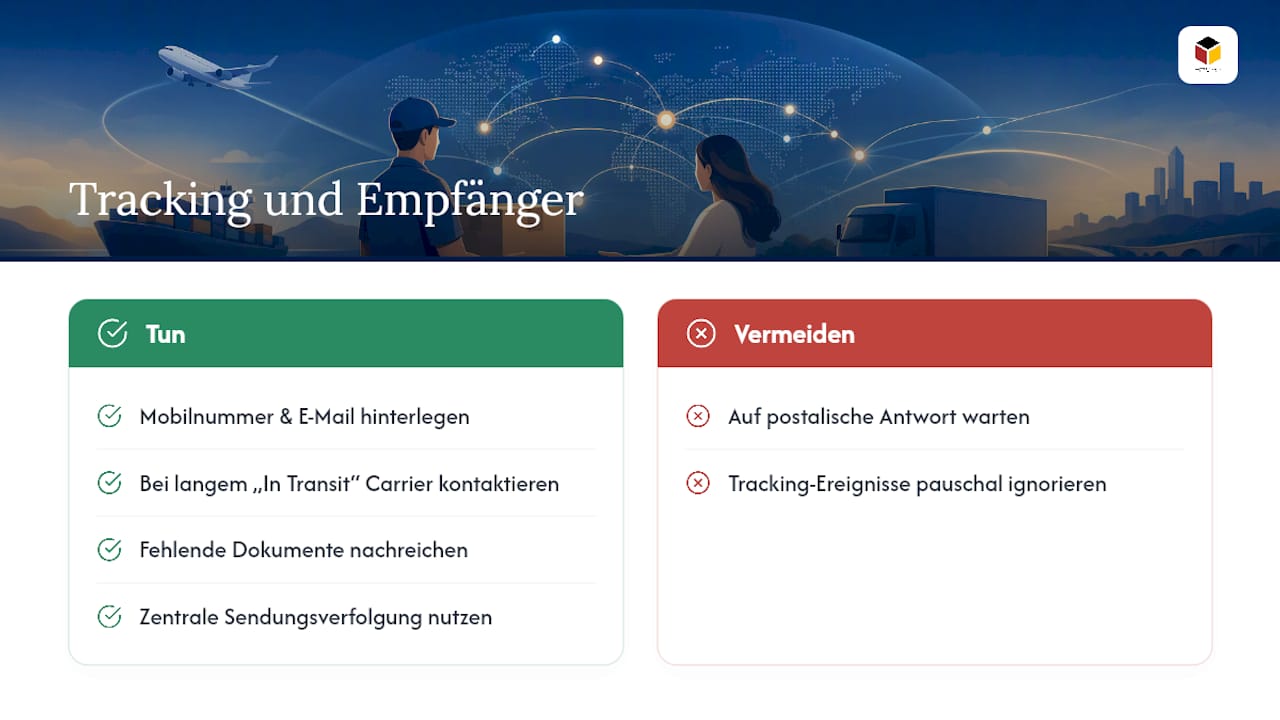
Providing a mobile phone number and email address significantly speeds up notification, as carriers can respond immediately to customs inquiries instead of waiting for a postal reply. This also considerably reduces the number of returned packages.
If the "In Transit" status remains unusually long, direct contact with the carrier or customs authorities, combined with submitting any missing documents, is usually the only solution. Those using multiple carriers simultaneously benefit from a centralized solution. Shipment Tracking, which brings all tracking data together in one place.
Standard delivery time versus guaranteed delivery time: The difference matters
A standard runtime is a statistical average estimateNo guarantee. A delivery time is only guaranteed if the carrier offers a service level agreement with a refund in case of delay.
For non-critical shipments, the standard delivery time with a slight buffer is perfectly adequate. For time-sensitive deliveries, such as contract documents or spare parts for a production line, a guaranteed express service is worthwhile despite the higher costs. Standard delivery times typically fail in the event of unannounced customs inspections or during the seasonal peak around Christmas, when even reliable routes can be disrupted.

How Paket International makes transit times more predictable
Anyone who regularly ships internationally knows the problem: Every carrier has its own transit time tables, customs requirements, and forms. Paket International combines shipping cost calculation and customs clearance into one automated process, making transit times more predictable for you instead of a collection of individual cases.
The platform calculates shipping costs and customs duties in seconds and automates customs clearance, eliminating the need for manual form completion. This reduces the very sources of error that would otherwise lead to delays of several days: incomplete customs data, incorrect HS codes, and late documents. For companies with regular international shipping, complex customs cases, or high shipment volumes, the difference is particularly noticeable, as processes can be repeated instead of being checked anew each time.
The central dashboard lets you keep track of all shipments, regardless of which parcel service is currently in use, be it DHL, UPS, FedEx, DPD, or DB Schenker. Anyone wanting to know how automated customs processing specifically affects their own shipping route can find information on the page [link to relevant page]. International shipping with professional customs clearance It provides an overview of the functions and allows users to directly calculate the cost of their own shipment.
Sources
- International express shipping – when it's especially urgent | DHL
- Standard delivery times for parcel shipping explained | GLS
- Sending parcels internationally – prices, delivery times & tips | Parcel check
- How to ship internationally | UPS – Germany