
Pay-per-label model: Is billing per label worthwhile?
The pay-per-label model charges a fee for each shipping label generated and is particularly suitable for retailers with low or fluctuating shipping volumes. Those who consistently ship high volumes are often better off with a flat rate or subscription. Before making a decision, surcharges, customs fees, and return costs should be factored into the calculation.
In short:
- The pay-per-label model is particularly suitable for retailers with fluctuating shipping volumes, as it often becomes more expensive with high overall volumes.
- Additional costs such as surcharges, customs fees and returns quickly add up and can increase the pure label fee by several hundred euros per month.
- For monthly shipments exceeding 10.000, a flat-rate or subscription solution is usually cheaper because small price differences significantly impact the overall bill.
- For seasonal or irregular shipping volumes, the pay-per-label model is less risky, while for consistently high volumes, a subscription is usually more economical.
- Continuous cost control requires reviewing actual surcharges and integrating automated tariff comparisons to avoid unexpected additional costs.
Table of Contents
- Which costs and fees per label really matter?
- Cost comparison: Pay-per-label versus flat rate and subscription
- When pay-per-label is worthwhile and where the risks lie
- Planning the transition: Technical and organizational checklist
- How Paket International supports the pay-per-label model
- The next step for your shipping team
- Sources
- FAQ
Which costs and fees per label really matter?
The figure displayed for label printing is rarely the actual total cost. It is made up of several components, and those who only focus on the platform fee underestimate the actual labeling costs at the end of the month.
The platform's labeling fee is usually the smallest item. Above that is the actual parcel service rate, which varies considerably depending on weight, zone, and transit time. Additional surcharges are also added, which many retailers only notice when they receive the invoice.
- Fuel surcharge, usually a percentage surcharge on the base price
- Surcharges for remote delivery regions (Remote Area)
- Seasonal surcharges during peak periods such as November and December
- Additional services such as collection, pallet shipping or handling of bulky goods
- Customs and import duties on international shipments
- Insurance and return costs as well as subsequent weight adjustments
Pro tip: When reviewing each offer from a provider, check whether the stated labeling fee already includes the surcharges or whether these appear separately on the monthly invoice. This is where the biggest discrepancies are often hidden.
Small amounts per label quickly add up to significant sums with high volume. A price change of just €0,02 per label leads to... €200 additional costs...without any change to the actual service. Those who don't regularly check their data usage against their actual bill often unknowingly pay for such increases for months. An overview of typical shipping surcharges helps to identify these items early.
Cost comparison: Pay-per-label versus flat rate and subscription
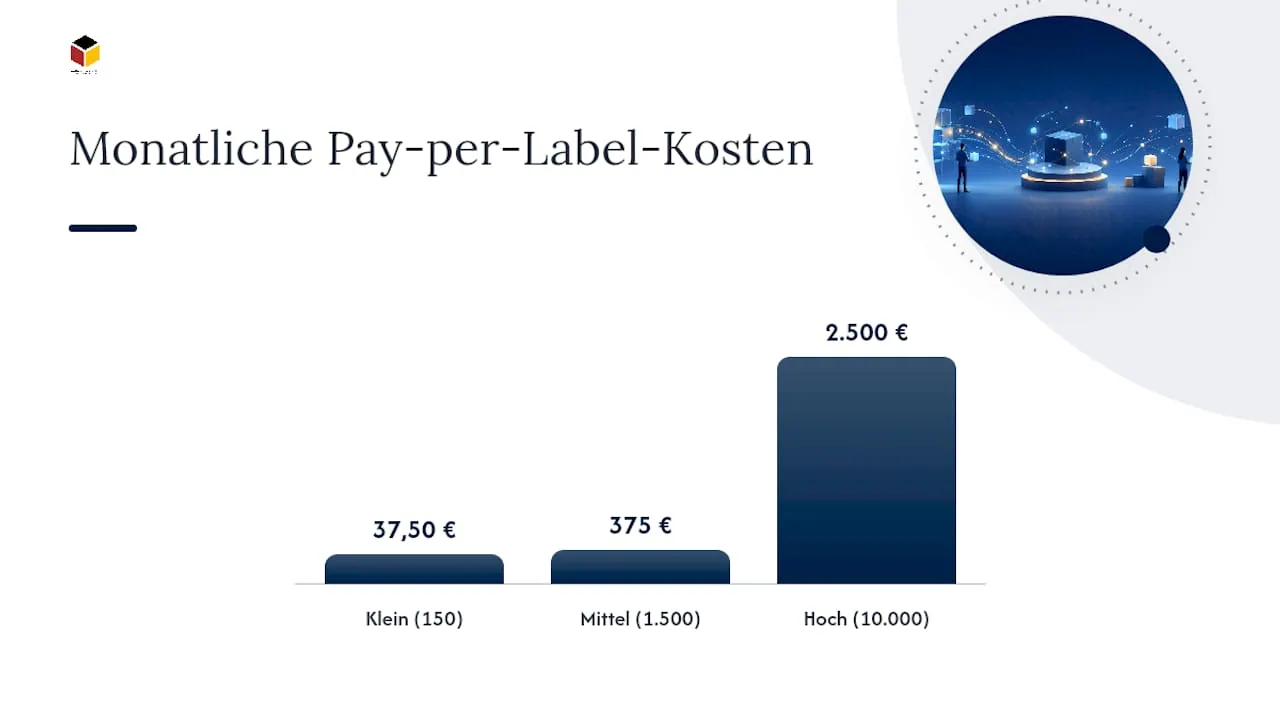
Whether a pay-per-label pricing model or a subscription is more cost-effective depends almost entirely on the volume and its predictability. The total monthly costs can be compared using a simple formula: base fee plus (number of labels times price per label) plus surcharges. With the subscription model, a fixed monthly fee usually replaces some or all of the variable label costs; however, many providers require a minimum contract term.
Three example calculations clearly demonstrate the difference:
- Small volume (150 shipments/month): Pay-per-label at approximately €0,25 per label results in roughly €37,50 in pure label costs, excluding any base fee. A subscription with a fixed price of €29 and 100 included labels would incur additional costs for the remaining 50 labels and would hardly be cheaper.
- Medium volume (1.500 shipments/month): Pay-per-label costs around €375 at the same unit price. A tiered subscription with a lower label fee after a certain volume can already be cheaper, as Tariff overviews demonstrate.
- High volume (10.000 shipments/month): Here, the calculation almost always tips towards a flat rate, because even small differences in unit prices add up massively.
These figures are for guidance only and not exact market prices, as rates vary depending on the provider, destination country, and negotiating position. Additional factors often distort pure price comparisons: the scope of support, contractually guaranteed response times (SLAs), and the option to use your own carrier contracts (bring-your-own-contract) significantly alter the actual cost-effectiveness.
When pay-per-label is worthwhile and where the risks lie
This model is particularly well-suited to business models that do not allow for reliable forecasts of future shipment volumes. For startups without a shipping history, seasonal shops with significant fluctuations, market tests in new countries, or complex international single shipments, billing per label is usually the less risky option because no fixed costs are incurred when no shipment takes place.
The risks only become apparent with growth. A rapid increase in volume can suddenly make a pay-per-label strategy more expensive than a subscription. Unexpected surcharges during the off-season further distort the calculations, and a high volume of returns often quickly negates the supposed cost savings.
Three criteria help with classification:
- Monthly shipment volume and its expected development over the next twelve months
- Predictability of demand, such as seasonal patterns or marketing campaigns
- Existing carrier contracts that can be integrated into a new model
Multi-carrier software bundles various parcel services and selects them via automated selection. Rate shopping the most suitable offer is selected, which facilitates cost control regardless of the chosen pricing model.
Planning the transition: Technical and organizational checklist
Changing the pricing model for labels is rarely a spur-of-the-moment decision. Preparing for the transition helps avoid costly adjustments during ongoing operations.
First, reliable basic data is needed:
- Monthly shipment volume of the last twelve months, including seasonal peaks
- Average weights and package dimensions per assortment
- Key target markets and the Incoterms applicable there
- Current return rate, as it directly affects the total costs
The technical steps follow. A plugin or API integration, for example via WooCommerce or PrestaShopIt connects the shop and the shipping platform. The field mapping between the shop system, the platform, and the parcel service must be checked, as well as print formats (ZPL, PDF A4, or the common 4x6 format), because errors at this point will later lead to returns and manual rework. Guide to label creation helps with the practical implementation of such tests.
Organizationally, this includes:
- Define reporting that separately reports label costs and surcharges.
- Set up monitoring for changes in surcharges so that price increases are noticed immediately.
- Document support channels and response times (SLA) in writing with the provider.
Anyone who takes this practical recommendation seriously and creates a sample calculation with an actual monthly volume before switching will see the added value compared to the previous solution much more clearly. Checklist for contract logistics provides additional practical examples for detailed organizational planning.
How Paket International supports the pay-per-label model
Paket International calculates shipping costs and customs fees fully automatically in seconds, instead of requiring retailers to perform manual rate comparisons. The platform connects shop systems, parcel services such as DHL, UPS, FedEx, DPD, and DB Schenker, as well as customs services, in a single process, enabling the creation of labels without any media breaks.
Integration is achieved via plugins for WooCommerce and PrestaShop, significantly reducing the technical effort for shop owners. Zero-click automation handles customs clearance without manual intervention, resulting in the greatest time savings, especially for individual international shipments. A transparent dashboard displays all shipments, costs, and surcharges in one place, making it much easier to manage your pay-per-label model than with scattered tariff sheets from various providers.
Automation can significantly reduce administrative costs and shipping expenses, although the exact savings depend on the process and shipment volume. Those who wish to estimate the savings for their own business can find information on the page about... Multi-carrier shipping Further technical details regarding the connection.
The next step for your shipping team
For retailers who understand from this article that the label fee alone is only one part of the bill, Paket International offers a direct route from calculation to finished shipment, without having to manually compare rates between multiple providers.
Instead of checking surcharges, customs duties, and label prices individually, the platform calculates them automatically and displays the result directly on the dashboard before the label is printed. This is particularly relevant for teams that need to choose between multiple parcel services and keep track of surcharges, customs values, and total costs. Those dealing with varying customs rates internationally will find more information on the website. Customs clearance and shipping costs a concrete overview of how these items fit into the overall invoice.
The easiest way to get started is through a real TV show: Anyone who watches International shipping with automated customs clearance Once you've calculated the costs for a typical order, you can immediately see how the label fee, surcharge and customs costs compare to the previous solution.
Sources
- Multi-carrier shipping: All parcel services in one software – Logistics Journal
- Sendcloud expands automation and adjusts prices
- Overview of pricing models | SendDrop Help
FAQ
What exactly is a pay-per-label model?
A pay-per-label model is a transaction-based pricing model for labels, where a fee is charged for each shipping label actually produced, instead of a fixed monthly fee.
At what volume does a subscription become more worthwhile than pay-per-label?
This depends on the respective unit price and the subscription conditions, but with consistently high shipment volumes in the four-figure range per month, the calculation usually tips towards a flat rate, because small price differences per label add up significantly.
What additional costs are incurred for international shipping, besides the label fee?
In addition to the actual labeling fee, fuel surcharges, customs and import duties, insurance costs, and possible weight adjustments are usually incurred.
Can I submit my own carrier contracts to Paket International?
Paket International connects shop systems directly with parcel services such as DHL, UPS, FedEx, DPD and DB Schenker and automatically calculates costs and customs fees, which makes it easier to control existing agreements.
How do I check if surcharges are included in my label fee?
The most reliable way is to look at the provider's monthly bill, as surcharges such as fuel or remote area fees are often shown separately there.