
Pay-per-label shipping: How SMEs can really calculate correctly
Pay-per-label is usually more worthwhile for retailers with fluctuating or manageable shipping volumes than a fixed subscription, because there are no fixed costs for unused capacity. Three factors are crucial: surcharges per label, customs and export costs for international shipping, and the return volume. For consistently high and even volumes, however, a business customer contract with tiered pricing is often more advantageous. An automated platform like Paket International can reduce process costs in both cases, as customs declarations and label creation are handled without manual intervention.
In short:
- For retailers with fluctuating shipping volumes, pay-per-label usually remains cheaper than a fixed subscription, as there are no fixed costs.
- The actual shipping costs depend on the base price, weight, zone, product class and possible surcharges, which for international shipments include customs duties and export costs.
- For high, constant volumes of around 200 shipments per year or more, business customer contracts with tiered pricing are worthwhile, while for small quantities the fixed costs are often too high.
- Automated platforms like Paket International minimize errors in customs declarations and label creation, significantly reducing process costs.
- Returns can increase costs due to unused labels and customs fees, which is why regular cost monitoring and clever billing models are particularly important.
Table of Contents
- Which costs and fees per label really matter?
- Cost comparison: Pay-per-label versus flat rate or subscription
- When pay-per-label is worthwhile: criteria, advantages and risks
- Planning the transition: Technical and organizational checklist
- How to practically create and bill for a shipping label
- How Paket International automates pay-per-label for merchants
- Legal framework for shipping with a label
- Typical pitfalls and hidden costs in the pay-per-label model
- Calculation examples for transparent cost illustration
- Recommendations for optimizing shipping costs
- Overview of providers in the pay-per-label sector
- Implement pay-per-label directly with Paket International.
- Sources
- FAQ
Which costs and fees per label really matter?
A shipping label is never just the postage cost. The base price depends on weight, shipping zone, and product class—that is, whether a package is sent as standard, express, or bulky goods. Even an incorrect weight entry in the system can lead to additional charges later, because parcel services reweigh shipments at the distribution center.
Furthermore, several surcharges often come together, which are rarely noticeable on the initial price overview:
- Express surcharge for prioritized delivery
- Bulky goods surcharge if volume and weight are unfavorable to each other
- Island or remote area surcharge for hard-to-reach delivery regions
- Fuel surcharge, which can change monthly
- Customs duty for shipments outside the EU
For international shipments, correct customs documents are also required. For exports outside the EU, an electronic export declaration via ATLAS is mandatory for goods exceeding a certain value; the exact thresholds and exceptions vary depending on the type of goods. Entering incorrect commodity codes here risks delays in customs warehousing, not just a higher invoice.
Returns further increase the cost of the model if they are not factored into the price. For example, at DHL, end customers purchase using this model. Returns for self-paying customers The label is pre-filled, and billing to the retailer is production-based. Therefore, only what was actually transported is charged.
Pro tip: Check the actual breakdown of your shipping costs by surcharge type each month, not just the total amount. This way you can immediately see if a single surcharge is growing disproportionately.
On some platforms, a label is initially displayed as a reserved amount in the Wallet or balance settledbefore it becomes part of a consolidated batch. Cancelled labels generally result in a credit note to the same balance, making cash flow more predictable than an immediate individual charge per shipment.
Cost comparison: Pay-per-label versus flat rate or subscription
The calculation is essentially simple: A subscription has fixed monthly costs plus a lower unit price per label. Pay-per-label has no fixed costs but a slightly higher unit price. However, to compare the total costs, processing costs must be factored in, including time spent on error correction, handling complaints, and manual customs entries.
Three examples illustrate the scale:
- Very low volume, with only a few labels per month: A subscription with a basic fee is almost never worthwhile here, because the fixed costs are spread over too few broadcasts. Pay-per-label remains cheaper as long as the unit price isn't inflated by frequent surcharges.
- Medium volume, with several hundred to several thousand labels per month: This is where things get tricky. A business customer contract with tiered pricing can be cheaper as long as the volume remains constant. If it fluctuates significantly seasonally, for example during the Christmas season compared to the quieter summer months, pay-per-label remains more flexible.
- High volume, with several thousand labels per month: From this point on, a fixed-term contract usually makes more sense. From 200 shipments per year Merchants can use business customer contracts with Deutsche Post and DHL without a basic fee, but with prices that are tiered according to shipment volume. For very high volumes, the cost per label is significantly lower than with the standard pay-per-label tariff.
The rule of thumb is: above a certain, constant volume, a subscription becomes financially cheaper. But automation changes this calculation. If a platform handles customs declarations, address verification, and label creation without manual intervention, the error rate decreases, and this error rate often costs more in practice than the pure price difference between the models. A contract model with a lower unit price is of little use if a third of the time is lost to customs corrections.
When pay-per-label is worthwhile: criteria, advantages and risks
Volume is the primary filter, but not the only one. Seasonality and the number of sales channels also play a role. A retailer who ships via their own online store, marketplaces, and occasionally B2B orders benefits from the flexibility of being able to freely choose different parcel services for each shipment, instead of being tied to a single partner.
International sales bring additional complexity due to customs requirements. Anyone who regularly sells outside the EU should check whether a platform automatically provides the export declaration, instead of having to register each shipment individually in the customs portal.
Business models with high return rates, such as in the fashion industry, require special attention. A high return rate can derail the pay-per-label model if return labels are not integrated into the same automated billing system as the initial shipment.
The biggest risks rarely lie in the unit price itself:
- Lack of integration between shop system and shipping solution results in duplicate data entry
- Incorrect customs or commodity codes lead to delays in the customs warehouse.
- Surprising surcharges that only become visible on the consolidated invoice.
- Manual post-processing for incorrectly recorded measurements or weights
Pro tip: Before switching over, create a list of your ten most frequent shipping combinations, including destination country, weight, and product class. Test these exact combinations in the new solution first before switching over your entire shipping process.
Planning the transition: Technical and organizational checklist
A change rarely happens overnight, but with a clear sequence, the effort remains manageable.
- Check integrations: Check whether your shop system has a suitable plugin or whether you need to use an API connection. Bidirectional tracking, i.e., status feedback from the carrier back to the shop system, saves a lot of support time later on.
- Ensuring data quality: Dimensions, weight, and recipient addresses must be correct before the first label is generated live. For international shipments, commodity codes and a valid EORI number are also required.
- Clarify customs workflow: Check who will handle the ATLAS registration, the platform or your own team, and which export documents are required for each destination country.
- Understanding billing: Find out whether a wallet or balance model is used and how cancellation flows are handled. Define a simple key performance indicator (KPI), such as cost per shipment, to make month-by-month comparisons possible.
- Plan for a test phase: Closely monitor label cancellations and return behavior during the first few weeks before switching over to the full shipping process.
| Checkpoint | What matters |
|---|---|
| Integration | Plugin or API, bidirectional tracking |
| Data quality | Dimensions, weight, addresses, commodity codes, EORI |
| Customs workflow | ATLAS jurisdiction, export documents |
| Accounting | Wallet/Balance, Cancellation Policy, Cost per Shipment |
| Monitoring | Cancellation rate, return behavior in the test phase |
How to practically create and bill for a shipping label
The standard process remains almost identical for every provider: enter shipment data, check the rate, generate the label, hand it over to the parcel service, and then track and bill the shipment. The difference lies in how many of these steps are done manually.
With manual online postage, you enter each shipment individually, which is sufficient for occasional shipments, but quickly becomes a source of errors when dealing with several hundred shipments per month. A platform or API solution automatically handles rate comparison and label creation from the shop data, saving time and reducing data entry errors.
A similar principle applies to returns. A self-service returns link allows customers to create a pre-filled label themselves, instead of contacting support. Billing can be structured so that only the return labels actually used are charged.
In every process, it remains important to avoid errors before clicking on "Generate label":
- Check address against official postcode databases
- Enter realistic dimensions and weight, not estimates.
- Check commodity codes for international shipments before printing the label.
How Paket International automates pay-per-label for merchants
Paket International automatically calculates shipping costs and customs fees within seconds as soon as shipment data is transferred from the connected shop. The platform connects multiple parcel services in a central dashboard, eliminating the need for manual comparison across various portals.
The key element is automated customs clearance, which aims to prevent typical errors in commodity codes or export information without requiring an employee to check each shipment individually. According to Paket International, this significantly reduces processing costs because paperwork is eliminated and potential sources of error are minimized.
The practical cost-saving levers lie in several areas:
- Fewer manual customs entries thanks to automatic data transfer from the shop system
- Lower error rate in commodity codes and export information
- Faster customs clearance through automated processes
- One dashboard for all shipments instead of multiple carrier portals
Legal framework for shipping with a label
Those who ship internationally are not only bound by contractual obligations with the parcel service, but also by customs law. Exports outside the EU often require customs clearance. electronic export declaration required via the ATLAS system, with thresholds and exemptions varying depending on the type of goods and the destination country.
Two pieces of information are particularly prone to error: the EORI number, the registration number for economic operators in customs transactions, and the commodity code, which defines the customs tariff classification of the goods. An incorrect code can lead to the rejection of the declaration or to delays in customs warehousing, regardless of how reliable the parcel service itself is.
For certain product categories, export licenses also come into play, for example, for dual-use goods or sanctioned destination countries. These licensing requirements depend on the type of goods, quantity, and destination country and cannot be answered in general terms. Anyone who regularly exports to specific countries should have their product range checked against the current export control lists instead of relying on past experience.
Furthermore, from a data protection perspective, recipient data processed via a shipping platform is subject to the same regulations as any other customer data processing in online retail. Therefore, reviewing the data processing agreement of the respective provider is part of the due diligence process before switching to a different platform, not just afterward.
Typical pitfalls and hidden costs in the pay-per-label model
The most obvious pitfall is focusing solely on the base price. A label shown as €4,90 in a comparison tool can be significantly more expensive in the final bill if weight or bulky item surcharges are only calculated after the package has been handed over to the parcel service.
A second, often overlooked point is reweighing. Distribution centers automatically weigh and measure shipments, and deviations from the entered values lead to additional charges that only appear on the consolidated invoice weeks later. Those who haven't standardized their packaging processes often notice these discrepancies too late.

International shipping involves an additional layer of costs: customs duties that were not factored in beforehand. If the shipment is cleared through customs in the destination country instead of clarifying the costs in advance, the bill often ends up with the recipient or delivery is delayed, which in turn leads to complaints.
Returns also harbor hidden costs. A production-based billing model like DHL's "Self-Pay Returns" initially sounds fair because only actually used labels are charged. However, if many customers generate a label and then don't return the shipment, the label remains unused, distorting the cost calculation if the retailer is still planning with a fixed return rate.
Finally, it's worth taking a look at minimum order quantities in framework agreements. Some tiered pricing only applies if a certain annual volume is actually reached. If the threshold is missed, the retailer drops back to a more expensive price bracket, often without prior warning.
Calculation examples for transparent cost illustration
Concrete figures are more helpful than abstract percentages. A retailer with 300 shipments per month, mostly domestic, pays a unit price for pay-per-label shipping, which consists of a base price plus any applicable surcharges. If the weight remains consistently below 2 kilograms and the bulky goods surcharge is waived, the calculation is simple: unit price multiplied by the number of shipments, without a base fee.
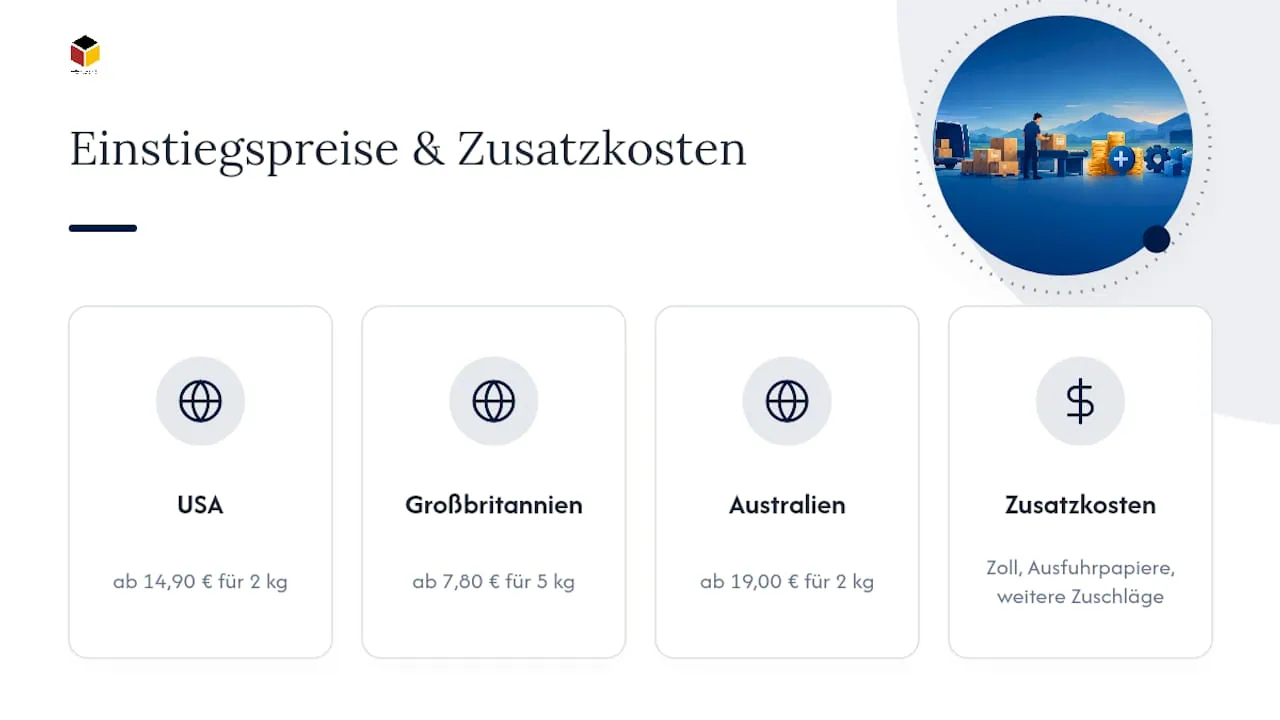
The situation is different for international shipping. For example, those who regularly ship to the USA can use Paket International with Shipments from €14,90 Calculate for a two-kilogram package. For shipping to Great Britain, the starting price for five kilograms is €7,80, and to Australia for two kilograms it is €19,00. These base prices are a starting point; customs duties, export documents, and any surcharges will be added depending on the value of the goods and the destination country.
A second example illustrates the effect of returns: If a fashion retailer sells 1.000 items per month with a return rate of 30%This results in an additional 300 label costs, which are often missing from the original calculation. If returns billing is production-based, as with DHL's self-pay model, only returns that are actually transported are included in the invoice, which brings the calculation much closer to reality than a pure estimate based on order numbers.
Recommendations for optimizing shipping costs
The most effective lever is rarely the negotiated price per label, but rather the reduction of errors that lead to additional charges. Standardizing packaging sizes and consistently checking weights before shipping avoids a significant portion of these subsequent surcharges.
A second lever lies in consciously comparing parcel services for each shipment type. Not every provider is equally cost-effective for every combination of weight, destination, and product class, and a multi-carrier comparison per shipment can save more over the course of a year than a single negotiated discount.
For international shipments, it's also worthwhile to correctly define your customs tariff number once and save it for recurring products, instead of determining it anew for each shipment. This not only reduces the time spent but also the risk of customs rejections.
Return costs can be reduced by integrating the returns process into the invoicing system from the outset, instead of treating it as a separate process. A returns link that automatically generates the appropriate label and customs documents significantly reduces administrative backlogs compared to manual processing of each case.
Finally, regularly checking your key performance indicator (KPI) "cost per shipment," broken down by destination country and product category, is helpful. Tracking this figure monthly allows you to identify cost drivers before they accumulate into a real problem.
Overview of providers in the pay-per-label sector
For retailers who buy shipping labels on demand, there are essentially two options: classic business customer portals of the parcel services themselves or specialized shipping platforms that bring together several carriers.
The Post & DHL business customer portal is aimed at retailers who primarily work with one carrier. It offers label generation, CSV import, and reporting, but without automatic comparison with other parcel services. Business customers can access special rates without a basic fee for shipments of 200 or more per year, with prices tiered according to shipment volume.
Multi-carrier platforms like Paket International take a different approach: They combine DHL, UPS, FedEx, DPD, and DB Schenker in a single dashboard and also automate customs calculations. This is particularly relevant for retailers who sell internationally and don't want to manually compare providers for each destination country.
For the returns process itself, DHL's self-pay return shipping option remains a reliable benchmark because billing is production-based and only the labels actually used are charged. Combining this approach with an automated platform ensures consistent handling of both outbound and return shipments, instead of running two separate billing systems in parallel.
Implement pay-per-label directly with Paket International.
Paket International offers exactly what the comparison above shows: billing per label created instead of a fixed basic fee, combined with automated customs clearance and integration via API or shop plugins.
The difference to a traditional business customer portal lies in the customs automation: Instead of manually checking commodity codes and export documents, the platform automatically calculates shipping costs and customs duties as soon as the shipment data is transferred from the connected shop. According to Paket International, this reduces the error rate and saves time that would otherwise be spent on customs corrections.
For retailers selling internationally, it's worth taking a look at Paket International's customs processing to see how export declarations and commodity code checks work in the background. Those who want to check specific prices for individual destination countries can find the current conditions for international shipments directly on the platform, including starting prices for shipping to the USA, UK, and Australia. The next step is straightforward: connect shipment data from your own shop for testing purposes and check the automatic cost calculation for your ten most frequent shipping combinations.
Sources
For those who wish to delve deeper into specific topics: Details on business customer billing are provided by the DHL Business Customer Portal of Deutsche Post, return procedures are explained in the DHL Returns Overview, and the Potsdam Chamber of Industry and Commerce (IHK Potsdam) provides information on ATLAS obligations and export declarations. Additionally, the following resources are available: Kiki London Benelux A practical perspective on shipping costs and customs information.
- DHL parcel delivery ensures satisfied customers | E-commerce | Deutsche Post
- DHL Returns – Simple returns processing for your customers | DHL
- How your labels are billed | SendDrop Help
FAQ
What is pay-per-label and how is it billed?
Pay-per-label means you only pay for shipping labels you actually create, without a fixed base fee. Billing is either immediate per label or aggregated via a wallet or balance model, where canceled labels are usually credited back.
How do I create a shipping label?
You enter shipment data such as weight, dimensions, and recipient address, compare the available rates, and then generate the label for handover to the parcel service. With a connected platform like Paket International, rate comparison and customs calculation run automatically in the background.
Where can I get a shipping label?
Shipping labels can be generated either directly through the customer portal of a parcel service like DHL or via a multi-carrier platform that compares several providers. Those who regularly ship internationally benefit from this. Shipping platform, which automatically includes the customs documents.
At what volume does a subscription become more worthwhile than pay-per-label?
For consistently high volumes, often several thousand shipments per month or more, a business customer contract with tiered pricing is usually more cost-effective. Merchants can already benefit from business customer rates starting at 200 shipments per year, although pay-per-label remains more flexible for fluctuating volumes.
How much does a shipping label cost at Paket International?
Paket International lists fixed prices for selected destination countries, for example, starting at €14,90 for a two-kilogram package to the USA or from €7,80 for five kilograms to Great Britain; these prices can be viewed on the price overview. Current conditions for other shipping methods are available directly on the platform.