
International shipping of bulky goods: How to successfully ship goods abroad
Yes, international shipping of bulky goods is possible. For short and light bulky items, special bulky goods rates offered by parcel services are suitable; for long or heavy items, a freight forwarder with pallet shipping is usually necessary. The length, dimensions, and weight of the shipment are crucial factors. For shipments outside the EU, customs formalities and Incoterms also come into play, influencing the process and costs.
In short:
- The bulky goods surcharge for international shipping depends on dimensions, volumetric weight and destination country, which necessitates individual quotes.
- When shipping abroad, the choice between parcel service bulky goods rates and freight forwarding solutions is crucial for costs, process and scope of transport.
- For shipments outside the EU, customs formalities, EORI number, HS code and Incoterms are essential to avoid delays and unexpected costs.
- Packaging and preparation, such as securely securing the load and precise measurement after packing, are crucial for an undamaged arrival.
- Efficient planning includes the accurate documentation of dimensions, the determination of appropriate Incoterms, and the clarification of customs and transport costs with the service provider.
Table of Contents
- What is bulky goods? Dimensions, weight and typical examples
- Shipping methods: Parcel service bulky goods rates vs. freight forwarding, pallet and general cargo
- Costs and bulky goods surcharges: Which factors determine the price
- Packaging and preparation: How to secure bulky goods for international transport
- Customs, export formalities and Incoterms: What matters for international shipments
- Decision-making aid: Checklist and questions for your transport service provider
- Brief overview: How Paket International simplifies international bulky goods shipments
- Sources
- FAQ
What is bulky goods? Dimensions, weight and typical examples
Bulky goods refer to shipments that, due to their dimensions or volume, cannot be handled like a standard parcel, even if their actual weight is low. Parcel services base their calculations on the longest edge, the circumference, and the so-called volumetric weight, which relates length, width, and height to the actual weight.
Typical examples:
- Carpets and roll goods with great length but low weight
- Furniture such as tables, cabinets or sofas
- Tires and rims, individually or as a set
- Long pipes, rods or profiles made of metal or plastic
As long as dimensions and weight remain within the limits of the respective bulky goods tariffs, shipping via [unclear] is possible. parcel services with freight services Still feasible. If the shipment significantly exceeds these limits, a freight forwarding company is usually the only option.
Shipping methods: Parcel service bulky goods rates vs. freight forwarding, pallet and general cargo
There are essentially two options for shipping bulky goods: the bulky goods surcharge charged by parcel services or the traditional freight forwarding route. Both differ significantly in cost, process, and suitability.
- Oversized parcel shipping rates apply to shipments that exceed normal parcel dimensions but remain manageable. These rates incur a surcharge, but often also include a collection service directly from the customer's door.
- Freight forwarding, pallet and general cargo are the appropriate choice for heavy or very long goods that are fixed on a pallet and transported in groupage traffic.
- Less than one load (LTL) consolidates multiple loads from different customers onto one vehicle, thus reducing the cost per shipment.
- Full truckloads (FTL) are only worthwhile for larger quantities or when time is a crucial factor.
Parcel services excel with smaller quantities and shorter transit times, while freight forwarders usually offer the more economical solution for weight, volume, and international distances. Those shipping just a single piece of furniture or a few tires are generally better off with a parcel service's bulky goods rate. Anyone shipping multiple pallets or very bulky machine parts should contact a freight forwarder directly.
Costs and bulky goods surcharges: Which factors determine the price
The price for international shipping of bulky goods is made up of several components, not just the pure weight.
- Dimensions and volumetric weight, which is often higher than the actual weight
- Distance and destination country, as intercontinental routes are naturally more expensive
- Service levels such as Economy, Express or doorstep pickup
- Insurance against transport damage or loss
- Customs duties and fees for customs clearance on shipments outside the EU
According to the European Commission among the common causes of delays and cost disputes in exports. Clearly defining Incoterms from the outset helps avoid unexpected additional charges at the border.
The greatest potential for savings lies in optimizing dimensions: packing a shipment as compactly as possible reduces its volumetric weight and thus the oversized item surcharge. Groupage shipments via freight forwarders also reduce the cost per unit, while insurance, although it incurs an additional charge, remains worthwhile for high-value or fragile goods.
Packaging and preparation: How to secure bulky goods for international transport
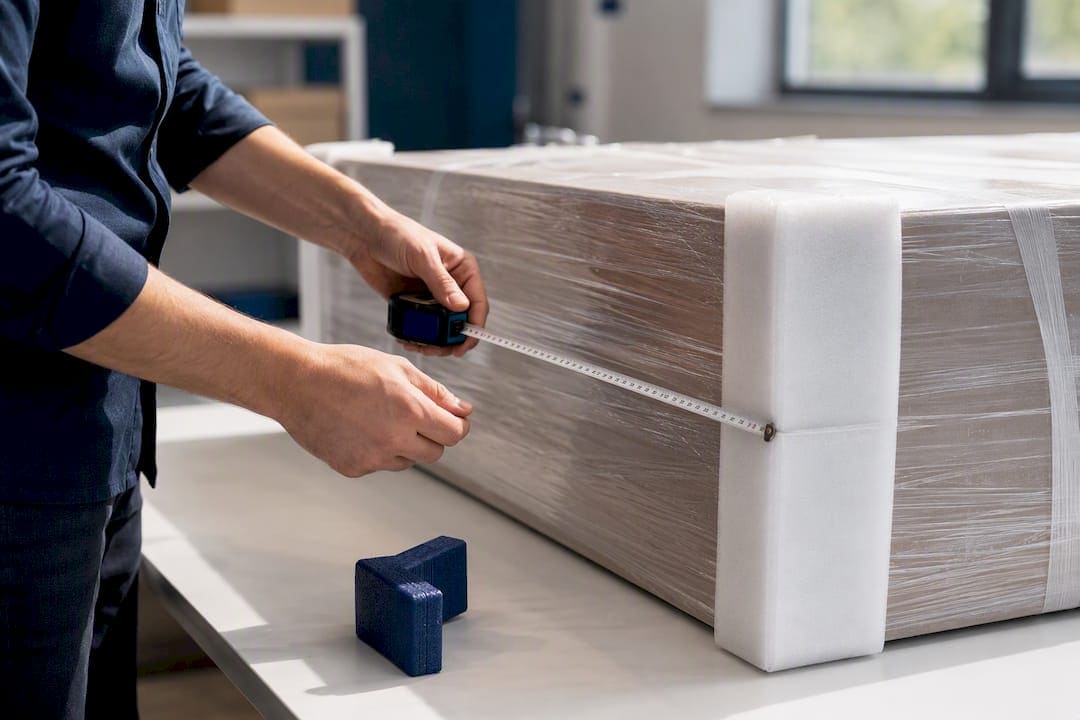
Thorough preparation often determines whether a bulky shipment arrives undamaged and without additional costs. The dimensions are measured at the longest point (length, width, and height), and this determines the volumetric weight, which many shipping companies use for pricing.
- Secure edges and corners with sturdy edge protectors to prevent pressure marks.
- Fill any voids with cushioning material to prevent the goods from shifting during transport.
- When shipping on pallets, secure the load firmly with tension straps or stretch film.
- Pack long or rolled items in sturdy cardboard tubes or wooden crates.
Fragile surfaces such as painted furniture or glass surfaces need additional protection with corrugated cardboard or foam mats. Category page with information on bulky goods shows practical preparation steps for different types of goods.
Pro tip: Measure the shipment again after packing, as cushioning material often changes the final dimensions and therefore the volumetric weight.
Customs, export formalities and Incoterms: What matters for international shipments
As soon as a bulky goods shipment leaves the EU, additional obligations apply that do not apply to intra-European shipments. Anyone who exports regularly will find the following points unavoidable:
- A Eori number This is mandatory for companies exporting from the EU, as the European Commission states. More information is explained by the [source/organization - context needed]. EORI page of Paket International.
- The HS code determines which customs duties and restrictions apply to a product and should be checked via TARIC before shipment.
- The electronic export declaration In Germany, this runs via ATLAS, while the European AES system, according to the European Commission supports the digitalization of export formalities across Europe.
- Incoterms They regulate who is responsible for transport, insurance and customs clearance, such as EXW or DDP.
The export procedure consists of an export declaration and presentation of the goods at the customs office of exit, with the declaration usually being made electronically.
European Commission, Exportation
Private individuals without their own EORI number can usually have the customs clearance process handled by a service provider or customs broker, which remains the more practical option for individual shipments. A brief overview of the common clauses is provided by... Incoterms page.
Decision-making aid: Checklist and questions for your transport service provider
Before booking, it is worth conducting a structured comparison to ensure that no hidden costs or formalities are overlooked.
- Document dimensions and weight precisely, including packaging.
- Determine the appropriate Incoterm and coordinate with the supplier.
- Check insurance coverage and compare it with the value of the goods.
- Clarify pickup and delivery options at the destination.
- Compare the offered duration with your own time frame
- Question the supplier's customs service, especially for shipments outside the EU.
Sensible questions to ask a transport provider include who handles the export declaration, how the volumetric weight is calculated, and what additional costs might arise besides the base price. It's generally advisable to allow extra time for customs and transport, as clearance and international transit times are rarely predictable. An overview of pallet shipping costs and procedures can be found on the international pallet shipping page.
Brief overview: How Paket International simplifies international bulky goods shipments
Paket International automates cost calculation, customs clearance, and shipment tracking for international bulky goods shipments via a central platform. Instead of manually filling out forms, the platform calculates shipping costs and customs duties directly, connecting parcel services, customs services, and the customers' own systems.
For businesses, this means less paperwork and a dashboard for centrally managing all shipments and customs documents. Those who regularly ship bulky goods or pallets abroad will find suitable options on the bulky goods category page or directly on the page for... International shipping with professional customs clearance.
Sources
For legally sound information on customs and export, it is worth consulting the export regulations of the EU Commission as well as the... Information sheet on the registration requirement German customs. Country-specific information should be checked individually before each shipment.
- Customs duties and procedures on exports – Your Europe
- Automated Export System (AES) – Taxation and Customs Union
FAQ
What is the surcharge for bulky goods in international shipping?
The surcharge depends on dimensions, volumetric weight, and destination country, and is calculated differently by each provider. Therefore, a fixed figure cannot be given; comparing offers based on the exact shipment details will reveal the actual costs.
Who offers the cheapest way to ship bulky goods abroad?
The cheapest offer depends heavily on the size, weight, and destination country of the shipment, which is why a direct comparison of several providers is advisable. Platforms automatically compare multiple parcel services and shipping options simultaneously.
Can I, as a private individual, send bulky goods abroad?
Yes, private individuals can ship bulky goods internationally, but often need assistance with export declarations for shipments outside the EU. Without their own EORI number, the chosen service provider usually handles the formal steps.
What are the maximum dimensions for bulky goods shipped via a parcel service?
The maximum size depends on the specific parcel service and its bulky goods tariff, and varies from provider to provider. If a shipment significantly exceeds the permissible dimensions or weight, a freight forwarder offering pallet shipping is the appropriate solution.