

Partial shipments customs: Authorization, ATLAS codes and documentation requirements
Partial shipments may require authorization, especially for machinery and disassembled equipment. Therefore, companies should clarify three things immediately: review or submit an authorization application with a component list, correctly define the ATLAS information such as the additional information code and document type codes, and fully document the export records for each partial shipment. Coordinating these three steps with the responsible customs office early on will prevent delays in clearance.
In short:
- For disassembled machines, a formal application for approval with a list of components is recommended at least one month before shipment to avoid delays.
- For partial shipments, the correct codes are essential in the ATLAS system, in particular the additional information code 40400, the document type codes 2PFI and 2PFE, and a unique part number.
- Each partial shipment requires a separate customs declaration, regardless of the progress of transport, in order to avoid errors in the goods issue confirmation.
- A complete application for authorization includes a list of components, commercial invoice, proof of origin, shipping documents and authorization number, which must be submitted no later than three days after the last partial shipment.
- Automated customs processes and central dashboards at Paket International simplify administration and reduce errors in customs clearance for machinery and equipment.
Table of Contents
- What legally constitutes a partial shipment?
- Legal basis: ZT-1600 and UZK-IA regarding approval requirements
- Which ATLAS codes are needed for partial shipments?
- Single-stage or two-stage procedure: What applies to partial shipments?
- Goods issue confirmation and proof of arrival: Where errors occur
- Checklist: What documents are required for the application for approval?
- How Paket International simplifies customs clearance for partial shipments
- Important legal and practical sources
- Sources
- FAQ
What legally constitutes a partial shipment?
A partial shipment occurs when economically related goods are sent in multiple transports instead of a single delivery. A typical example is a production machine that, for reasons of space or weight, is divided into several containers and only reassembled into a functional unit at its destination.
This is clearly different from two other constellations that are often confused in practice:
- Consolidated customs clearance: Several independent goods from different recipients are processed together, but do not form a technical unit.
- Small shipments: individual, self-contained shipments of goods below certain value limits, usually sent by mail.
- Impermissible denominationThe artificial division of a shipment in order to undercut value limits or duties is legally prohibited.
The distinction is not a mere formality. It determines which procedure, which additional code, and ultimately which approval requirement applies.
Legal basis: ZT-1600 and UZK-IA regarding approval requirements
The authorization requirement for partial consignments is primarily based on two legal sources: the Implementing Regulation to the Union Customs Code (UCC-IA), specifically Articles 221 and 336, and the practical application of the law. ZT-1600 Working Guideline for Machines in Partial ShipmentsWhile the UCC-IA sets the legal framework, ZT-1600 specifies what customs authorities actually require for disassembled machinery.
ZT-1600 results in four fixed requirements:
- A formal application for approval before the start of shipping.
- A complete list of all individual components of the machine.
- A fixed approval period within which all partial shipments must arrive.
- A reporting obligation exists within three days of the arrival of the last partial shipment.
In practice, a one-month lead time is considered a useful guideline for submitting an application, as Information from the Chamber of Industry and Commerce This guideline, however, is not a rigid law. Customs authorities often demonstrate flexibility in their approval practices if companies communicate early and transparently.
Pro tip: Do not submit the component list only with the first partial shipment. Submit it in full to the responsible customs office before the first shipment; this will significantly speed up the subsequent registration of each partial shipment.
Which ATLAS codes are needed for partial shipments?
The technical recording in the ATLAS system determines whether a partial shipment proceeds smoothly or gets stuck at the responsible office. Different procedures are available for registration, depending on the type of shipment:
- ATLAS for regular customs declarations in commercial transactions, including partial shipments of machinery and equipment.
- PIK (Internet registration for postal and courier shipments) for shipments up to 150 euros; since April 1, 2024, electronic registration is mandatory for commercial applicants.
- IZA for special intra-Community or simplified registration procedures, depending on the value of the goods and the recipient's status.
Three fields are particularly prone to errors during the actual registration process: the additional information code 40400, which identifies a partial shipment as such; the document type codes 2PFI and 2PFE for linking to the component directory; and the sequential part number, which uniquely assigns each shipment to its overall delivery. Important for classification: The complete machine is classified as a whole for tariff purposes, not each individual component separately. Anyone who instead declares each component individually risks an incorrect customs tariff number and therefore incorrect duties.
Single-stage or two-stage procedure: What applies to partial shipments?
For exports, customs distinguishes between a single-stage procedure, which is primarily intended for small consignments with simplified declarations, and a two-stage procedure with separate export and exit declarations, which is used for more complex consignments such as disassembled machines.
For partial shipments, a clear rule applies: If a single shipment is divided into several individual shipments, a separate export or re-export declaration is required for each partial shipment in accordance with Article 336 of the UCC-IA. Splitting shipments solely to fall below value thresholds is not permitted.
For logistics planning, this means specifically how... a practical contribution on the topic of customs for vehicles in Albania shows:
- Each part of the broadcast needs its own complete registration, not just a reference to the previous one.
- Deadlines for the approval period continue to run regardless of the actual progress of the transport.
- Delays in a partial shipment affect the reporting deadline for the entire shipment.
Goods issue confirmation and proof of arrival: Where errors occur
The export customs office only confirms the exit of the goods once all partial consignments have actually left the customs territory of the Union. To do this, it collects several partial results reported by one or more exit customs offices, as described in the... EU guidance on partial consignments This describes the process. Only when the final partial result arrives is the export considered fully confirmed. Unforeseen circumstances can lead to partial shipments passing through different border crossings, which further complicates the reconciliation process.
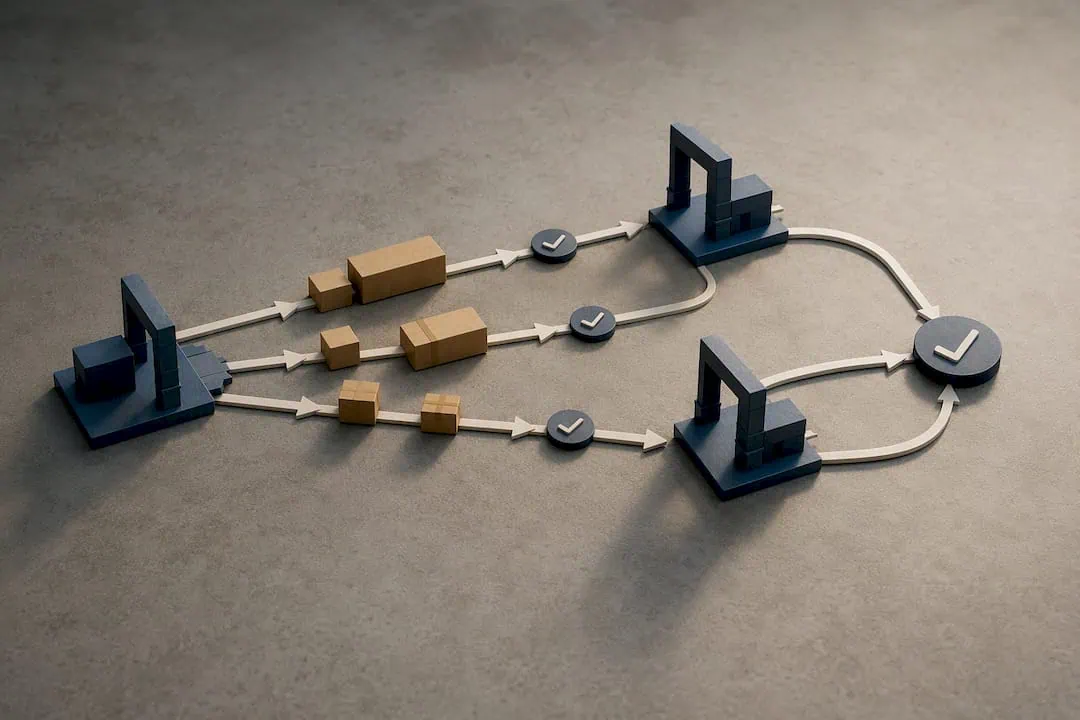
In practice, most problems arise not from missing documents, but from inconsistent data: differing invoice details between partial shipments, missing links between the declaration and the component list, or an incorrect TARIC classification of individual components. Practical observations show that precisely this insufficient linking of invoice data, commodity codes, and recipient data across multiple partial shipments is the most frequent reason for missing outbound documentation.
Pro tip: Assign a unique, consistent reference number to each partial shipment, which appears identically on the invoice, shipping document, and customs declaration. This alone prevents most linking errors during subsequent verification.
Checklist: What documents are required for the application for approval?
A complete application significantly reduces the number of inquiries from customs and speeds up processing. The following sequence has proven effective in practice:
- List of all individual components with a unique assignment to the overall product.
- Commercial invoice with consistent product descriptions across all partial shipments.
- Proof of origin for the entire product, not for individual components.
- Complete shipping documents for each partial transport.
- Notification number of the approval, which is referenced in every subsequent application.
- Sequential part number that documents the progress of the overall delivery.
After each partial shipment is dispatched, a notification must be sent to the responsible customs monitoring office, no later than three days after the arrival of the last partial shipment. Failure to meet this deadline risks inquiries and, in the worst case, a reassessment of the entire authorization. Practitioners recommend structured inventories with a uniform naming convention, precisely because this is where most gaps in documentation arise.
How Paket International simplifies customs clearance for partial shipments
It's easy to lose track of things between component lists, ATLAS codes, and export documentation, especially when multiple partial shipments are in transit simultaneously. Shipping cost and customs duty calculations, as well as customs clearance, can be automated and integrated into ATLAS workflows to avoid manual duplication of effort.
A central dashboard allows you to view each partial shipment, including associated documents and processing status, to reduce linkage gaps by consolidating invoice data, shipping documents, and customs declarations in one place. For companies that regularly ship machinery or disassembled equipment, it's worth taking a look at the... Services for the shipping of machines and disassembled plants or directly on the automated customs clearance, in order to prepare the next shipment without paperwork.
Important legal and practical sources
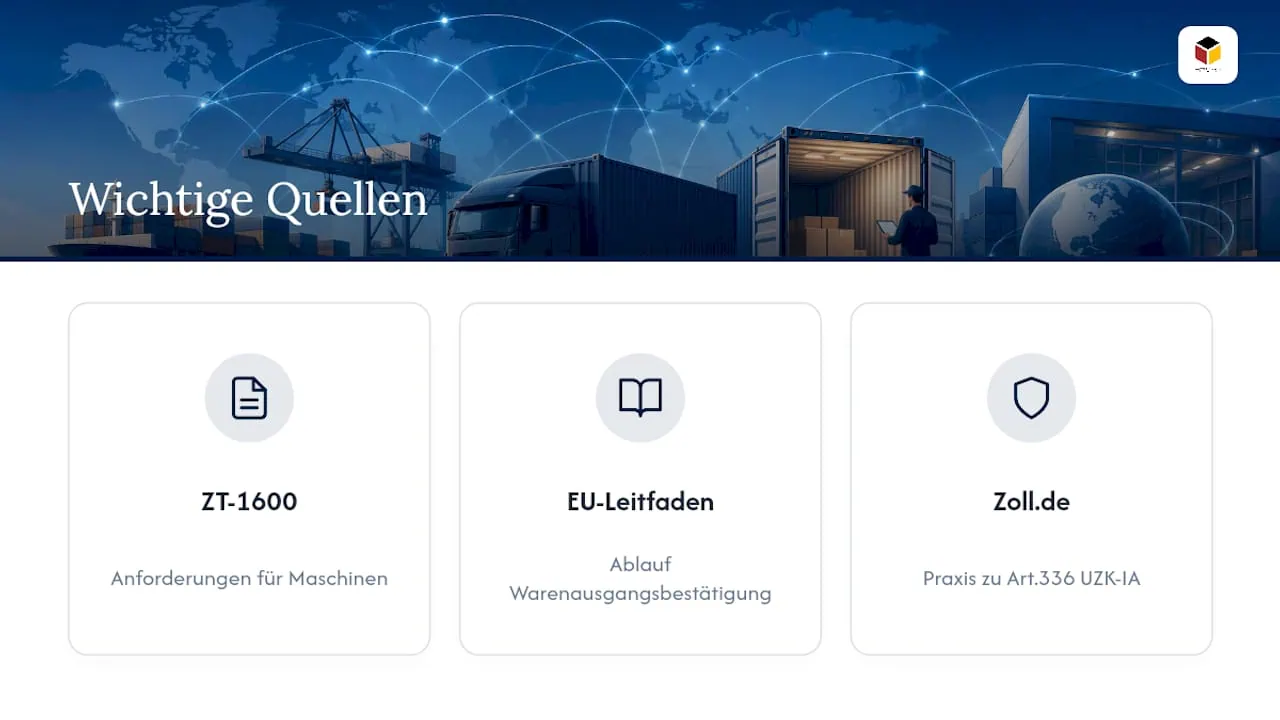
For a more in-depth examination of one's own cases, it is worthwhile to look at the original texts: The ZT-1600 Directive provides the specific requirements for machinery in partial consignments, the EU guide to partial consignments explains the procedure for the confirmation of goods exit, and the Zoll.de page on the single-stage export procedure summarizes Art. 336 UCC-IA in a practical manner.
Sources
- ZT-1600, Work guideline for machines in partial shipments – Findok Internet
- EU Guide: Partial Contributions (German version)
- New regulations for imports in 2024 – Chamber of Industry and Commerce
FAQ
What are the three forms of customs declaration?
German customs law distinguishes between written declaration via ATLAS, simplified electronic declaration via IPK for postal and courier shipments, and, in exceptional cases, oral declaration for certain small shipments, which has not been permitted for commercial postal and courier shipments since April 2024.
What goods are subject to customs declaration?
In principle, all goods imported into or exported from a non-EU country to the Union are subject to declaration, regardless of their value. In the case of partial shipments, this applies to each individual partial shipment, not just the entire shipment.
What documents are required for customs declaration?
For partial shipments, this includes the commercial invoice, proof of origin, complete freight documents, and, in the case of machines requiring approval, additionally the list of individual components and the approval number.
What customs documents are required?
The most important customs documents include the customs declaration itself, the commercial invoice, the proof of origin, shipping documents, and, in the case of export, the export declaration with the associated proof of exit. A platform like Paket International automatically compiles these documents for each shipment in the dashboard.