
Automating US shipping: Customs, Magento and DDP for German B2B
For retailers with regular shipments to the USA, "USA Shipping Customs" primarily means one thing today: a fully automated platform that calculates customs duties, taxes, and shipping costs in real time and handles customs declarations without manual intervention. This is no longer a convenience feature, but a necessity since the de minimis exemption has been virtually eliminated, and every shipment can now be subject to customs duties. Those who fail to digitize these processes pay twice: in time and in errors.
In short:
- An automated shipping platform to the USA must cover all five core functions; otherwise, manual bottlenecks and sources of error will arise.
- Today, goods are usually correctly classified using AI-supported text recognition to minimize errors in HS codes and avoid subsequent claims.
- Since the abolition of the de minimis threshold, a customs inspection is necessary for every shipment, making a shipment-specific landed cost calculation essential.
- For legally compliant import, complete and correct documents, including commercial invoice, packing list and additional documents, are absolutely necessary.
- The choice between informal and formal import procedures depends on the value of the goods, with higher values requiring a licensed broker and a formal entry.
Table of Contents
- What must a platform for shipping to the USA with customs be able to do?
- What is the technical architecture behind automated shipping to the USA?
- What data and documents does every shipment to the USA require?
- How are landed costs and Incoterms billed for US customers?
- How can an automated customs solution be successfully rolled out within a company?
- What are the limits of automation in US shipping?
- What customs regulations and quarantine requirements apply to imports into the USA?
- Which HS codes apply to product groups frequently exported to the USA?
- Immediate customs clearance or subsequent customs clearance: Which procedure is appropriate?
- What customs duty exemption limits still apply to shipments to the USA?
- How can delays in US customs clearance be avoided?
- What import taxes, duties, and fees are currently levied on shipments to the USA?
- Paket International automates your USA shipping from calculation to delivery.
- Sources
What must a platform for shipping to the USA with customs be able to do?
A platform for US shipping with customs clearance stands or falls on five functional blocks. If one is missing, a manual bottleneck will remain somewhere in the chain, no matter how well the rest is automated.
Classifying goods using HS codes is the first critical point. Modern systems combine rule-based databases with AI-supported text recognition from product descriptions, which, according to expert articles on the subject, AI-supported customs clearance Classification errors are significantly reduced, and the risk of costly subsequent claims is lowered.
This is followed by the landed cost calculation: customs duties, US import taxes, shipping costs, and broker fees are added up before shipping, not just at the border. Only in this way can a realistic final price be displayed at checkout.
For the actual customs clearance, the platform needs an electronic connection to the relevant systems; in Germany, exports are processed via... ATLAS, in the USA takes over CBP/ACE The import side. Both systems speak different data formats, which is why good middleware translates between them.
Further requirements at a glance:
- Carrier and broker integrations with seamless tracking across the entire route.
- Support for various Incoterms, especially DDP and DAP
- Configuration of the Importer of Record (IOR)depending on whether the trader or the recipient is responsible for the import
- Automatic check to see if a shipment requires a formal entry
If one of these elements is missing, automation remains piecemeal, and this is precisely where many isolated solutions fail.
What is the technical architecture behind automated shipping to the USA?
The basic architecture almost always follows the same pattern: The shop or ERP system provides the raw data, a central tariff and customs engine processes it, and webhooks report status changes back to the merchant. Providers like Digicust describe this API-first model as the standard architecture for automated customs solutions in e-commerce.
Three steps are performed in every broadcast:
- The shop transmits order data, article numbers and destination country to the central engine.
- The engine classifies the goods, calculates landed costs, and generates the customs declaration including the shipping label.
- Webhooks send status updates (cleared through customs, shipped, delivered) back to the shop and customer, which significantly reduces WISMO requests ("Where is my order").
Mandatory fields such as EORI number, HS code, country of origin, and net value are validated in the system before the shipment is even booked. If a field is missing, the system blocks the booking instead of letting the shipment get held up at the border later.
For Magento shops, ready-made connectors exist that transfer order data directly from the checkout to the customs engine, including automatic label generation. Before going live, a three-stage test is recommended: first, sandbox transactions with test data, then random samples with real, but low-value, shipments, and only then the full rollout.

Pro tip: Test the Magento integration first with shipments under $50. This way, you'll spot data transfer errors before they become costly with a high-value B2B shipment.
What data and documents does every shipment to the USA require?
Before a shipment crosses the border, a specific data set must be complete and accurate. According to DHL, gaps here are... most frequent cause of delays upon import into the USA.
The mandatory fee includes:
- Complete sender and recipient details including phone number and email address
- EORI number of the consignor for exports from the EU
- Correct HS code and country of origin for each item
- Net value of the goods in US dollars, not the gross selling price
- Commercial invoice and packing list; for certain product groups, additionally a certificate of origin or information for Partner Government Agencies (PGA), for example in the case of food or electronics with radio approval
Before going live, a test plan with sandbox bookings is recommended, followed by spot checks of the first ten to twenty live broadcasts. Recording error rate, throughput time, and cost per broadcast as KPIs will provide a reliable data basis for fine-tuning after a month.
How are landed costs and Incoterms billed for US customers?
Landed costs consist of several components, which can vary depending on the state and type of goods:
- US import duties depend on the HS code and country of origin.
- Sales tax of the destination state, unless the recipient is exempt from tax.
- Transport and insurance costs
- Broker and customs clearance fees
The choice of Incoterm determines who bears these costs and when. DDP (Delivered Duty Paid) If the sender covers all fees upfront, the recipient sees a flat final price with no surprises at the door. DAP (Delivered At Place) Or, with DDU, the recipient only pays customs duties and taxes upon delivery, which often leads to liquidity issues and delays for B2B customers in the USA because the shipment remains in customs stock until payment is received.
For checkout, this means: Anyone offering DDP should display the landed costs before completing the purchase, not just on the invoice afterwards. Furthermore, for goods valued above a certain threshold, usually $2.500, US Customs requires a formal entry form. CBP Form 7501, which noticeably slows down the process if it is not prepared.
How can an automated customs solution be successfully rolled out within a company?
A four-phase rollout has proven effective in practice:
- Scoping: Which product categories, which target regions in the USA, and what shipping volume per month?
- Integration: Connecting the shop or ERP system to the customs engine, setting up the carrier interfaces.
- Pilot: A limited product range and a small customer group test the full process over four to six weeks.
- Rollout: Expansion to the entire product range, accompanied by monitoring.
The IT department is never solely responsible, as customs, logistics, and customer service teams need to collaborate because each department has its own data requirements. Customs checks classification and compliance, logistics the carrier connections, and customer service handles communication in case of delays.
Suitable metrics include throughput time per shipment, error rate in customs declaration, cost per shipment, and the WISMO rate as an indicator of customer satisfaction.
Pro tip: Before the pilot project, establish a baseline: How long does a US shipment take on average today, and how many shipments get held up in customs? Without this initial data, the success of the automation cannot be measured later.
What are the limits of automation in US shipping?
Automation handles execution, but not liability. The shipper remains legally responsible for incorrect customs declarations, even if a system generated them. Audit logs with complete traceability of every decision are therefore not a nice-to-have, but essential protection in case of disputes.
For goods with dual-use potential, meaning goods with both civilian and potentially military uses, manual review is still necessary. No algorithm should make the final decision here. Furthermore, data transfers to US systems like CBP/ACE raise GDPR issues as soon as personal recipient data flows to third countries—a point that many implementations initially underestimate.
Since the de minimis rule for shipments to the USA practically was liftedEach individual shipment is subject to a customs inspection, regardless of the value of the goods. This drastically increases the volume of cases to be reviewed and makes escalation flows for exceptional cases and regular data quality checks mandatory, not optional.
What customs regulations and quarantine requirements apply to imports into the USA?
In addition to standard customs regulations, certain product categories are subject to additional inspections by specialized US authorities. Foodstuffs, plants, and wooden packaging are subject to inspection by the USDA (US Department of Agriculture)Electronics with radio modules often require a FCC-labeling, and certain cosmetic or health products fall under the FDA.
Wooden packaging and pallets must comply with international standards. ISPM 15 They must be treated and labeled, otherwise they risk being returned or destroyed at the border. For plant-based products, the APHIS (Animal and Plant Health Inspection Service) for pests, which requires additional registration for natural products or packaging material made of wood.
These additional checks run parallel to regular customs clearance and are often overlooked in practice because they don't appear in the standard HS code data set. An automated platform can flag product groups relevant to PGA (Process General Access) and display the additional data requirements before shipment, instead of only providing the information upon customs rejection. For B2B shippers who regularly export the same product groups, a one-time check to determine which PGA requirements apply to their product range is worthwhile, as this classification rarely changes from shipment to shipment.
Which HS codes apply to product groups frequently exported to the USA?
The correct customs tariff number directly determines the amount of import duty, and even small discrepancies in the code can mean significant cost differences. Certain product groups appear particularly frequently for German B2B exporters.
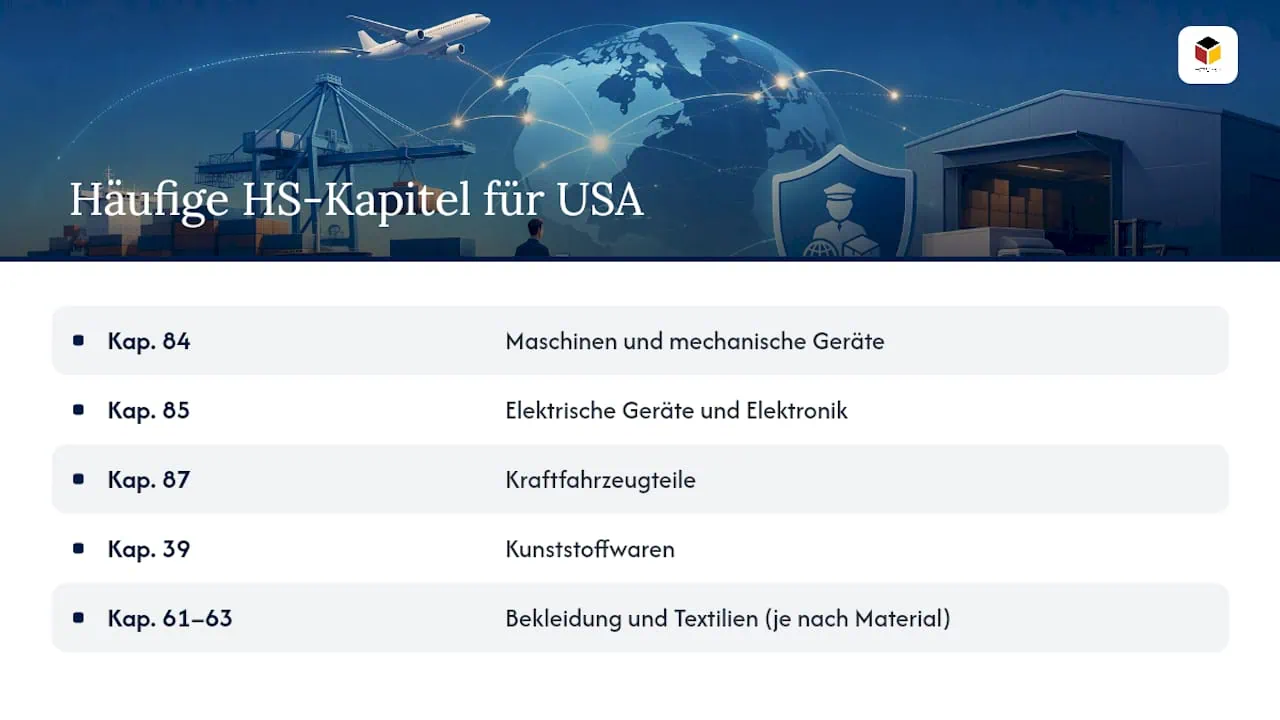
Machines and mechanical equipment usually fall under the category of Chapter 84 of the Harmonized System, electrical appliances and electronics in Chapter 85. Motor vehicle parts are under Chapter 87 classified, plastic goods under Chapter 39, and clothing and textiles are distributed across the Chapters 61 to 63, depending on the material and workmanship.
Within these chapters, the six-digit international HS code determines the general classification, while the USA uses a ten-digit extension after the HS code for customs clearance. Harmonized Tariff Schedule (HTS) demand. These last four digits are US-specific and determine the actual applicable customs duty rate.
A practical example: A machine tool with HS code 8459 can, depending on the exact HTS sub-position, be equipped with 0% or be subject to customs duties of several percentage points. Anyone who regularly exports the same product groups should have the HTS classification professionally reviewed and then store it as a fixed master data record in the shipping platform, instead of determining it anew for each shipment.
Immediate customs clearance or subsequent customs clearance: Which procedure is appropriate?
When importing goods into the USA, customs generally distinguishes between two processing routes, which differ significantly in speed and formal requirements.
The Informal Entry This applies to shipments below a certain value and is largely automated, often directly via the courier service without a separate customs declaration through a broker. It is suitable for smaller B2B samples or spare parts deliveries and is the faster way through customs.
The Formal Entry This becomes mandatory for goods valued at typically US$2.500 or more and requires CBP Form 7501 and often a licensed Customs Broker. This route takes longer, requires full documentation and a Customs Bond, but offers legal certainty for larger or recurring shipments.
For companies with high shipping volumes, an additional [option] is worthwhile. Continuous BondAn annual security deposit eliminates the need for individual shipping bonds and speeds up formal entry. The applicable procedure is usually not determined by the sender, but automatically based on the value and type of goods during the customs declaration. An automated platform should be aware of this threshold and prepare shipments accordingly, rather than only determining it at the border.
What customs duty exemption limits still apply to shipments to the USA?
The former de minimis exemption limit The $800 threshold, below which shipments could enter the US without customs duties or formal entry, has been virtually eliminated. Since the rule change in 2025, almost every shipment is subject to customs inspection, as reports on parcel shipments to the US confirm, regardless of how low the value of the goods is.
This fundamentally changes the calculations for B2B shippers. Where previously small sample shipments or spare parts often passed through duty-free, today virtually every shipment must be factored in, even if it is small in individual cases. For pricing at checkout, this means: Anyone who continues to calculate with "duty-free from X dollars" is out of touch with reality and risks unexpected additional charges from the customer.
In practical terms, this means that for automation, the landed cost calculation is no longer optional but must be performed for every single shipment, even for small quantities and samples. Anyone still using static exemption limits in their pricing logic should remove this rule from their system as soon as possible and replace it with a shipment-based, real-time calculation.
How can delays in US customs clearance be avoided?
Delays almost always arise from the same three issues: incomplete documentation, incorrect classification, and missing broker information. Systematically addressing these three points significantly reduces the risk of shipments being held up.
A complete and accurate commercial invoice, including a description of goods, HS code, country of origin, and value per item, is a basic requirement. DHL points out that carriers are increasingly demanding verified broker accounts or detailed, shipment-based data sets because blanket or incomplete information is the most frequent cause of inquiries from US Customs.
Specific measures that have proven effective in practice:
- Always issue commercial invoices in English and with US dollar values.
- Please provide the recipient's phone number and email address so that CBP can contact you directly if there are any questions.
- Have HS codes checked in advance, instead of simply copying them from old shipments.
- For PGA-relevant goods, have the additional documents ready before shipping, do not submit them only upon request.
- Set up a fixed customs broker or a continuous bond for regular shipments.
By incorporating these points as mandatory fields into your own shipping platform, you prevent human errors at the source, instead of correcting them later in the customs warehouse.
What import taxes, duties, and fees are currently levied on shipments to the USA?
The total cost of a shipment to the USA consists of several types of duties, which vary depending on the type of goods and the state. The standard import duty is determined by the HTS code and ranges between [insert values here] depending on the product category. 0% and a double-digit percentage.
In addition to regular customs duties, product-specific punitive duties may apply, which have been adjusted several times in recent years and, according to specialist articles on AI-supported customs clearance, represent one of the biggest current challenges for automated systems because rates can change at short notice.
Add to that Sales tax of the respective US state, which is levied on the end customer and varies from state to state; in some cases, it is waived entirely. For formal entry, broker fees and, if applicable, the cost of a customs bond are added. For B2B shippers, this means: Reliable calculations require constantly updated customs rates, not a table stored once, because tariffs and state taxes change faster than a manually maintained system can be updated.
Paket International automates your USA shipping from calculation to delivery.
Paket International is the practical alternative to manual customs clearance for German B2B shippers to the USA: Instead of manually filling out commercial invoices and looking up HS codes individually, the platform calculates shipping costs and customs duties in seconds and handles customs clearance automatically.
The platform connects your ERP or online shop, for example via the Magento integrationIt connects directly to the systems of parcel services DHL, UPS, FedEx, DPD, and DB Schenker and automatically compares their rates. A central dashboard allows you to monitor every shipment, from landed cost calculation to delivery in the USA, supplemented by proactive communication regarding customs inquiries before a shipment gets delayed.
For merchants with high shipping volumes, Paket International offers guaranteed total costs, ensuring that the price displayed at checkout remains the same upon delivery. Those who regularly ship to the USA can find suitable rates on the USA shipping overview page and book directly. automated customs clearance Set up your own product range, completely without a lengthy onboarding process.
Sources
- Package to the USA: Information on shipping, customs and duties
- Information on shipping to the USA (DHL)