

Digital customs power of attorney: How to set it up in a legally compliant manner
A digital customs power of attorney allows third parties to submit customs declarations correctly and on time in your name. It replaces the paper form with a digital process in the customs portal and thus forms the legal basis for automated customs processing. For it to be valid, you need three things: an EORI number, registration of both parties in the portal, and ideally, a eIDAS-compliant electronic signature.
What should be done now?
- Check existing powers of attorney in the customs portal: Are the legal form, EORI, and signature still up to date?
- If a power of attorney is missing, create it digitally instead of waiting for paper forms.
- Where possible, use a qualified electronic signature for maximum legal certainty.
Key insights
A digital customs power of attorney is only legally valid if EORI, registration in the customs portal and a suitable electronic signature are all correctly present.
| Theme | Details |
|---|---|
| Correct type of power of attorney | Choose a standing power of attorney for regular shipments, or a single power of attorney for one-off shipments only. |
| EORI as a requirement | Without a correct EORI number, no customs declaration will be accepted on behalf of the company. |
| Digital registration | Both parties must register in the customs portal via ELSTER, BundID or online ID card. |
| Signature according to eIDAS | A qualified electronic signature offers the highest level of legal certainty for digital powers of attorney. |
| Use automation | Paket International automatically checks mandatory fields and reduces paperwork during customs clearance. |
Table of Contents
- What is a customs power of attorney? Individual power of attorney, standing power of attorney, and types of representation.
- What mandatory information is required for a legally valid power of attorney?
- How do you digitally set up a power of attorney in the customs portal?
- Practical checklist: These mistakes cost time and money
- How do automated platforms verify powers of attorney and customs data?
- How automated customs clearance simplifies your everyday life
- Customs clearance without manual power of attorney verification
- Frequently asked questions about digital customs authorization
- Sources
What is a customs power of attorney? Individual power of attorney, standing power of attorney, and types of representation.
A customs power of attorney is the legal authorization to allow a third party to submit customs declarations on your behalf. For one-off shipments, a power of attorney is usually sufficient. Individual power of attorneyAnyone who regularly ships internationally needs one. Permanent power of attorney, which is permanently valid for all shipments and does not need to be reissued for each export. According to companies, Forum Publishing The majority of powers of attorney are permanent powers of attorney, while individual powers of attorney are rather the exception.
It is also important to distinguish between direct and indirect representation:
- Direct representationThe authorized representative acts exclusively in the name and on behalf of the principal. Liability largely remains with the company.
- Indirect representationThe authorized representative acts in his own name, but on behalf of the principal, and thereby assumes co-responsibility under customs law.
In practical terms, this means: Those who want to retain full control over customs decisions choose direct representation. Those who want to outsource processes completely accept shared liability with indirect representation, but gain relief in day-to-day operations.
What mandatory information is required for a legally valid power of attorney?
Nothing works without an EORI number. Companies absolutely need one, while for private individuals, an address and signature are often sufficient, as Forum Verlag points out. The EORI number uniquely identifies your company to all European customs authorities and must exactly match the commercial register entry.
Before submitting, these points should be on your checklist:
- EORI number correctly and up-to-date entered
- Signature of an authorized signatory (managing director or authorized signatory with verifiable power of attorney)
- The legal form matches the commercial register.
- Commodity tariff number and procedure code for the respective shipment checked
- Delivery terms (Incoterms) clearly defined
Pro tip: Don't wait until you ship to check the customs tariff number; check it when you first enter the item into the system. An incorrect code is one of the most common reasons for customs inquiries.
Errors in precisely these fields count according to Logistics Journal These are among the main causes of delays, additional storage costs, and returns. An incorrectly transferred legal form or an illegible signature is often enough to hold up a shipment for days.
How do you digitally set up a power of attorney in the customs portal?
The digital process begins with registration, not with the form itself. Both parties, the grantor and the agent, must register on the customs portal, either via ELSTER, the Federal ID card, or the online ID. Additionally, consent for digital data retrieval is required; without this, the power of attorney is not valid.
Here's how to proceed:
- Register in the customs portal using ELSTER certificate, BundID or online identification function.
- In your profile, agree to digital data retrieval; otherwise, the power of attorney will be ineffective.
- Open the "Manage powers of attorney" section in your profile.
- Select the desired customs service for which the power of attorney should apply.
- Activate the power of attorney and have it confirmed by the authorized representative in the portal.
- Document the date and scope of the release for your internal power of attorney overview.
Not every service is automatically covered by this single authorization. The customs portal allows for differentiated configurations, and authorizations do not automatically apply to the EU Trader portal; separate setup is required there. Therefore, anyone processing EU-wide trading data via the Trader portal should plan for this step separately and not assume that a customs authorization granted once will automatically apply everywhere.
Pro tip: Create a separate authorization for each service, instead of expecting a "general authorization." This takes five minutes more, but saves you from later inquiries about why a particular application was rejected.

Practical checklist: These mistakes cost time and money
Before each shipment, it's worth briefly comparing the commercial invoice, bill of lading, and power of attorney details. If the information doesn't match exactly, processing is almost always delayed.
- The commercial invoice and the bill of lading show the same description of goods and the same value.
- The EORI number is transmitted without errors, not just "similarly" correct.
- The signature is legible and comes from an authorized person.
- Commodity tariff numbers are complete for all items
- The payment agreement for import duties is clearly regulated.
The consequences of incorrect information are rarely cosmetic. A different legal form or an incorrect EORI number often leads to storage costs because the shipment remains in customs warehouse until the issue is resolved. In the worst case, the goods are returned to the sender, resulting in double the time and freight costs.
Pro tip: For long-term powers of attorney, schedule a regular annual review, especially after a change in management. An outdated power of attorney often only comes to light when a shipment is already stuck in customs.
A central responsibility mapping is also helpful: Who creates powers of attorney, who checks them, who updates them after staff changes? Without clear responsibilities, precisely these kinds of checks are neglected until it's too late.
How do automated platforms verify powers of attorney and customs data?
Automated platforms handle precisely those verification steps that are most time-consuming to perform manually. Paket International automatically checks mandatory fields such as EORI, commodity code, and signature authorization, pre-fills recurring information, and calculates customs duties in seconds instead of hours of manual work.
The practical benefits are evident in three areas:
- Less paperwork, because power of attorney data is stored once and automatically reused.
- Time and cost savings through automated customs clearance without manual intervention
- Fewer queries from customs because mandatory fields are checked before submission.
Before choosing a provider, consider three questions: Does the platform support eIDAS-compliant signatures? Can it be integrated into your ERP or shop system via API or plugin? Are there traceable audit logs in case customs authorities have questions about identity in a specific case? According to YouTrust, such inquiries do occur despite electronic signatures, which is why a complete record of approvals is invaluable.
Templates, signatures and legal validity at a glance
Official sample forms can be found, among other places, on the customs portal itself; although the form is not subject to any specific format, written proof remains the safer option. The crucial difference lies between a qualified eIDAS signature and a simple electronic signature: according to YouTrust, only the qualified version offers the highest level of legal certainty for customs purposes.
- Simple signatures are often sufficient for everyday use, but pose risks of proving their validity in case of a dispute.
- For international shipments outside the EU, additional authentications or apostilles may be required.
How automated customs clearance simplifies your everyday life
Digital customs authorizations only work reliably if registration, mandatory fields and signature work together correctly from the start.
| Theme | Details |
|---|---|
| Choose the type of power of attorney | Use a single power of attorney for individual cases, and a permanent power of attorney for regular mailings. |
| Check required fields | EORI, legal form and signature must exactly match the commercial register. |
| Register digitally | Registration in the customs portal via ELSTER, BundID or online ID card is required. |
| Secure signature | An eIDAS-compliant signature offers the highest level of legal certainty for digital powers of attorney. |
| use automation | Paket International automatically checks mandatory fields and calculates customs fees without manual intervention. |
Official help pages and further reading articles
The power of attorney help page of the customs portal as well as instructions for Customs tariff number provide additional details for practical application.
Customs clearance without manual power of attorney verification
Anyone who manages digital customs authorizations themselves knows the hassle: checking registrations, verifying required fields, checking signatures, and repeating the process for every new service. Paket International automates these steps and directly integrates them with the calculation of shipping costs and customs duties.
The platform pre-checks mandatory information such as EORI and commodity code, calculates landed costs in seconds, and handles customs clearance without manual intervention. According to the company, this significantly reduces administrative effort and saves up to [amount of savings]. 80%. A central dashboard allows you to keep track of all shipments, authorizations and documents, instead of distributing them across multiple systems.
Those who regularly ship electronics, furniture, or bulky goods internationally benefit particularly from the automatic customs clearanceBecause mandatory fields are checked again for each shipment, without you having to do it yourself. See directly how your next shipment can be calculated and processed via Paket International's automated customs clearance.
Frequently asked questions about digital customs authorization
What exactly is a digital customs power of attorney?
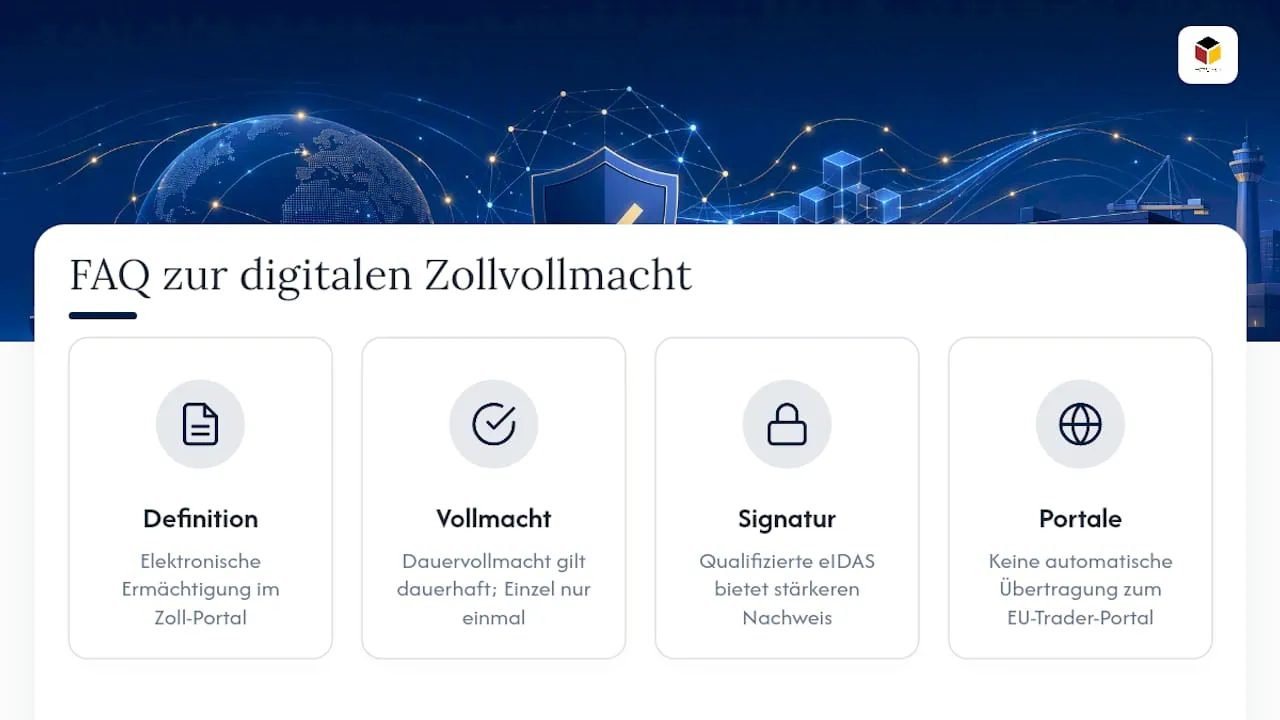
It is the electronic form of authorization by which a company allows a third party to make customs declarations on its behalf, set up and managed via the customs portal.
Do I need a new authorization for each shipment?
No. For regular shipments, a standing power of attorney that remains valid indefinitely is sufficient. A separate power of attorney is only necessary for one-off or special shipments.
Is a simple electronic signature sufficient for customs purposes?
It may suffice for everyday use, but offers less legal certainty than a qualified eIDAS signature, which provides better proof in case of disputes.
Which details most frequently cause delays?
An incorrect EORI number, a different legal form, or an illegible signature are among the most common causes of queries and storage times.
Does a power of attorney granted in the customs portal automatically also apply to the EU Trader portal?
No, a separate configuration is necessary for this, as the systems do not automatically transfer powers of attorney.
How can automated customs clearance meaningfully complement digital powers of attorney?
Platforms like Paket International check mandatory fields in advance, calculate fees automatically, and thereby reduce queries and manual follow-up.
Sources
- How to correctly fill out a customs power of attorney: What do you need to pay attention to…
- The EU regulation on electronic signatures
- Customs Power of Attorney: Free Template & Completion Guide – Logistics Journal